Those of us that went to the North Campus of the University of Delhi in the late 80s (and probably even those of earlier vintage) might recall the Tibetan camp nearby where one could obtain some inexpensive and rather tasty food. The world remains unaware of the tastiness of Tibetan cuisine, and I attribute it to laziness. After all, nearly 80 years ago, Peter Fleming trekked across the land and talked about how a Tibetan staple sustained him:
Tsamba has much to recommend it, and if I were a poet I would write an ode to the stuff. It is sustaining, digestible and cheap. For nearly three months we had tsamba for breakfast and tsamba for lunch, and the diet was neither as unappetizing nor as monotonous as it sounds. One of the great virtues of tsamba is that you can vary the flavour and the consistency at will. You can make it into a cake or you can make it into a porridge; and either can be flavoured with sugar, salt, pepper, vinegar, or (on special occasions for you only had one bottle) Worcester Sauce. And, as if that were not enough, you can make it with cocoa instead of with tea. I would not go so far as to say that you never get tired of tsamba, but you would get tired of anything else much quicker.
The non-Tibetan may suffer from a serious lack of expertise in the preparation of barley-based food, and Fleming is kind enough to provide some tips:
You fill your shallow wooden bowl with tea, then you let the butter melt in the tea (the butter is usually rancid and has a good cheesy flavour); then you put a handful of tsamba in. At first it floats; then like a child’s castle of sand, its foundation begins to be eaten by the liquid. You coax it with your fingers until it is more or less saturated and has become a paste; this you knead until you have a kind of doughy cake in your hand and the wooden bowl is empty and clean. Breakfast is ready.
(from Shadow Tibet. Check it out for an exemplary exposition on all things tsamba. Man, I'm hungry again.)
Eugenio Fuentes is a writer of slow-burning fiction peopled with characters limned with a tender sympathy. The most tragic of them have a dignity that shines through the vicissitudes of their fortunes. In The Blood of Angels, these qualities are visible in ample quantities. There is not much food, not really. But then there comes a passage such as the following that is so, so moving.
He went into the house and, without once looking into the living room, at the pictures on the fireplace and everything he left behind, went down the stairs into the cellar. The fruit he'd picked over the last month hung from the roof beams: melons from a reed-rope, strings of beans, garlic, grapes, peppers, chilli and laurel. On the floor, heaped on a tarpaulin were figs, apples, potatoes and quinces. The mixture of scents coming from the different ripening fruits created an intense, sickly-sweet smell in the cellar.
Before, when all the members of the household had lived and were hungry, they picked many of the fruits hanging on the trees, shiny without artificial help, plump like coloured light bulbs - the whole farm lit up by the glow of pears, peaches, cherries and apples. Those reserves of food lasted until Christmas. Yet in the last couple of years, although the crops had dwindled and they kept little for themselves, they ended up throwing a good part of it away, uneaten by them and their younger son. Dried fruit became impossibly hard to swallow; it felt like the pears and quinces had turned sour, grapes left a smoky taste in their mouths and cherries left their mouths full of stones. When his elder son had lived that never happened; when he had lived the harvest never seemed sufficient. Before he'd started to die he would come home full of energy, always hungry, and if dinner was late, he would go down to the cellar and take whatever fruit he liked. But in the last couple of years such a big store made no sense.
Very slowly, almost fondly, he tied the slipknot and made sure it slipped properly before slinging it over one of the roof beams.
Kanoko Okamoto's A Riot of Goldfish comprises two novellas, one the eponymous one and the other eponymous to this blog's title. Eponymity, don't you know. At any rate, in The Food Demon, there's an intense young man called Besshiro who bullies his wife and wants to be known as Sensei. Unfortunately, in the Japan of his time, there's little respect accorded to a chef, even to one as skilled as he.
His best friend brought out the best in him:
The sorts of things he usually ate, such as soupe a l'oigninon served baked in a small bowl covered in cheese, rice with stewed ox tongue, or salad with haricots verts and vinaigrette, were easy enough for Besshiro to prepare. But dishes like duck simmered in duck blood or eel medallions with vinegared aspic were new to Besshiro and more challenging to make even with the detailed instructions his friend would rattle off from his bed. Simmering the duck blood on an alcohol burner made a rich and sticky broth, like a good red-bean soup, in which the slices of duck were cooked along with salt and pepper. He tasted the meat after cooking it very lightly and was surprised to find that it did not taste badly. His friend explained that it was the specialty of a famous duck restaurant in Paris and was considered quite an elaborate and extravagant dish.
Another time, Besshiro, insulted by what he considered the superficiality of an art lover's criticism, invites her and her husband to dine with him. He is convinced that she will reveal the shallow nature of her understanding of art, and is determined to outdo himself in his culinary attempt just to show her up:
But Besshiro proceeded on the assumption that the woman was a connoisseur and busied himself ordering foods that could stand up to a connoisseur's scrutiny, like moroko fish straight from the Moroko River in Sakamoto, and pepper tree bark from Kurama.
The woman looked impressed and thanked him as she began to eat. 'This catfish roe is gorgeous!' 'And the stewed ebi imo potatoes are exquisite!' As her lips took on a coat of oil from the kara-age, she said simply 'Delicious!' 'Delicious!' and ate on single-mindedly.
Kiran Desai's The Inheritance of Loss has a cook as one of its heroes, and so one would expect much gustatory peroration. One wouldn't be disappointed. One could be slightly underwhelmed. Some passages remind me of shopping in a Soviet department store. The Soviets had no alternative. Why is this judge so pigheaded as to insist on dining at this absolutely appalling joint?
The judge walked into the kitchen and found two green chilis looking ridiculous in a tin cup on a wooden stand that read "Best Potato Exhibit 1933."
Nothing else.
He went to the front desk. "Nobody in the kitchen."
The man at the reception was half asleep. "It is very late, sir. Go next door to Glenary's. They have a full restaurant and bar."
"We have come here for dinner. Should I report you to the management?" Resentfully the man went around to the back, and eventually a reluctant waiter arrived at their table; dried lentil scabs on his blue jacket made yellow dabs...
"Roast mutton with mint sauce. Is the mutton tender?" asked the judge imperiously.
The waiter remained unintimidated: "Who can get tender mutton?" he said scornfully.
"Tomato soup?"
He considered this option but lacked the conviction to break free of the considering. After several undecided minutes had passed, Bose broke the spell by asking, "Rissoles?" That might salvage the evening.
"Oh no," the waiter said, shaking his head and smiling insolently. "No, that you cannot get."
In the London Review of Books, Safa al Ahmad wrote about her visit to her ancestral village in Hasa in eastern Saudi Arabia. It is a Shiite area, and has faced constant oppression and intimidation by the majority Sunnis that rule the kingdom. Hospitality, however, is honour, and food is a major part of it.
Lunch was ready. Set on the floor was a square plastic mat with a big platter of white fluffy rice, fried fish and chicken on top. Around it were plates of salad, vegetable stews and the Hasawi signature – sticky dates, to be eaten before, during or after a meal.
The Saudi leadership has tried a carrot and stick approach to Hasawis. They pumped money into the area to help build up the infrastructure. At the same time, they clamped down on any sign of dissension.
As the men started to leave, I remembered a friend’s story about his encounter with a fisherman. To catch grouper fish, the fisherman would use a three-pronged hook with a shiny bit of metal attached to it. The fish would be attracted by the glitter. ‘Don’t you worry the fish will catch on to your trick?’ my friend asked. The man laughed. ‘One fish I caught was covered in these hooks. The fish make the same mistake over and over again.’ ‘Shia in Saudi Arabia,’ my friend said, ‘are a bit like grouper fish. The government knows exactly how to catch us every time.’
When the boss worked in Paris, nearly thirty years ago, he was wont to go several times a week to Brasserie Chartier in the ninth arondissement. Cheap and cheerful food, he said, very uneven in quality. Sometimes decent, sometimes brilliant. He recommended I check it out on my recent visit to that city.
Over the years, others have reached the same conclusion. It has become a veritable tourist magnet. When I presented myself the other day, there was a queue of quivering visitors snaking out of the passage leading to the restaurant, down the Rue du Fabourg Montmartre and up to the Boulevard Montmartre. I looked at the line acerbically (it was unaffected) and stalked off.
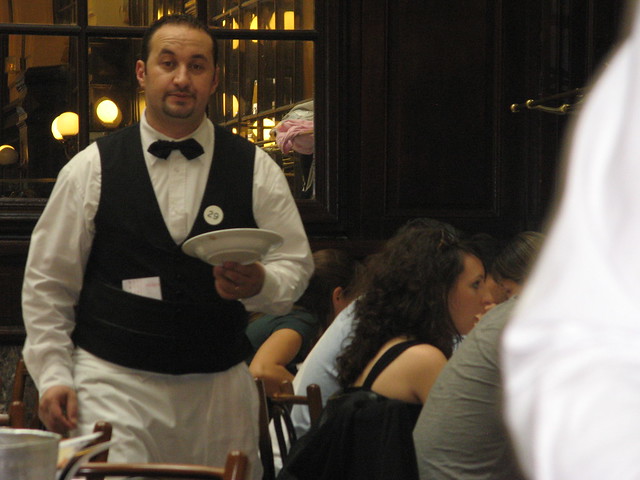
Waiter at Chartier. Fancy, innit?
I came back the next day when Chez Casimir, the place I wanted to go to for its eat-all-you-can buffet, was too full to accommodate a sweaty visitor. It was nearly 14:30, and there were no lines at Chartier. Inside, the place was abuzz. Waiters in traditional waitering outfits whizzed around efficiently. One of them ushered me to a table for four. All the four seats were occupied, although only two had humans on them. The other two chairs had their belongings. The waiter urged the diners to collect their stuff, and plonked me on one of the newly vacant chairs. The diners smiled tightly at me.
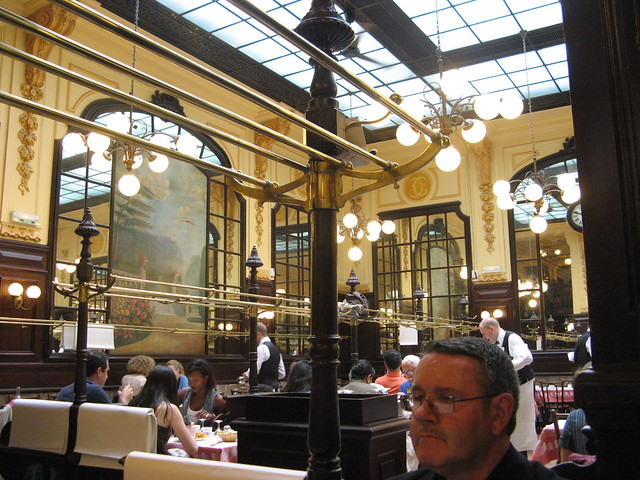
I looked around. The interior was all brass and hanging lights, very French in that turn-of-the-century way. Before I could blink twice, the waiter had brought the day's menu card. There were main courses for 10 euros, side dishes for 2 to 3 euros, half-bottles of wine for 6 euros, desserts for 3 euros. Bliss! When my fish main course and champignons made an appearance, even the tightly smiling couple next to me were impressed.
Mancunian at Chartier.
I hadn't paid attention earlier to what they were saying. We had spoken brief bits of French to each other, and my own is not so good that I can discern accents. I sent a text to the wife ('Eating in a traditional brasserie next to a couple of Frenchies'); shortly thereafter I realised the couple were visiting Mancunians. ('The Frenchies are from Manchester!' went the next text.)
"What's he havin'?" said the man.
"Fish," said the woman. "And mushrooms."
I refused to let on that I spoke English. Their conversation was suitably entertaining. They compared Expedia and Thomas Cook. They agreed that the steak they had just eaten could quite well have been English food. They wondered whether they should take the funicular to Montmartre. They wondered what the Chartreuse dessert was. It turned out to be whipped cream dipped in Chartreuse syrup. Yuck, I thought.
My fish wasn't great, but the Champignons a la Provence were crunchy and munchy. The rose I had was refreshing, but otherwise forgettable. (I can only vaguely recall that I had a rose, in fact.) Dessert was good - a sorbet of cassis. The Mancunians looked on enviously.
They took a picture of me. I offered to take a picture of them. Their camera batteries were discharged. They asked me where I was from. I pretended to be Nepali. They had no idea what I was talking about.
"Kathmandu?" I urged. "No, no," they said. "We don't have any more batteries."
Service compris, said the menu card, so when it was time to pay, I did not plonk down a tip. The waiters courteously encouraged me to enjoy my Sunday and hoped to see me again.
They may have dressed like traditional French garçons, but by thunder they didn't behave like them.
A few weeks ago, I was in Paris where I snuck into the Guimet Museum to see their brilliant exhibition on Lucknow during the rule of Awadh. Originally created by the Los Angeles County Museum of Art, this exhibition revealed the luxury and opulence and the artistic and musical splendour of the Nawabs. The exhibition ended mid-July, but I managed to dig up a French newspaper article about it, and translated it at Tangentialia.
“When Cornelius Kingsley Garrison Billings, the millionaire founder of petrochemical giant Union Carbide, took his prize-winning trotters on a goodwill tour of Eastern Europe in 1909, he brought along horse-racing journalist Murray Howe to chronicle the trip in weekly dispatches to The Horse Review magazine.” (from the Moscow Times.)
Murray Hove took 400 photos in Moscow and St Petersburg (recently published on Flickr by his great-grandson, occasioning much excitement in the Russian blogosphere), and wrote letters home, complete with foodiness:
“The zakouski [appetizers] table has no seats, you simply walk up and take a plate and a fork — then you spear a couple of bites of caviar, a pickled sterlet’s fin, a toasted sturgeon’s ear and a liberal portion of sunflower salad. All this you wash down with a small whiskey glass full of vodka. If you are thirsty you can increase the number of vodkas without drawing attention.”
Poor Mark Twain. There he was, A Tramp Abroad, sorely missing that good ol' fashioned food which America is rightly known for - size and succulence entirely its own.
To particularize: the average American's simplest and commonest form of breakfast consists of coffee and beefsteak; well, in Europe, coffee is an unknown beverage. You can get what the European hotel-keeper thinks is coffee, but it resembles the real thing as hypocrisy resembles holiness. It is a feeble, characterless, uninspiring sort of stuff, and almost as undrinkable as if it had been made in an American hotel. The milk used for it is what the French call "Christian" milk - milk which has been baptized.
After a few months' acquaintance with European "coffee", one's mind weakens, and his faith with it, and he begins to wonder if the rich beverage of home, with its clotted layer of yellow cream on top of it, is not a mere dream, after all, and a thing which never existed.
Next comes the European bread - fair enough, good enough, after a fashion, but cold; cold and tough, and unsympathetic; and never any change, never any variety - always the same tiresome thing.
Next, the butter - the sham and tasteless butter; no salt in it, and made of goodness knows what.
Then there is the beefsteak. They have it in Europe, but they don't know how to cook it. Neither will they cut it right. It comes on the table in a small, round pewter platter. It lies in the center of this platter, in a bordering bed of grease-soaked potatoes; it is the size, shape, and thickness of a man's hand with the thumb and fingers cut off. It is a little overdone, is rather dry, it tastes pretty insipidly, it rouses no enthusiasm.
Imagine a poor exile contemplating that inert thing; and imagine an angel suddenly sweeping down out of a better land and setting before him a mighty porterhouse steak an inch and a half thick, hot and sputtering from the griddle; dusted with a fragrant pepper; enriched with little melting bits of butter of the most unimpeachable freshness and genuineness; the precious juices of the meat trickling out and joining the gravy, archipelagoed with mushrooms; a township or two of tender, yellowish fat gracing an outlying district of this ample county of beefsteak; the long white bone which divides the sirloin from the tenderloin still in its place; and imagine that the angel also adds a great cup of American home-made coffee, with a cream a-froth on top, some real butter, firm and yellow and fresh, some smoking hot-biscuits, a plate of hot buckwheat cakes, with transparent syrup - could words describe the gratitude of this exile?
Our team secretary turned thirty recently. She brought cakes, which were demolished by investment professionals in sore need of a sugar rush. When I stopped by her desk to felicitate her on her achievement, she was clutching her head in despair.
'Why so despondent?' quoth I.
'It's the end,' she moaned. 'It's all downhill now.'
'Oh come on,' I said. 'It is not that bad. You're still young.'
She looked at me in disbelief. Then she looked at my bald head, and cheered up momentarily.
'How old are you, if you don't mind my asking?' she said.
'Forty-two,' said I.
'Well, you, um, you look, er, younger than that,' she said.
Clearly, her innate honesty was struggling against her tact.
'You look,' she began again, and her voice faltered. 'You look about, er, thirty-five.'
I burst out laughing. She went back to clutching her head.
In Al-Hind: the Making of the Indo-Islamic World, André Wink makes the claim that the Rashtrakuta kingdom's rise in the Western Deccan and the Gujarat area was a direct consequence of a sharp rise in trade with the Persian Gulf, following the establishment of the great Arab caliphate of Baghdad and the Arab conquest of Sindh. He adds that the demise of the Rashtrakutas (AD 743-974) coincides with the fall of that trade in the late 10th century, when the Fatimid caliphate gained ascendancy in Egypt.
During the early period of consideration, trade between the Middle-East and India was predominantly between the Persian Gulf and Gujarat, with the great ports of Cambay, Somnath, Asawal and Broach all documented by Arab geographers and merchants. al-Biruni, for instance, writes: 'the reason why in particular Somnath has become so famous is that it was a harbour for seafaring people, and a station for those who went to and fro between Sofala in the country of the Zanj and China.' There was a Jewish trading outpost at Broach, and Parsis thrived along the west coast. The Arabs imported large quantities of teakwood, important for shipbuilding, as well as perfumes, bamboo, ginger, indigo, and cotton cloth of every colour. Much of the trade was conducted by foreigners; the Gujarati Hindus and Muslims were not, at this point, dominant.
Towards the late 10th century, however, the great ports of Gujarat began to decline. According to Wink, the proximate cause was the steady erosion of the Persian Gulf trade as the Red Sea and Egypt became more important. These countries dealt more with Malabar and Coromandel. The resultant decline in wealth and power of the Rashtrakutas was matched by the growing clout of the Cholas in the south of India, with the predictable result.
Still, during the reign of the Rashtrakuta kings, their domain with its capital at Mankir (present-day Malkhed) was considered to be the greatest in al-Hind (as the Arabs called India). 'The kings of al-Hind are not subject to a single king: each of them alone possesses authority in his own country; but the Ballahara is the king of kings (malik al-muluk) of al-Hind.' What is this Ballahara? Well, it's the Arabicised form of the Sanskrit title Vallabharaja, 'beloved lord and husband king'. Both Sanskrit and Arabic sources assert that the Rashtrakuta kings were paramount overlords over India for nearly 200 years. Indeed, the temple of Krishneswara at Rameswaram proclaims the Rashtrakuta advance into the deep south of India; Kanauj was a major conquest in the north. The great art works of Elephanta and Ellora exemplify the high culture and wealth of the Rashtrakutas.
The Arab chronicler Masudi says of this kingdom:
The most powerful king in al-Hind of our time is the Ballahara, king of the city of Mankir ... the greatest centre (of the country). ... This was the name of the first sovereign (of this kingdom), but it has become the dynastic title of his successors on the throne of Mankir and so it remained until the present ... Most of the kings of al-Hind turn their faces towards him whiel they are praying and prostrate (salla) themselves before his ambassadors when they arrive at his court ... He owns horses, numerous elephants and great riches ... He has a large kingdom, and his country has vast stretches of cultivated lands, abundant commerce and plentiful resources. He receives large amounts of revenues and his wealth is enormous ... The Ballahara lives in the city of Mankir. This city is forty parasangs in length, is made of teak, bamboo, and other sorts of wood. It is said that there are a million elephtants to transport the goods of the people. In the king's own stable there are sixty thousand elephants, and one hundred and twenty thousand elephants belong to the cloth-bleachers there. In the idolhouse, there are about twenty thousand idols made of a variety of materials such as gold, silver, iron, copper, brass, and ivory, as also of crushed stones adorned with precoius jewels ... In it there is also an idol made of gold, which is twelve cubits in height. It is on a throne of gold, under the centre of a golden dome, adorned with jewels, pearls and precious stones.
Interestingly, no Rashtrakuta coinage has been found! Indeed, there are no coins from their predecessors in Gujarat, the Chalukyas, either. That's not to say there were no coins at all in Gujarat - there's considerable evidence of large quantities of unminted bullion in the land, much of which served to decorate temples or become idols. Furthermore, the main coinage of the medieval world was the gold dinar and the silver dirham, and the lands of the Indian Ocean were fully integrated in that economy. Wink suggests that the Rashtrakutas were part of this Arab monetary network of dinars and dirhams. While there were also silver pieces circulating in the Rashtrakuta kingdom that were remarked upon by Arab chroniclers: '... the monetary means are constituted by the tatariya dirhams which each weigh 1½ dirham and are minted as the coin of the king', the dominance of the Arab coinage suffices to resolve the paradox of a wealthy kingdom that did not issue its own coin.
There's an entire world of poetry, literature and art devoted to the railways. Imagine three London stations, and imagine the references that suffuse them: Sherlock Holmes at St Pancras, or Harry Potter at King's Cross, or Dombey at Euston. What is the source of the railways' mystique? And why have they inspired litterateurs from William Wordsworth to J. K. Rowling?
Locomotives and the atmosphere they brew have been a source of inspiration for writers and poets for the past two hundred years. In Edwardian times, the railways were the lifeblood of the nation, the starting point of all adventures. A big station like York was a microcosm of the society it served. Here a writer like Andrew Martin could bring together characters like travelling gentlemen and chimney sweeps on the move. Station guards contended with cutpurses and station loungers and other species of railway riffraff. Stations teemed with life.
Martin set his novels in the Edwardian period because that was the zenith of the British rail network. His father had worked in the finance department of British Rail at York, and forever having to come up with cut backs. His novels were his vicarious revenge.
His father was railway aristocracy; not only was he able to travel at will in first class, but so was his family. Martin would occasionally take the train to London as a fourteen-year old boy, lounging comfortably in a first class seat, reading a book. A harassed-looking businessman would huff up to him and say, 'Are you aware you are in a first-class seat, young man?' to which he would reply, 'Yes, I am, thanks.' and return to his book.
Trains, he said (and I heartily agree), are superior to cars. You can read on trains. You will only feel sick in a car. Trains have a wgealth of culture behind them. Cars have not.
Train travel was not always so sedate. A hundred and fifty years earlier, you might have been gripping the armrests of your seat in quiet panic rather than read a book. Imagine your shock of a speeding train when the fastest thing you had ever seen before was a stagecoach. You thought your brains would fly out of your ears at that speed.
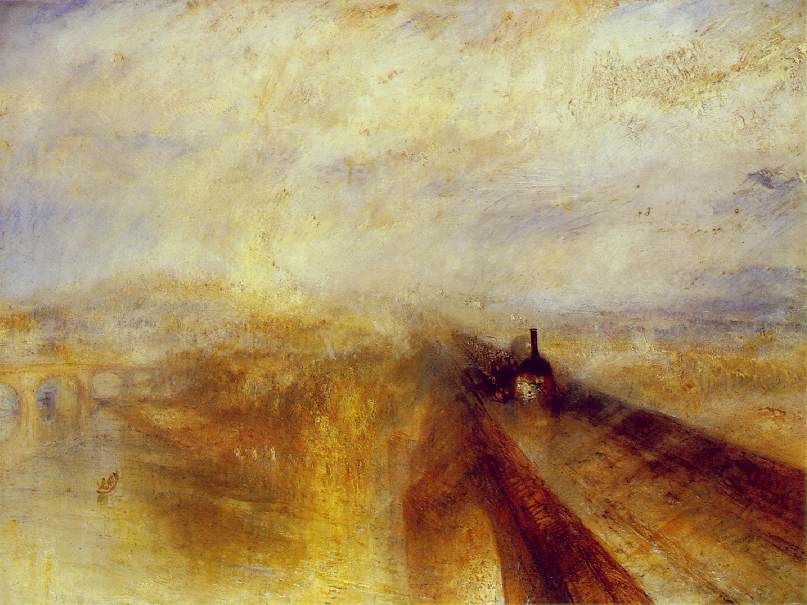
Turner's Rain,Steam and Speed [Wikimedia Commons]
One day in 1843 the artist Turner was travelling on the Great Western Railway. He stuck his head out of the window of a first class carriage during a rainstorm. He was most forcibly impressed. He was met with the demonic force of speed through a cloud of smoke and rain. The experience gave birth to his painting 'Rain, Steam and Speed - the Great Western Railway'. If you want to be pedantic about it, you would say that the painting shows a Gooch Firefly 222 locomotive. That's hardly the point. The image to the viewer is that of a bullet aimed straight at the heart.
Andrew Martin got into trouble at the National Gallery when he leaned too close to the painting when showing his son the hare running ahead of the locomotive. The hare, a very fast animal, is being caught up by the engine. Man is getting the upper hand over nature.
The advent of the railway in Britain was cataclysmic, concentrated into a few frenetic years. Nine-tenths of the current mileage were authorised in three years from 1844. These vast iron gatecrashers thundered through back gardens, cellars, beautiful meadows and social conventions. From the outset, they attracted the scornful eye of writers and anyone with a vested interest in contemplation. In 'a just disdain', Wordsworth wrote of England being blighted by steam.
Now, for your shame, a Power, the Thirst of Gold, That rules o'er Britain like a baneful star, Wills that your peace, your beauty, shall be sold, And clear way made for her triumphal car
A lightning rod for the railways anxieties of the time was Charles Dickens. His railway novel Dombey and Son contains one of the first descriptions of the landscape flickering past the train window.
Through the hollow, on the height, by the heath, by the orchard, by the park, by the garden, over the canal, across the river, where the sheep are feeding, where the mill is going, where the barge is floating, where the dead are lying, where the factory is smoking, where the stream is running, where the village clusters, where the great cathedral rises, where the bleak moor lies, and the wild breeze smooths or ruffles it at its inconstant will; away, with a shriek, and a roar, and a rattle, and no trace to leave behind but dust and vapour: like as in the track of the remorseless monster, Death!
A theme of Dombey and Son is the destruction wrought by the building of the London to Birmingham line that runs to Euston station. This was the first railway to come into North London. Unfortunately when it came to be built in the 1830s, Camden happened to be in the way. Dickens was a man attached to the idea of Merrie England, and much attached to the stagecoach. In his book, he referred to Camden as Staggs' Gardens. He knew the area well, having been brought up here when it had been more or less a village. During the construction of the railway he saw places he knew, including part of his old school, being destroyed. He was morbidly fascinated by the process.
The railways were omnipotent, and so like many other works of the time, Dombey and Son features a death by locomotive. The treacherous Carker is run over by a train; he
felt the earth tremble—knew in a moment that the rush was come—uttered a shriek—looked round—saw the red eyes, bleared and dim, in the daylight, close upon him—was beaten down, caught up, and whirled away upon a jagged mill, that spun him round and round, and struck him limb from limb, and licked his stream of life up with its fiery heat, and cast his mutilated fragments in the air.
It wasn't just the gutting of towns and villages that seemed wrong to the sensitive literary folk. The locomotives themselves appeared to be demonic powers, with a killing edge to them. In Anthony Trollope's The Prime Minister, the villain Lopez is 'knocked to bloody atoms' by a shrieking Scottish express. In Leo Tolstoy's Anna Karenina, the heroine commits suicide by leaping in front of an oncoming engine. Locomotives didn't just appear to be murderous figments of the imagination - they did have an unfortunate habit of killing people. Steam engines, scary enough when stationary, were whirled about the country at fantastical speeds. At the opening of the Liverpool and Manchester Railway in 1830, a Cabinet Minister, William Huskisson, was knocked down and killed. No wonder the government has been so reluctant to fund the railways ever since.
It was a simple equation: more railways meant more deaths. The 1860s were the darkest period when gory stories of mayhem caused by trains were rarely off the headlines. These 'smashes', as they were known, magnetised and repelled the Victorians in equal measure. Here was a very modern way to die.
In the 1860s, there were more trains on the same lines, going ever faster, the chances of collision ever so greater. The authorities did little to enforce safety standards till the 1880s.
Cartoonists portrayed the locomotives as beasts, dragon-like, intent on the destruction of mere humans. Returning from France on 9 June 1865, all of Charles Dickens' fears of the railways came true, when he was involved in a terrific crash near Staplehurst in Kent. The accident was caused by a work-gang lifting tracks off a viaduct. They had reckoned without the 2.38 from Folkestone to London.
Dickens helped soothe the injured and the dying with a flask of brandy and cool water in his top hat. Ten people died in the crash, and for the rest of his life, all of Dickens' anxieties would be subsumed by the greater one over Staplehurst.
The accident prompted him to write one of his greatest ghost stories, 'The Signal-Man'. A superbly gloomy version appeared on TV every Christmas during Andrew Martin's childhood. The story concerns a signal-man stuck in a cutting next to a glowering red light. He is at the mercy of an electric bell and the necessity of showing his red flag as a train rolled past. He is a fascinatingly neurotic man with many interests. He has taught himself a language whilst in his signal box, he has worked at decimals and fractions. But he is tormented by the loneliness of his job, the memory of two previous accidents, and a premonition of a third. He constantly feels the urge to send the telegraphic signal 'Danger. Take care.' but he can't say why. Of course, a smash is looming.
Dickens has often been described as the last victim of the Staplehurst accident. Later in life he attributed his ill health to 'railway shaking'. He died on the fifth anniversary of the crash.
In the 19th century, the railways shaped culture in other, benign, ways. People began to read on trains, and so in 1848, W.H. Smith opened their first railway bookstore at Euston Station. Books sold in stations were the forerunners of the airport novel: a new genre, inexpensive, with plots that could hold a passenger's attention throughout the distractions of a train journey, all that stopping and starting and 'Excuse me, is this the train for Birmingham?' As Cecily said in Oscar Wilde's The Importance of Being Earnest : "One should always have something sensational to read in the train."
An entire industry of sensationalist literature developed, with writers competing for the riders' attentions, and for shelf-space on W.H.Smith's stores. Between garish covers, there was everything the man or woman on the 2.22 desired: sex, insanity, and above all, violent death.
Cheaply bound thrillers were known as 'yellow backs' and their authors, such as Mary Elizabeth Braddon, sold in their thousands from the railway bookshops. The success of Braddon irritated George Eliot, who wrote to her publisher: 'I suppose the reason my own six shilling editions are never on the railway stalls is that they are not so attractive to the majority.' One reviewer of Braddon's work expressed regret that a book 'without a murder, a divorce, a seduction, or a bigamy, is not apparently considered either worth writing or reading.'
The Victorian sensation stories would play upon their readers' anxieties about railway travel. A woman sitting alone in a carriage might read about a woman sitting alone in a carriage, except that in the story, a strange man would leap in through the window, a strange man with a top hat and a moustache. Such breaches of compartment etiquette would be depicted later in the cinema, as in Alfred Hitchcock's version of John Buchan's The Thirty-Nine Steps where Robert Donat's character bursts in on Madeline Carroll, while she is reading, alone.
Hitchcock was no trainspotter, and his film contains one notorious mistake (notorious among the persnickety sticklers, that is). When Hannay leaves for Scotland, he is on the London and Northeastern train, as he should be. Hitchcock cuts away here, and when he cuts back, the train that is next shown is a Great Western emerging from Box Tunnel near Bath.
In the original novel, trains are marginal, but Hitchcock uses them to boost the speed and tension of the narrative. But he also made use of another tension involved in train travel: that of not being entirely sure who your travelling companions are. Walter de la Mare wrote: 'It's a fascinating experience, railway travelling. One is cast into a passing privacy with a fellow stranger, and then it is gone.'
By the end of the 19th century, trains had been tamed and were no longer a danger in themselves. They had become comprehensible. When Sherlock Holmes rode on a train, the journey was not a worry in his mind.
"We are going well," said he, looking out of the window and glancing at his watch. "Our rate at present is fifty-three and a half miles an hour."
"I have not observed the quarter-mile posts," said I.
"Nor have I. But the telegraph posts upon this line are sixty yards apart, and the calculation is a simple one..."
Holmes and Watson depart from every terminus in London save Marylebone. The only reason for that lacuna is that it was built too late, in 1899, by which time they were almost done. And they were never above recourse to that humble document, the railway timetable.
Until the 1960s, British railway timetables were called Bradshaws, after the man who started publishing them in 1841. They were thick as bricks, and filled with exasperating footnotes such as 'except Mondays' and 'should the arrival of the steamer be late, the train will not stop.' In those days, a man would have a Bradshaw as readily to hand as one would have car keys today. But often Dr Watson didn't need a Bradshaw - he knew the times of the trains without having to look them up. In 'The Retired Colourman', for instance, Holmes asks Watson to look up the train times to Little Pearlington in Essex, and despite the bizarre obscurity of the destination, the latter immediately replies, 'There is one at 5.20 from Liverpool Street.' We have the beginnings of that fantastic sub-genre of literature where the pedantry of detective fiction is combined with the even more pedantic railway timetable, resulting something evermore pedantic: a murder mystery with train timings at its core.
Take Agatha Christie's novel, 4.50 from Paddington. A timetable and a map provide Miss Marple with vital clues to a murder witnessed on a passing train. In the snappily titled film version ('Murder, She Said', 1961, directed by George Pollock), Miss Marple says:
"Ah yes, here we are. Now, I calculate the 5 o'clock express to Brackhampton overtook my train somewhere about here."
"But how can you be sure?" "I remember the ticket collector saying 'Five minutes to Brackhampton', and it couldn't have been more than a minute after the murder that he came in. So that makes it six minutes before Brackhampton, at, say, 30 miles an hour. So that makes it about ... there."
The apex (or nadir) of this sub-genre is The Cask, a 1920 novel by Freeman Wills Crofts, which is all about the logistics of transporting by rail a particular barrel, which contains a dead body. Crofts was an engineer, and he wrote like an engineer. His novel seemed as full of numbers as of letters:
He looked at the timetable again. The train in question reached Calais at 3.31 and the boat left at 3.45. That was a delay of 14 minutes. Would there be time, he wondered, to make two long-distance phone calls in fourteen minutes?
By the 20th century, it appeared that no part of England was untouched by the railways. Even obscure little towns such as Oakworth in Yorkshire appeared to have several dozen passenger and goods trains trundling through them every day. Today there is a well-preserved station in Oakworth, famous for being the site for both film and television adaptations for E. Nesbit's The Railway Children.
The book came out in 1906, and by then the British were thoroughly used to railways in their every day lives. Trains could be seen as cosy and whimsical, as well as potentially dangerous. Far from being despoilers of the landscape, they had become an integral part of it. They were no longer Gothic, but sentimentalised and loved. For the Railway children, the trains were an idyll and a joy. Nesbit writes: 'The rocks and hills and valleys and trees, the canal, and above all, the railway, were so new and so perfectly pleasing that the remembrance of the old life in the villa grew to seem like a dream.'
Almost any novel of the early 20th century is a railway novel, as long as a character moves along any distance. The notion of the railway and the landscape coexisting in harmony may appear natural, but it was a deliberately fostered one. Train companies of the time were very image-conscious. They might be said to be pioneers in public relations. The poster was their primary medium, so evocative of a mellower, sunnier age.
Giving names to trains, such as the Flying Scotsman, only added to the mystique of train travel. The romance of rail lasted well into the 1950s. In that time, the weirdos and the misfits were the boys not interested in trains. Between 1911 and 1950, The Wonderbook of Railways for Boys and Girls went through twenty-one editions. It is filled with detailed accounts of railway workings. A chat with an engine driver, and Mr Brown the signal-man. At the same time, railway stories were being written for children in their thousands: Life or Death, The Indian Rail Yarn, The Missing Mail Bag...
The perfect evocation of the railways in England is often taken to be in the form of a poem, Adlestrop by Edward Thomas. On the face of it, the poem recalls a non-event. Thomas' train makes an unscheduled stop in Adlestrop in Gloucestershire. Nothing happened, but the tranquillity of the moment and the sense of time suspended across the sunny English countryside stayed with Thomas.
Yes, I remember Adlestrop – The name because one afternoon Of heat the express-train drew up there Unwontendly. It was late June.
The steam hissed. Someone cleared his throat. No one left and no one came On the bare platform. What I saw Was Adlestrop – only the name
And willows, willow-herb, and grass, And meadowsweet, and haycocks dry, No whit less still and lonely fair Than the high cloudlets in the sky.
And for that minute a blackbird sang Close by, and round him, mistier, Farther and farther, all the birds Of Oxfordshire and Gloucestershire.
That kind of poignancy could only have been generated retrospectively. His diary records the date of the stop: June 23, 1914. But the poem was written when he was serving in the British Army in the World War I, in which he would be killed. The view of the railways became firmly imprinted on the nation - through a haze of nostalgia.
During the Great War, the railways took on another significance - they took soldiers to the front, and brought them in rather fewer numbers back. As the public gained familiarity with terms such as 'ambulance carriage' and 'hospital train', the word 'departure' took on a more ominous meaning. Marcel Proust said railway stations were inherently tragic places because they carried people into the unknown. Imagine how much the stakes were raised for wartime departures. Thomas Hardy's poem 'In A Waiting Room' from a collection published in 1917 captures the leave-taking on a wet morning, described as being 'sick as the day of doom.'
A soldier and wife, with haggard look Subdued to stone by strong endeavour; And then I heard From a casual word They were parting as they believed for ever.
In the poem, the soldier and his wife are only two characters in a waiting room filled with others. The narrator's attention is quickly diverted by some laughing children. The private agony of the parting couple is swiftly put aside.
In WWII, the collision of personal misery and mundane chatter in the waiting room was brought to the cinema. David Lean's 'Brief Encounter' beautifully realised this. In the film, the railway station is described as 'the most ordinary place in the world', but where an earlier tormented heroine might have flung herself onto the tracks like Anna Karenina, in the 1940s, the worst a locomotive can do is to fling a bit of grit into Celia Johnson's eye.
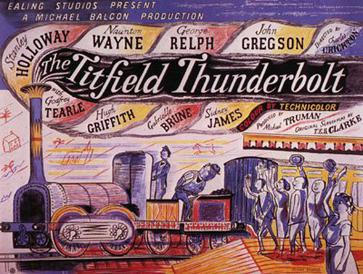
(Titfield Thunderbolt film poster, Wikimedia Commons)
After the war, Britain focused on becoming a modern nation, and the feelings of affection it had held for the train were transferred, for a while at least, onto the motor car. The railways were nationalised, and the romance began to wear off. It was the car that could now take you to picturesque backwaters of the land, and you no longer had to share space with people who picked their teeth in an annoying way, or were just plain murderous-looking. Like a man with a mid-life crisis, trying not to look old-fashioned, people began to look upon trains as second class, a social service for those who were too poor or decrepit to drive. That moment of transition was captured by the 1953 film, 'The Titfield Thunderbolt'. Here a cherished branch line is threatened by a local bus service, and the competition between rail and road is played out for the cameras.
Ironically, in real life, that branch line had already been closed. A BBC crew filmed the making the movie, including the famous scene of the runaway train. The scriptwriter was a neighbour of Dr Beeching, the future chairman of the British Railways Board, and slayer of branch lines.
Given the aesthetic appeal of the railways, it is not surprising that a poet became their greatest champion when they came under attack. 'Rumble under, thunder over, train and tram, alternate go' he wrote:
Rumbling under blackened girders, Midland bound for Cricklewood, Puffed its sulphur to where that Land of Laundries stood. Rumble under, thunder over, train and tram alternate go, Shake the floor and smudge the ledger, Charrington, Sells Dale and Co., Nuts and nuggets in the window
Such a dynamic thrust from such unpretentious lines.
For Betjeman, the railways' appeal was their permanence, a treasure bequeathed by our forefathers, 'a Victorian's world and the present, in a moment's neighbourhood.' In his poetry, the railway station stands for a world that is fading or has vanished completely. 'Monody on the Death of Aldersgate Street Station' began:
Snow falls in the buffet of Aldersgate station, Soot hangs in the tunnel in clouds of steam. City of London! before the next desecration Let your steepled forest of churches be my theme.
Betjeman appears to elide churches and railway stations, with both offering a refuge from the modern world. It is apt that he was behind the impetus to save St Pancras from demolition; St Pancras being a Christian saint and a railway station.
As Dr Beeching's cuts took hold, so did come the end of the reign of steam. Carnforth, where David Lean's Brief Encounters was filmed, became the dumping ground for the disused locomotives.
Diesel had none of the romantic elegance of the old steam. And today, even locomotives appear to be on their way out. Instead, we have multiple units that are as graceful and aerodynamic as wardrobes, with charmless names like 365 class. They are functional, and like worms, they can still move after being chopped in half. But they are hardly going to inspire our writers.
The great stations of times past are distressingly anodyne today. At York, the signal cabin is now a Costa Coffee; the night station master's cabin (a location for a strangely, even satanically, compelling job description) is a tourist information centre; the old booking hall is a Burger King. Stations are no longer about the business of railways. They are in the business of retail. The mysterious soot-blackened hinterlands have been tidied away. We are passengers no longer. We are officially customers, consumers, of course.
The railway satirist who writes under the name Tyresius has updated Adlestrop for the modern day:
Haycocks and meadows sweet, I wouldn't know. I never looked outside the train. Just canned beer from a plastic cup. Until the damned thing started again.
The few people who write about the railways today are writing about what doesn't exist today, or even what never existed at all. Note that the Hogwarts Express of Harry Potter fame is not a diesel multiple unit. Its departure platform, the fabled nine-and-three-quarters, is a portal to a fantasy land a world away from modern King's Cross. And in the self-consciously cool series of Bourne films, Matt Damon arrives in London not on a plane, but on the Eurostar. This is highly promising.
For a revival of literary focus on the railways, the high-speed Eurostar may offer the only hope in Britain. Two hundred mile-an-hour trains. Champagne on tap in the buffet. Smartly turned out railway staff. A long undersea tunnel - anything could happen in that. For the future of trains to be assured, they much once again become the vehicles of our dreams.
[This is a (very) paraphrased rendition of Andrew Martin's 'Between the Lines: Railways in Fiction and Film', shown on BBC Four.]
I have modestly given myself the name of the greatest of the Eldar: Fëanor, the maker of the Silmarils and the creator of the Tengwar. He was a Master of many things. I am merely a Jack.