JOST A MON

The idle ramblings of a Jack of some trades, Master of none

Feb 26, 2009

Goldbach's Comet

As I'm slightly at loose end at the moment, I'm flexing my fingers with a bit of R coding. To those unaware of the wondrous possibilities offered by this programming language, I can only say it's good stuff. Its capabilities have been outlined here and there, most recently in the New York Times, and is the programming environment of choice for statisticians and epidemiologists and others.

I'm intrigued by Goldbach's Comet, which - contrary to your astronomical visions - has less to do with the cosmos than with mathematics. In 1742, Christian Goldbach conjectured in a letter to Leonhard Euler that every even number greater than 2 can be expressed as the sum of two primes. In common with lots of theorems in number theory, this is more easily stated than proved. In fact, the closest anyone has come to proving this assertion is Olivier Ramaré, who in 1995 showed that every even number is the sum of at most 6 primes.

We can introduce the Goldbach function (or partition) at this point. G(n) is defined as the number of ways the number n can be expressed as the sum of two primes. If n is odd, we force G(n) = 0. For even n , e.g., G(10) = 2 because 10 = 3 + 7 = 5 + 5.

If we now plot the even numbers against their Goldbach numbers, we get a graph that looks like a fine spray tapering to a point, as in the figure below. This is Goldbach's Comet.


Now, what's the easiest way to compute G(n)? The brute-force way, of course. A computer doesn't groan and creak at repetitive exercise, so code such as the following will do the job - for small numbers n.
library(gmp)
library(gtools)
goldbach <- function(n)
{
count <- 0
if (even(n)) {
for (i in seq(3, n / 2, by = 2)) {
if ((isprime(i) > 0) & (isprime(n - i) > 0)) {
count <- count + 1
}
}
}
count
}

Note that I'm not really doing any bounds checking here: the function will collapse for n < 6.

Now, the thing about R is that it's a vectorised language, and works rather well on arrays. It even provides a routine called Vectorize() to convert a function such as goldbach() that takes a single argument into one that takes an array. So if you wanted to compute goldbach() for 6, 8, ..., 3000, you don't have to write a loop to do it (although you could); instead, you'd just do the following
n <- 3000
x <- seq(6, n, by = 2)
y <- Vectorize(goldbach)(x)
And then you can plot the comet
plot(x = x, y = y, type = "p", col = "red", lwd = 2)
The limitations of the brute-force approach are quite evident even with this toy example. It takes my machine about 10.5 seconds to compute G(n) for even numbers up to 3000. For every argument n, it generates all the odd numbers x less than n / 2, and checks if each of x and n - x is prime. The total number of possible pairs tested for all even numbers up to n is, therefore, about the square of n. The primality test is another computational hog (isprime() does trial divisions up to a certain size of n, and probabilistic tests beyond that). So what quick improvements can we make?

For one thing, we can pre-generate the list of primes until n / 2, and then test if for every prime p in the list, (n - p) is also in the list. We immediately get rid of the multiple calls to isprime() in the original code. Here's the modified routine
goldbach2 <- function(n)
{
count <- 0
if (even(n)) {
x <- 1 : n
x <- x[isprime(x) > 0]
p <- x[x <= n / 2]
for (i in p) {
if ((n - i) %in% x) {
count <- count + 1
}
i <- x[i + 1]
}
}
ifelse(n == 6, 1, count)
}
This does slightly better: 9.2 seconds, an improvement of about 12%. The operation that takes the longest is %in%, which searches the array of primes to see if every (n - i) is in it. It's not efficient to call it separately for every candidate in (n - p). It's optimised for vector operations, and here's where R's superb vector handling comes to the fore. We can replace the entire for-loop with just a couple of lines of code, to get
goldbach3 <- function(n)
{
count <- 0
if (even(n)) {
x <- 1 : n
x <- x[isprime(x) > 0] # Generate all primes up to n
np <- x[x >= n / 2]
p <- x[x <= n / 2]
count <- sum((n - p) %in% np)
}
ifelse(n == 6, 1, count)
}
This does the same job in 3.3 seconds. Better, eh? Note here that (n - p) creates a vector of differences between the argument n and the list p of primes smaller than n / 2. The %in% operator is vectorised, as I said above, and it zips through the entire vector (n - p) to test for membership in the vector np. Wherever there's a match, R tags a TRUE (a boolean with numeric value 1) and everywhere else a FALSE (numerically 0). Summing the booleans gives us the count of primes that add up to n.

But if R is such a deliciously vectorisable language, why call the function goldbach3() for every even number? We could, instead, generate the entire sequence of Goldbach partitions within the function call itself, and do without using any loops at all, not even the artificial Vectorize() routine that we used on each of the previous tests. We will create the list of primes smaller than n as before. We then create all possible sums of pairs of these primes. The R function outer() enables us to do this rapidly. Of course, outer() creates a matrix, but we are only interested in the upper triangle of it (it is a symmetric matrix, obviously), so we extract that bit by means of the upperTriangle() routine. We can then bash it back into an array and remove all entries that exceed n. Finally, the R function hist() can be used to compute the number of times each entry in this array repeats itself, and that becomes the required series of Goldbach partitions
goldbach4 <- function(n)
{
xx <- 1 : n
xx <- xx[isprime(xx) > 0]
xx <- xx[-1]
z <- as.numeric(upperTriangle(outer(xx, xx, "+"),
diag = TRUE))
z <- z[z <= n]
hist(z, plot = FALSE,
breaks = seq(4, max(z), by = 2))$counts
}
This takes 0.01 seconds to run! It is an incredible speedup from an admittedly shoddy original code. Of course, I note that I'm now trading space (i.e. memory) for time: I'm creating a large matrix internally within the function. As n increases, I'll sooner or later hit the largest size that R can support. I tried running this bit of code for n = 100000, and it collapsed with the message that R cannot allocate space for a vector of size 390MB. But for n = 70000, the code runs in 7.4 seconds.

I'm sure experienced R users will be able to improve this code still further. Mathematicians active in the area have even faster algorithms for the computation of Goldbach's function. For further details check out the papers below.

Richstein, J. Verifying the Goldbach Conjecture upto 4 . 10 14, Mathematics of Computation, Vol 70, Number 236, pp 1745-1749.

Liang W., et al, Fractals in the statistics of Goldbach partition, ArXiv, March 2006.

I've decided to forgive Selçuk Altun, despite his protagonists assassinating other mustachioed characters. Towards the end of his tongue-in-cheek and somewhat trying-hard-to-be-clever novel, Songs My Mother Never Taught Me, is a quest for a murderer, which ends up involving visits and researches into six parts of Istanbul that I had never previously heard of. My first thought was that Altun made up these venues and their back histories. I was wrong - and, really, what need is there to concoct such wonders when the city itself is a miracle? So here you go - six visits to hidden parts of Stamboul, mosques and graveyards in equal measure.

Kariye Museum

 kariye Over fifteen hundred years old and surrounded by some truly ugly buildings, this edifice used to be a church, converted to a mosque during the years of Ottoman rule, and finally became a secular museum from about 1948. Supposedly, foreigners are charged three times the entry rate as locals, but that's par for the course for those of us from India where such discrimination is even more overt. Altun's protagonist, Arda's murdered father once claimed that the thematic frescoes on the ceiling were 'Byzantium's most astounding visual works'.

When the church became a mosque in the sixteenth century, the eyes of the Blessed Jesus were made null and void. (But in the right wing, one can sense the dim foreknowledge in the concerned eyes of the Virgin Mary fixed on her baby.)


Cellatlar, The Executioners' Graveyard

Arda couldn't find anything on the Cellatlar (Executioners') Graveyard in encyclopedias or the Internet. He has a point - I am unable to dig anything out about it, other than what's described in the book. The graveyard is on a slope by the historic Pierre Loti Coffee House on the ridges of Eyüp Sultan district.

Over the graves were erected thick stones of human height. Even though these executioners only fulfilled state orders, they have always been universally detested, buried separately, and never admitted into public cemeteries.

The coffee-house was named after the French writer, Loti, who, for no reason other than that he was a foreigner, was treated with exaggerated hospitality by the Ottomans. The view of the city and the Golden Horn is supposedly rather good from here. The coffee is said to be tasteless.

Although the executioners were ostracised even in death, there is a reason why they were buried in the holy grounds of Eyüp. The gratitude of the State, perhaps? Roughly carved gigantic gravestones mark their burial spots. Right by this ghoulish graveyard is the more salubrious burial ground of elite Ottomans. Sultan Beyazit II's Grand Mufti (who fathered 99 children, each given, no doubt, one of the equally numerous names of Allah) has his remains interred there. Also, Field Marshal Çakmak's large gravestone graces the area, I am quite pleased to announce.


Kıztaşı, The Maiden Stone

In the Fatih district of Stamboul is the fifth century Kıztaşı monument, named the Maiden Stone after the sculpture of Nike, the Greek goddess of victory, on the northern face of the pedestal. The obelisk itself, made from a single block of grey stone, was erected in honour of the Emperor Markianos (451-457) by his lackey Tatianus, then governor of the city. In 1908, the surrounding area was torched in a fire, and the column could no longer be hidden in private grounds. It is said that a statue of Markianos once stood on the column; it had the interesting ability to tell if girls walking by were virgins or not. When Justinian II played the trick on his sister-in-law, the statue broke.
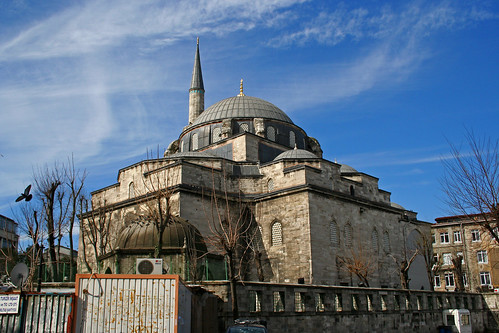
Kıztaşı lies on a quiet street in a genteel area, and the Byzantine buildings seem to have hypnotized the neighbouring buildings and city-dwellers... While not surprised that disgusting weeds had embraced the pillar, concealing it till it became a rubbish dump for plastic bottles, I couldn't come to terms with the abandonment of a stone column, thus depriving history of an inscription that summarized 1,500 years of its past. At a time of column vandalism, I hated to see a campaigning poster for local government elections hanging at a height that only a giraffe could reach.


İmrahor Camii, Mosque of the Stablemaster

The Holy Church of St. John the Baptist, the oldest sacred building in Istanbul, dating from the fifth century, had been open for worship for a millennium. Then it was reopened as a mosque, and dubbed İmrahor Camii. It is by Çamlıca, and is a high-walled building, converted for Islamic worship in 1468 by a Sultan's stable-manager, a post known as İmrahor. An enormous fig-tree spreads across the courtyard. At the south wing, I followed the henna-coloured bricks of a powerful wall, and saw with pleasure the west wing embellished with the names of heroes from the eastern provinces, opposite a park with red-tiled paths that matched the colour of the secluded museum... Like an unfinished Kahn project, the museum with its geometrical floor design as enchanting as a silk carpet was a remarkable monument. It had survived the 1782 fire and the earthquake of 1894, but in 1908 the roof had collapsed under heavy snow and now it would never be repaired. I walked through the main gate feeling uneasily that I was a citizen of a country that didn't even have the sensitivity of an Ottoman stable-master.

Oh, and feel free to have a cake soaked in syrup, called a tulumba, at the nearby Rumeli cakeshop.


Atik Ali Paşa Mosque

  The philanthropic donor who converted the Kariye church into a mosque also bequeathed a large complex of buildings in the district of Çemberlitaş. Hadım Ali Paşa was twice the Grand Vizier of Sultan Beyazit II, and in contemporary sources, referred to as Atik Ali Paşa. Now Hadım means Eunuch, while Atik means Energetic (There can't be a more suitable word than atik to describe someone who can rise from pimping to becoming prime minister, Arda's father might have said), and clearly this man knew where his allegiance lay, building the mosque in 1502 in tribute to the Ottomans.

The mosque has five domes; opposite the three-gated entrance to it is a lovely old fountain. Arda saw a notice on it: PLEASE DO NOT TAKE LARGE CANFULS OF WATER, and it turned his stomach when he saw the subtitle Pest Extermination Service stuck prominently on the notice. The environs were peaceful; supposedly there were diamond and silver workshops in the neighbourhood, all operating miraculously in silence.

The mosque's facade is of cut sandstone. There are four attached buildings to the left of the courtyard. It was interesting to see cobblers and grocery-stores creating income for the mosque complex under the old buildings rented out to silver wholesalers. Were the construction date and the architect of this geometrically simple and architecturally attractive monument deliberately kept unclear?


The Sadeddin Efendi Fountain in the Karacaahmet Cemetery

A fountain now used for ablutions is situated on the axis of the mosque, graveyard and tomb of the man who built it. (Istanbul is famous for its fountains, which not only provided water for ablutions before prayer but also for drinking; many date from Byzantine times, although several philanthropists established some during the Ottoman era.)  Arda discovered that this was the only Su Güzeli (Water Beauty) engraved by the orientalist artists Eugene Flandin and W.H. Bartlett.

It lies on the right side of the street that leads to Tunusbağı, following the angle of the Karacaahmet tomb. It was built in 1741 (AH 1154) by Sadeddin Efendi, son of Kazasker Feyzullah Efendi, and grandson of Şeyhülislam Hodja Sadeddin Efendi - who wrote Tacü' t-Tevarih (The Domain of Islam) - to bless the soul of his dying daughter Zübeyde. Sadeddin Efendi was a lecturer; during his post as a mullah in Egypt he acted as judge in Mecca and Istanbul and died in 1759. He lies in an open tomb behind the fountain...


Take it away, Szerelem!

Feb 20, 2009

Best Translated Poetry

The University of Rochester has declared the winners of the 2009 Best Translated Book of the Year award (sponsored by Melville House and Open Letter Books). Needless to say, none of the crime fiction I'm reading at the mo has even figured in the longlist. Oh well.

The winner in the poetry section is Hiraide Takashi (ably translated by Sawako Nawakasu), for The Fighting Spirit of the Walnut. I'm as clueless as the next person when it comes to poetry, and Hiraide's work requires as much concentration as aqua regia. Here's one example:
Continuous thoughts of packaging ice. No matter what I write it melts, even the
address. If and when it arrives, that person will be gone.
Hiraide's poems are not long; they are epigrammatic and terse. According to some reviewers, he is not so much about emotion as about wordplay and linguistic wallops. Not entirely impenetrable, then. Here's another:
Summoning up my last bit of energy, I shall give a gift to your pale doorway. So that it might become your first bit of food before heading over to the other eye. Whirling tides that are sealed in. And the sun with new bandages. Drupes with wisdom.
Hmm. I expect I'll sample his mots at infrequent intervals, but if anyone gets a hold of this little book, please do post a full review and critique.

Feb 17, 2009

Turkish Whiskers

I was enjoying Selçuk Altun's Songs My Mother Never Taught Me very much until I came across this passage:

I was nauseated by the unpleasant image of a thirty-year-old man with his thin, pointed moustache, grinning maliciously at his prey. Why does the Anatolian male insist on the moustache habit? If it is a symbol of manhood, why is it forbidden in the army and police force? Whenever a disastrous crisis erupts in our country, there's always somebody with an ugly moustache involved.

To add insult to injury, the wielder of said moustache is unceremoniously bumped off shortly after this description. I've lost all respect for Mr Altun. As a (at one time) bearer of fungus on my upper lip, I object to this vilification, and demand an unreserved apology. At once.

This is the story of the rise and fall of a legendary city with a long-hidden legacy of hundreds and thousands of ancient manuscripts. Set against the backdrop of mighty kingdoms and visionary leaders, it talks of how old trade routes from the East became Ink Roads, bringing writing to the heart of West Africa, and how Timbuktu became its leading light, and how invasions and conquests caused that story to be buried in the desert sands of the Sahara. African storytellers have had their long oral traditions dismissed as mere song and dance; the ensuing lack of a written literature was interpreted as a lack of a literary tradition. But now a different interpretation is emerging: one that tells us that reading and writing has been as important a tradition in Africa as it has been in the other great civilisations of the world. As Timbuktu's manuscripts are brought out of hiding, the conviction grows that what they have to tell us will forever rewrite Africa's history.

By the 17th century, tales of an African Eldorado whose streets were paved with gold and whose culture was more glittering than any in Europe were beginning to percolate into the white man's consciousness in the North. As European colonialism grew apace, it became a matter of honour for the likes of England and France to send explorers across the Sahara, or from the sea, to find this fabled city named Timbuktu. The expeditions took years, involved violent strife with desert tribes and large losses of lives, so Timbuktu became synonymous with remoteness and the unknowable. But eventually Western Africa fell to the Europeans, and Mali, once the richest empire in the world, became nothing more than a backwater province of the French. It regained its independence only in the 1960s, and several years were to pass before the owners of its rich literary history felt safe enough to bring their manuscripts out of hiding.

Even today, few people realise that Mali was once Africa's most important seat of learning. From the 13th century onwards, Timbuktu became an academic centre and a paradise for scholars. Today, the memory of those glory days has diminished to a recollection of alphas, wise men from the North who spread knowledge of the word of Allah. In fact, these men were from Timbuktu, students and teachers of faith and science. Among Africans, perhaps only those studying Arabic and the Qur'an know of Mali's great past and its libraries; for the general public, Timbuktu remains a remote undistinguished town on the Niger river.

Families have passed on their manuscripts from generation to generation. Over 70,000 are now available in the thirty or so libraries that have opened in Timbuktu in recent years. Books and documents began to be collected eight centuries ago. The libraries now store whatever remnants have survived the ravages of time. Their contents offer a new and unrivalled source of understanding West African history.

At the Mamma Haidara centre, there are manuscripts on astronomy, medicine and theology, including commentaries on the Hadith. Several date from the 16th and the 17th centuries, and have been nibbled by termites. One astronomical treatise shows how to compute the positions of the stars, providing tables and algorithms. A theological document contains annotations and analyses of the Prophet's sayings, and deal with a variety of aspects of the lives of the faithful. One comment is about hygiene and the necessity for a moderate diet.

Paper was expensive in those days, and so margins of books were constantly reused. On the same page as the description of a moderate life, there appears a comment: today there was an earthquake in Timbuktu... In another book, there appears a five-hundred year old recipe for toothpaste. Take some salt and some sugar, and mix it up with some charcoal, and brush the paste on your teeth, and your teeth will become white. And what's more, it will get rid of your bad breath.

How did these libraries first come into being? How were they lost? How will their rediscovery alter perceptions of Africa?

At the end of the 10th century, when Timbuktu was founded, a large part of West Africa wasmali koran ruled by the Ghana empire. This was West Africa's first superpower, and its rulers were early converts to Islam. The spread of Islam was the compelling reason for the change in West African mores, and provided the impetus for its first literary tradition.

The first Muslims to arrive in West Africa were traders from the north, who then spread their faith across the Sahara all the way to the south coast. Just as in Europe, where most of the early manuscripts are religious texts written in Latin, the earliest texts in West Africa are religious as well, but written in Arabic, and discuss Islamic theology.

The Ahmed Baba institute, Timbuktu's only public library, stores Mali's national collection of manuscripts. Setup in 1973, it now has over 40 thousand documents. Even today, every week, they get around 700 new manuscripts, surely a surprising number. Whenever a new piece arrives, the librarian and his staff need to evaluate it. They select the ones that are in the best condition; the poor ones are set aside. There are many in African languages but written in the Arabic script. These are called Ajami texts. There are documents in Tamazight, Sorai, and other local languages that recount the history of the region. All of them are being digitised so that they can be made available to a worldwide scholarship. The first priority, however, is the conservation and the preservation of these manuscripts.

sufi mali Over 300,000 manuscripts are known to exist in the region, but so far a very small percentage has been translated or studied in any great detail. The conservation, transcription, preservation, study and analysis of the known documents is a task of decades. But thousands, maybe even hundreds of thousands of manuscripts are still hidden in cellars and basements or perhaps buried in the sands of the desert.

The last three hundred years have dealt a succession of blows to Timbuktu. Morocco invaded at the end of the 16th century. Power struggles between rival sects of fundamental Islamists created anarchy throughout the 18th and 19th centuries, followed swiftly by the indignity of French occupation. Like other colonisers, the French took away manuscripts as spoils of their victory. To protect their treasures, the custodians of the manuscripts began to hide them, and they went underground, resurfacing only over the last fifty years. But the custodians are still suspicious.

Before he began to work for his family library, Abdul Qader Haidara was a prospector for manuscripts employed by the national library, and it was his task to track down hidden caches and persuade their owners to hand them over to the state for safekeeping. Convincing them was a difficult matter. When the previous head of the national library approached an Imam of a local village who maintained his own trove, the latter was willing to treat with the director, promising him that they would work together. Several weeks passed, with the director making frequent trips and parleying with the Imam, convinced that his words were persuasive, only to find one day that a wall had been constructed around the manuscripts. The Imam announced that there would be no more discussion, and to this day, those manuscripts have not been yielded to the national library.

At the height of its golden age in the mid-1500s, Timbuktu's population had grown to about a hundred thousand souls. A quarter of them were teachers, students and scholars. Today, the city is a crumbling and dusty backwater, and there is little sign of the academic dominance of the past.

The challenge for historians is to meld the written and the oral descriptions of Africa's past. It is as much a mistake to base the retelling of Africa's history only the manuscripts as it is to depend entirely on the epics handed down over the generations.  Furthermore, a crucial source of information comes from archaeological digs along the Niger river, a source that also needs to be incorporated into new understanding. The Niger river is one of Africa's greatest, providing a source of livelihood and trade for sundry communities that waxed and waned along its banks. Between Djenne and Timbuktu alone, archaeological digs have confirmed that thriving and densely populated urbanised settlements began here as early as 500 BC. It was said that if someone in Djenne wanted to convey a message to someone in a distant village or city, all he had to do was shout, and his message could be carried over the flood-plains and the river to its destination because the entire region was so densely populated.

A pottery cover ten miles south of Timbuktu reveals a city that is twice the size of the medieval Timbuktu, which itself was twice the size of the London of the time. This was far from the only settlement here: these were not small, discrete townships, and their peoples lived peacefully for centuries. Very little evidence of warfare exists in West Africa before the advent of Islam, so economic cooperation appears to have been the order of the day. Some settlements were of farmers, others of fishermen, still others of potters and metalworkers. Once the landscape was covered in forest, which was cut down by the activities of the populace. The metalworkers alone would have required enormous quantities of wood to stoke their furnaces, and possibly contributed to the desertification of the land. Pottery was the ancient analogue of our tins and plastic bags; shards are found in huge quantities: pestles, pots, grindstones, utensils. The cityscape would have resembled the earthen villages that dot the countryside around Timbuktu today, only the density of occupation having changed over the millennia.

Archaeology doesn't tell us what happened to that urban civilisation, or how Timbuktu was born. That information we can glean from the oral tradition. Tuareg tribesmen are said to have established a camp by a well a few miles away from the mosquito-infested banks of the Niger. When the Tuareg headed off to graze their herds in the desert after the rains, they left their belongings to be looked after by a slave woman named Buktu, the lady with the large navel. Timbuktu, then, simply means, Buktu's well.

The Tuareg are the dominant tribes of the desert, an intimate knowledge of which has given them unrivalled control over the trade routes from the north and the east leading to the Niger. By the 10th century, commercial considerations had led to the establishment of a city where the Niger turns eastwards. This is where the trade routes from across the Sahara could safely converge. Timbuktu is where the camel meets the canoe, lying as it does between the desert and the river, where camel trains bringing in the riches of the Mediterranean could be offloaded onto boats and shipped to the kingdoms up and down the Niger, and gold arriving from the south could be used to pay for the luxuries of the north. Dates, European fabrics, glass, jewellery, tobacco, and salt from the Sahara poured into Mali on the camel trains. Boats from the south brought cereals, honey, gold, slaves. It is said that in the 14th century, two-thirds of the world's gold came from Mali, much of it passing through Timbuktu. Today's market here, however, is a small affair, although that other great mainstay of trans-Saharan trade, salt, still arrives by camel, brought by the Tuareg.

International trade in Timbuktu required written contracts, which generated a thriving business for scribes and notaries, who would need to produce documents in a lingua franca. Since the advent of Islam, Arabic became that common language of trade and discourse. In the wake of this religion, books also began to arrive in Timbuktu, and began to be traded like any other commodity, as wealthy merchants found a new indulgence. Books enhanced the status of their owners, and gave the pious a deeper understanding of their faith. The profit of this trade rivalled that from gold and slaves, and by the 13th century, prominent families in the city began to boast of their own private libraries. The sons of those families aspired not only to trade but also to scholarship. Paper was imported from Europe and China. Calligraphy became a viable and respected trade, creating new manuscripts based on indigenous work and copying documents coming from abroad. Their labours were impressively rewarded.

Sidiki Nazim, a calligrapher practising in Timbuktu today, says that in the Middle Ages, his work would have earned him great wealth: he would have owned houses and camels and gold. Today it is a completely different story. He is among the poorest in town, and the only one still practising this ancient craft.

cresques 1 Towards the end of the 13th century, Ghana was overtaken by a new Malian empire, which became the new power in the region with Timbuktu as its economic centre. When the emperor of Mali, Kanka Musa, made his grand pilgrimage to Mecca in 1324, he stopped at Timbuktu, acknowledging its supremacy as mercantile and cultural powerhouse of Western Africa. The Emperor was a pious man, and on that Hajj, he distributed fifteen tons of gold so generously in Egypt and Mecca that the price of gold was depressed there for a long time thereafter. News of his wealth and splendour as he wound his way around the Levant soon reached the ears of European merchantmen. Within fifty years of the pilgrimage, the Mallorcan cartographer Abraham Cresques had drawn up a map for the Holy Roman Emperor, Charles V, showing a black Emperor sitting on the golden throne of West Africa, with Timbuktu as its capital. The legend of a desert Eldorado began its grip on the European mind.

Kanka Musa brought back Arabic scholars to heighten the academy in Timbuktu, but it was said that they proved to be no match for the excellence of the city's black African scholars. He also commissioned new buildings to grace Timbuktu, including a grand palace designed by the Andalusian architect Es-Saheli, whom he had brought with him from his travels. When the palace fell into disuse, the site began to be used as an abattoir.

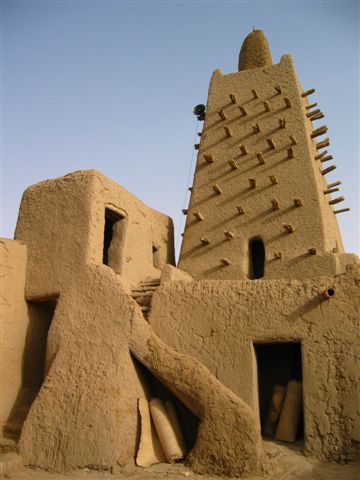
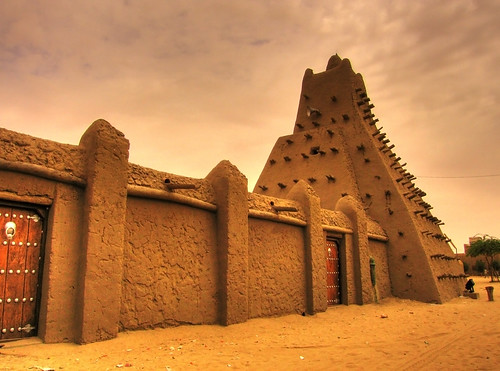
There is little sign of that great edifice today, although one remnant can be found: the Djingareybar Mosque [picture by Dave Lantner], also designed by Es-Saheli, patched up and restored several times over the past 600 years, it represents an almost futuristic notion of a mosque, quite distinct from the usual perception of Islam's houses of worship. Impressive as it is now, in its day it would awed Musa's people just as much as the great cathedrals of Europe, that left no doubts in the minds of their visitors exactly where the power lay. From outside, the mosque doesn't look very large. The interior, though, is huge. There are nine prayer aisles, each about a hundred metres long. It is comfortably cool within as well, almost air-conditioned. Mud brick being a bad conductor of heat, the halls are always at the temperature of the early morning.

In Islam, learning has been much prized, and the academicians of Timbuktu won praise and power in equal measure. When Ibn-Battuta, the greatest traveller of the Middle Ages, visited the city, he was spell-bound by its culture and learning, pointing out the piety, justice and tolerance of its inhabitants. Because of the depth of that learning, the African scholars of Timbuktu were able to distil the essence of their religion and convey it precisely to the people, leading to a tolerant form of Islam practised in West Africa. How much of this tolerance was occasioned by the filtering of Arabian ideas by African minds? Perhaps the Islam that took root in this part of the world was really a blend of the older occult faiths and the monotheism brought in from the East?

Sankore Madrassa The scholarly work in Timbuktu was concentrated in its three mosques: the Sankore mosque (photo by Rajarajaraja), commissioned, it is said, by a wealthy Tuareg woman in the 14th century, the Djigareybar mosque, and the Sidi Yahia mosque. These three mosques comprised the Sankore University, whose rise was signalled by the active research community and prolific writings that filled up the libraries. Timbuktu's Golden Age began in the final decades of the 15th century, fuelled by yet another turn in the cycle of West African imperial history. The Songhay empire, greatest of them all, reigned from Gao, over an area bigger than Western Europe. Under Sonni Ali Ber, an Emperor who championed African traditions, the kingdom was only nominally Muslim, and he refused to allow the dilution of local cultures by Islam. He arrived in Timbuktu in 1468 and showed the scholars there who was boss: they were to obey his diktats on pain of dismissal or death. He would not permit their religious principles and teachings to subsume his culture, he announced. The scholars fled to other towns and cities. But Sonni was a visionary as well, with a view of unity in Africa, so he always imposed his language wherever he conquered.

Sonni's successors were more devoutly Muslim, and they encouraged and funded Timbuktu's scholars. By then, Sankore University was recognised as a pre-eminent centre of learning and discourse. Of course, their interpretation of 'university' is quite different from ours. 180 Qur'anic schools taught children the basics of their faith. The well-off among them would go on to Sankore for three further levels of learning: Arabic grammar and literature, commentaries on the Qur'an, science and Islamic law. Examinations were both oral and written, and degrees were presented to the successful students in the form of a special turban. An interpretation could be made of the design of this turban: the dangling long cloth on the right of the u-shaped face with the circular wind over the head, when written right-to-left, would spell out the name of God, Allah.

A student wearing this turban would be led into the middle of a circle of scholars in the Sidi Yahia mosque, who would rip off his turban, claiming that he was unworthy of it. Then they would pose seven questions in Islamic law to him. If he answered correctly, he would be allowed to wear the turban, and they would all go to Sankore to party. The student then enters the community of wise men and the imam.

The scholars of Sankore were not just teachers. They were also the ruling elite, judges and legislators, who governed every aspect of the people's lives. Although they lived among the people, they were jealous of their power and kept literacy to themselves. As far as they were concerned, the common people only needed to know how to pray correctly, and that was the extent of their encouragement of reading. The spread of literacy in West Africa was also curtailed by significant barriers: the culture of writing followed the trade routes, and since these were mainly along the Niger, literacy was restricted to these regions as well.

In 1591, the Moroccan invasion destroyed the Songhay Empire, the Sankore University, and put a massive dent in any development of a modern nation state in West Africa. The fulcrum of knowledge and learning crumbled under the onslaught of the Maghrebis. Meanwhile, the European shift of trading from the Mediterranean to the Atlantic destroyed the economic basis for West Africa. Gold began to be imported in large quantities from the Americas, resulting in further impoverishment of the Niger belt. The markets became poorer, and while the Moroccans didn't stay on as occupiers, the region imploded in sectarian violence as one brand of fundamentalist Islam fought another through the 18th and 19th centuries. There was simply no time or energy left for learning.

A great consequence of the subsequent colonial occupation of Africa is how Africans (and the world) began to look and interpret its tradition and culture. Furthermore, the imposition of the French educational system on Mali destroyed the old Arabic scholarship, leading to a loss of continuity in learning and knowledge. This means that Timbuktu's manuscripts today are accessible to a very few people, a precarious position for any historiography to be in.

Even the small number of documents deciphered today reveal wonderful glimpses of Mali's past. A book of fatwas, or religious verdicts, describes the quotidian concerns of the laity. A woman whose husband went away on a mission agreed with him that if he didn't return in a certain number of days, she could divorce him and take up with another man. There were no witnesses to this agreement, however, so when the man returned much later, he found that his wife was married to another; the mufti declared that the second marriage was invalid and that she should return to the first man. The woman's voice rings down through the centuries: it is not just your money that I need, but also your companionship and support and love, and if you aren't here, why should I not find these in another man? Clearly there were concerns facing women, but equally, men had pressing anxieties as well. They wanted to be sure they were satisfying their wives, and when erectile dysfunction posed a problem, they were urged by the healer (who saw it as his holy Islamic duty to help out his brother) to apply the blood from the comb of a rooster to their feet or penis, to cure the condition.

After the Moroccan invasion, the scholars of Timbuktu began a new genre of historical writing called the Tarikhs, a rewriting of African history. These were a series of tracts meant to legitimise the elite's right to rule within the suzerainty of the Maghrebis. Their authors drew on oral tradition and written records to reinterpet the past within the light of subsequent events. As such, they need to be weighed carefully. Mohammed Kati who wrote the history of the Songhay Empire was a nephew of the clan, so it is naive to expect him to say anything negative about his Askia ancestors. In the Tarikh-al-Fattash, there are arguments supporting the Askia and condemning the Sonni. Both are from the same family but politically in opposition, and the bias colours the history. Likewise, the Tarikh-al-Sudan proposes in favour of the ruling powers and also in favour of the then dominant strand of religion; and so on, with other Tarikhs dealing with the Moroccan invasion.

Ajami, a genre aimed to reach a larger audience along the Niger, used Arabic writing for local African tongues. Ajami simply means any language other than Arabic, and the warring Sufis used it in propaganda favouring their own version of fundamentalist Islam in the region. On the other hand, it described the lives of commoners in a way that the Tarikhs didn't concern themselves with. The Ajami texts encompassed poetry and history and songs, preserving a dying oral culture. Without the Ajami manuscripts, there can be no unbiased retelling of African history.

Mali is a poor country, and fifty years after its independence, it is still more concerned with internal security than with the promotion of learning and historiography enabled by the rediscovery of the manuscripts of Timbuktu. A long-running Tuareg rebellion ended as late as 1996, but even today, they still clamour for greater autonomy or a state of their own. It's been a rocky road to a tentative peace. Meanwhile, the Sahara extends deeper into the country, parching the countryside and increasing the danger of flash-floods that destroy buildings and reduce the manuscripts to pulp. On top of all these problems, the flood-plains of the lifeblood of Timbuktu, the Niger, are receding year after year. Where once they touched the outskirts of the city, now they are more than five kilometres away.

Timbuktu no longer wants to remain in isolation. Especially among the youth, Western ideas abound, and the locals look forward to the prosperity brought in by tourism. The city is also looking outward more and more, twinning itself with other towns around the world. Hay-on-Wye on the Welsh borders is the latest to be twinned. Apparently, it had been a close competition between Hay and Glastonbury. No surprise, then, that the British city of books with its own literary festival and cultural tradition won out. 

Further Reading

  1. Lydia Polgreen, Timbuktu Hopes Ancient Texts Spark a Revival, New York Times, Aug 7, 2007.
  2. Matthias Schulz and Anwen Roberts, The Rush to Save Timbuktu's Crumbling Manuscripts, Der Spiegel, Jan 8, 2008.
  3. P. C. McKissack, F. McKissack, The Royal Kingdoms of Ghana, Mali, and Songhay: Life in Medieval Africa, Macmillan, 1995.
  4. The Road to Timbuktu, PBS Television Series.
  5. Gerald Rizzo, The Inland Niger Delta: A Cartographic Beacon, Afriterra Foundation.
  6. John O. Hunwick, STUDIES IN TA√RˆKH AL-FATT◊SH, III: KAfiTI ORIGINS (PDF!)
  7. Fallou Ngom, Ajami in Senegambia: The Research and Educational Potentials, Western Washington University.
  8. Aminatta Forna, The Lost Libraries of Timbuktu, The Times, Feb 7, 2009.

Notable People and Places

  1. Abdul Qader Haidara of the Mamma Haidara: Centre Juma Almajid pour la Conservation et la Restauration des Manuscrits a Tombouctou.
  2. Bouya Haidara, Head Librarian, Bibliotheque Ahmed Baba Aboul Abbas (1860-1931).
  3. Salem Ould Elhadj, Historian.
  4. Alexio Motsi, South African conservator
  5. Shahid Mathee (manuscript researcher)
  6. Samuel Sidibe (Director, Mali National Museum).
  7. Douglas Park (Archaeologist, Yale University), digs 10 miles south of Timbuktu.

Feb 13, 2009

Valentine's

Happy Valentine's, people. In case you are wondering what to do with your honey, especially in these parlous times when chocolate is too expensive and flowers too tawdry, head over to the National Gallery's cafe. Say to the waiter or waitress out of the corner of your mouth, "Marry me." Make sure your date doesn't hear this, of course.

You will then be given a free Bellini, which, I'm sure, your loved one will appreciate much more than the frothiest flute of champagne.

(Small print: make sure you've ordered a main dish before asking the serving staff to marry you. You won't get the free Bellini otherwise.)

(Oh, and yeah, in case you are looking for love, be at the Sainsbury Wing at 14:22 hours. A Flashdate is planned, following which the National Gallery has kindly agreed to a free guided tour of the general collection at 14:30. Bring a Valentine card.)

And, if you don't believe me, here's where I got this scuttlebutt from.


Growing up in Teheran, Newsha Tavakolian at first wanted to be a singer. She has a bright, slightly husky voice that showed great promise. Then she attended a photography course, people appreciated her photographs, and she decided she had found her metier. At the age of 16, she started knocking on door of a local newspaper, asking for a job. They sent her away, but she persisted for a month, going to the offices every day, until finally they gave in and made her the telephone operator. 1


Months later, they told me that I'd done very well but that my voice was too young. From that moment, I worked as the newspaper's photographer.


But it wasn't as easy as all that. Of the five photographers on the staff, she was the only woman. Her editor wouldn't send her to trouble spots, being protective of her. One day none of the men was available for an assignment, so she had to go. When the picture she took was published the next day, her colleagues were angry and wanted her to stay out of it. But she was very proud. 2

Over the ensuing 12 years, she has developed an impressive portfolio and considerable experience in photography of power and delicacy. Her oeuvre has extended from coverage of the Iraq war to the depredations of the floods of the river Kosi to the aftermath of the earthquake in Kashmir.

She is one of the youngest professional photographers in Iran, and is widely regarded as a role model for girls in that country. A BBC programme on life in Teheran focussed on the work and achievements of three women; she is one of them.

In a field dominated by men, she finds it easy to get stories and pictures that would be denied to them. Because women open up to her, she can enter their lives easily, unobtrusively.

Newsha points out that, historically, ever since Iranians realised that the West was more progressive than their own country, they have changed their art-forms to suit Western approval. She does not like this because it means that Iranian art becomes less relevant to Iranians, and contributes to stereotypical views among the foreigners. This is an argument that has increasing resonance in most of the developing world. As art becomes a commodity, only what makes money is considered valuable. Newsha would like Iranians to push social boundaries and extend beyond Western appreciation 3.

Currently, there is an exhibition of her works at the
Side Gallery in Newcastle. It's called Sisters in Chanel and Chador, which is less evocative of her sense of irony than demonstrative of a fundamental aspect of life in Iran. In the same family, there can be a member who wears western couture and another who revels in the traditional. Newsha's own family has this dichotomy: her father's side is conservative, while her mother's is liberal, but there is no tension between them, and they get along very well. 4

Thirty years after the Islamic Revolution that brought power to the clerics, Iranian society has not remained static and cowed. It is not rare any longer to see men with long hair and body piercing in the posher parts of the capital. The culture is changing, says Newsha. If her brother had studded his lips like this a few years ago, her father would have thrown him out of the house (here she makes a fluid kicking motion which is as funny as it is cute). But not any longer.

Of course, there are still restrictions on individual freedoms. There are unwritten red lines, censorship rules that cannot be crossed. The extent of hair exposed by women under their scarves is a function of the diligence of the clerical vigilantes. For all the claims of a moral state, there is rampant drug abuse and prostitution and sundered families. For every few steps that society makes towards hope, there are severe pull-backs. But the Iranian loves Iran, flaws and all, and strives to improve it. The Iranian doesn't hate the West, and would like, more than anything, to have cordial relations with those suspicious people in Europe and America.

One of the great advantages that have accrued to women after the clerical takeover is that Ayatollah Khomeini, staunch conservative in almost every other way, was also a literal reader of the holy book. Nowhere did it say that women should not work outside the home, he declared. The Prophet may have stopped his wives from employment, but he did not say that others should do so. And therefore from 1978 women have been entering the public scene in manifold ways - education, scientific research, and business. As long as they remain 'modest', there is little opposition to their presence in public.

Of course, as in any conservative society, there is a wide difference between the exterior and the interior. As the children of the Revolution grow into adulthood and take up their place as drivers of the Iranian economy, these differences begin to narrow, and the private and the public meld more and more. Newsha documents this change with an unerring eye.

Further reading

1. Patricia Simón,
Newsha Tavakolian, Iran's inside story, Sep 13, 2006.

2. Loolwa Khazoom, A Witness to History, ElleGirl.com, Sep 2005.

3. Newsha Tavakolian,
Images of Iran: Aiding the Stereotypes, Nov 2004.

4. Barbara Hodgson,
Iran in Focus, The Journal, Jan 14, 2009.

And check out some of Newsha's spectacular work
here.

Feb 11, 2009

Readers on the WC Line

For the past few days, I've been jotting down figures on a little scrap of paper as I travel on the Underground. For my efforts, I've received unblinking glares and suspicious stares of my fellow passengers. I blame Veena and her demographic research. She wanted to know what the bankers on the Waterloo and City Line read (as opposed to the folks she saw on the Northern Line). Here's what I found.

The majority reads nothing. They stand vacantly, shifting from foot to foot, or sit drooling at each other. I counted 333 people in the past week, of which 49% had reading material in their paws. Of these, the distribution was as follows:

  1. Free Papers (Metro and its afternoon cousins): 76%
  2. Broadsheets (Guardian, Independent, Times, Telegraph, Evening Standard): 6%
  3. Financial Times: 2% (well, 3 readers in all. Three! I'm not too surprised, though. The financial decision-makers would have obtained all the relevant news on their Blackberries or Bloomberg or Reuters screens the previous day.)
  4. Fiction: 10%
  5. Non-fiction: 5%
  6. The Economist: 1% (Now this is a bit surprising. I thought there might be a lot more middle-brow people among the City punters. I guess I was wrong.)

No preponderance of any particular kind of fiction. Of the 16 books I saw, I didn't observe any title repeated. Nor were any of the books particularly memorable. One guy avidly clutched at a brick of a Japanese thriller by Koushun Takami (in translation, of course). One woman read a Carlos Ruiz Zafon book in the original.

The (few) non-fiction readers proved just slightly more eclectic in their variety. There was a philosophy aficionado appreciating Bertrand Russell, and there was a political historian awed by Niall Ferguson. A couple of sports biographies and self-help books rounded off the rest.

So now you know.

Feb 8, 2009

Vivaldi's Orphans

In the 18th century, one of the greatest composers of the Western world formed a unique collaborative venture with a group of women that would last 36 years. The composer was Father Antonio Vivaldi, and the women were all figlie, or daughters, of an ancient Venetian institution named Ospedali della Pietà, or the Mercy - a home for abandoned children. In 2007, a choir named Schola Pietatis Antonio Vivaldi helped to road-test some of the latest discoveries about La Pietà and its musical history, and recorded some of his great sacred music entirely in female voice. Along the way, they dented the conventional musicological belief of the past two centuries that Vivaldi always meant to have men in his choirs. The BBC programme that portrayed the efforts of SPAV was a television gem, and deservedly won plaudits.

They sing like angels, and I swear there is nothing more diverting than the sight of a young and pretty woman with a pomegranate blossom over her ear conduct an orchestra with all the grace imaginable. (Charles de Brosses)

The brains behind the research is a husky-voiced woman named Micky White, who lives in La Pietà, and has been delving into the records of the institution to uncover hitherto unknown treasures of musicological and historical interest. The women who comprised the choir and the orchestra of La Pietà, she says, were brought up in the institution almost from birth, foundlings taken into care. Vivaldi understood that these women had been unwanted, discarded, and therefore vulnerable, and that sensitivity to their position informed all of his music written for La Pietà.

In the 18th century, wealthy men from all over Europe came to Venice to enjoy the strange combination of high culture, high art, and sex. Venice had a reputation for licentious behaviour in those days, and St. Mark's Square was a pimp's paradise. This sex industry had its consequences - a relentless flood of unwanted babies, many of whom were severely deformed by syphilis. It wasn't unknown for many unfortunate infants to be discreetly dropped into the canals of the city. More happily, however, there was an alternative for any woman unwilling or unable to take care of her child. Since the Middle Ages, four great Ospedali had formed a welfare system for Venice. The oldest of them, Mendicanti, is still Venice's main hospital, and was founded in the 12th century to succour lepers, beggars and the destitute. Another hospital took in famine victims, while a third looked after sufferers from syphilis and other infectious diseases. In 1346, the fourth, La Pietà, was established to take in abandoned children.

The introduction of music into these institutions appears to have occurred almost by accident. It had become quite clear to the Venetians that the foreigners traipsing into their city were interested in good music. During Lent, the opera houses were closed, so the tourists had to seek out other sources of musical entertainment. After heavy debauchery, they would go to church to ease their guilt, and there hear some of the finest music in Europe. To the congregation there was the added frisson in knowing that the women singing in the galleries above them were hidden from view behind metal grills, providing only an opaque silhouette of the choir producing the heavenly sounds.

This afternoon I went again into the Pietà. There was not much company and the girls played a thousand tricks in the singing, particularly in the duets, where there was a trial of skill and natural powers, as to who could go highest and lowest, ... , or run divisions with the greatest rapidity. At the hospitals and churches where it is not permitted to applaud in the same manner as at the opera, they cough, hem, or blow their noses to express admiration. (Charles Burney)

The women who were objects of this veneration were, on the one hand, musicians and vocalists of immaculate skill, and, on the other, deformed by disease, scarred by ringworm, pocked by smallpox, crippled by syphilis. In 1738, at the end of Vivaldi's association with the Pietà, there were a thousand women belonging in this institution. Even today, the Pietà fulfils the role of looking after the children of troubled families. It maintains much of its heritage, modernised to keep up with today's society. In the past, the Pietà educated boys and girls, taught them skills such as shoemaking and embroidery. Some children would be taken out of the city to be adopted; many remained within the Pietà's community all their lives. The Pietà owned large tracts of land, the proceeds of which were used for the upkeep of its wards.

M. le Blond introduced me to one after another of those famous singers whose voices and names were all that were known to me. ‘Come, Sophie,’ – she was horrible. ‘Come, Cattina,’ – she was blind in one eye. ‘Come, Bettina,’ – the smallpox had disfigured her. Scarcely one was without some considerable blemish . . . I was desolate.” However, by the end of the meal he was won over by their charm. “My way of looking at them changed so much that I left nearly in love with all these ugly girls. (Jean-Jacques Rousseau)

In Vivaldi's time, the musically oriented girls, the Figlie di Choro,  were trained to sing or play instruments, and many achieved renown throughout Europe for their excellence. Maestri wrote music and taught them; Vivaldi was only the greatest of their teachers and supporters.

Pietro d'Assissi, a Franciscan monk, founded La Pietà in 1346. It is not well-known at all, but in the Corte de la Pietà, one can still find the original building which stands to this day, where Pietro, disgusted by the sight of ill and unwanted children lying in the streets, established his hospice. The building is a private dwelling now, where the owner lives with his ten cats. Micky White points out that the symbolism is quite significant: when Pietro established La Pietà, he took in ten little children.

By the time La Pietà moved to its present location, the scaffetta was already established - originally a hole in the wall, then a revolving door - through which a child could be deposited safely. [Picture by Joebrent on Flickr.] Today, the scaffetta no longer exists, but there is still a plaque that threatens damnation and excommunication on anyone who abandons a child despite having the means to raise it. Once a baby was posted through the scaffetta, it was registered, with a description of the clothes it was wearing, and the date and time of entry was recorded, and a mark of P branded on its upper left arm. On an average, four children were put in the care of the Pietà every day. Occasionally, a mother might come back to reclaim her child, and in order to be able to identify her own, she would produce a token, maybe half of a coin, or half a playing card, the other half of which she had left with the baby. These details were also recorded in the Pietà's books. And when a death occurred in the hospice, an entry of death would be made in the same register.

Vivaldi was born just up the road from the Pietà. San Giovanni Battista was his parish church. The Red Priest, as he came to be called owing to his vividly blazing hair, was born here on 16 March, 1678. His father, Giovanni, was a violinist in the Doge's Chapel, who also taught at one of the ospedale. Antonio started training for the priesthood at the age of 15. He continued his training for ten years, but three years after being ordained as a priest, found himself unable to continue to offer Mass on account of ill health. His own description was a tightness of the chest, which led many to believe he was severely asthmatic. In 1703, he was hired as violin teacher at the Pietà, where he worked on and off for 36 years, until shortly before his death in 1740.

Vivaldi is best known today for his Four Seasons, and concerti for violin and string orchestra, but these are only four of nearly five hundred that he wrote, many of them for the girls of the Pietà. There's an old joke that Vivaldi wrote one concerto and then rewrote it 500 times, but this is a shame, because he was a highly experimental composer, and introduced many techniques and instruments into his repertoire. Scordatura, a means of retuning the strings to allow different combinations of notes to be played, was one such unusual technique. His sinecure at the Pietà also meant that he had the freedom to experiment with various combinations of instruments too, and he wrote pieces for soloists and orchestra that allowed each of the girls to shine.

For instance, he wrote 27 concerti for the cello, several of which were for one girl, called Theresa, who was obviously a fantastic cellist. He also wrote 9 sonatas for the cello, which are popular today with both amateur and professional players.

People have variously called Vivaldi shallow and flashy, and perhaps his concerti played today faster than he intended do sound over-embellished. But his sacred music, performed in the Pietà, by voices he wrote for, under the acoustics that he understood, has a truly divine character and spiritual depth.

One of Micky's achievements has been to uncover the names and identities of the women who performed in the Figlie di Choro. At any time, there were sixty musicians active. Over 140 of them have now been identified, students of Vivaldi, students such as Apollonia, the singer, and Anna-Maria, the violinist, characters with names such as Chiara and Samaritana and Pelegrina. Pelegrina started her training on the bass, moved onto the violin, and then began on the oboe. Almost all oboe parts that Vivaldi wrote are for Pelegrina; indeed, he recognised the individual talents and abilities of his musicians, and wrote specially to illuminate each one.

I can conceive of nothing as voluptuous or as moving as this music. What grieves me is those iron grills which allow only notes to pass through and conceal those angels of loveliness. As I listen, I feel a tremor of love such as I have never experienced before. (Jean-Jacques Rousseau)

Many of the women lived to an old age Pelegrina played the oboe till the age of 62, and then the violin till 77. She only stopped the oboe because by then she had no teeth. All the women worked very hard at their music; several were superb at many instruments, such as the mandolin and harp and oboe and violin; others, such as Apollonia, didn't play instruments because they were such brilliant vocalists. Some of the women were superstars all over Europe.

 Look here, leading the way, like the leader of her troops, comes Anna Maria, the incarnation of goodness and beauty... She plays the violin in such a way that anyone hearing her is transported to paradise. She is beautiful. She has fair hair, rosy cheeks, a snow-white breast, fiery eyes and noble features. (anonymous poem c. 1740)

In the Venice Conservatory, one finds the Anna Maria Notebooks, a collection of violin concerti written for her by Vivaldi. When she was sixteen years old, Vivaldi bought her a violin for 20 ducats, which was three months' salary for him. Clearly, he had a high opinion of her ability and potential.

four parts For years, musicologists have wondered how the singers were arranged in the Pietà. In particular, who would sing the tenor and bass parts? Nobody could believe that women could achieve these low registers, although in the Pietà registers, there was even a woman named Anna del Basso. It was long assumed that men were drafted to sing these parts, or that these parts were transposes up an octave, but with the SPAV ensemble that I mentioned above, it is quite clear that women can manage the entire range by themselves. Their bass, Margaret Jackson-Roberts, is that rare woman, a powerful and deep bass. She has, sadly, faced accusations of freakishness, but her voice is puissant and profound, and provides the much needed foundation for the rest of the choir. For example, in the penultimate movement of the Dixit Dominus, the Gloria Patri, three voices, bass, tenor and alto enter in that order, and we hear the sonority of the low voices. This is the closest that we come to solo writing for bass, and the effect, when executed by the women of SPAV, is magnificent.

In Venice's Central Archives, there are 78 kilometres of shelving storing documents from the hoary past of the city. This is one of the most important archives in Italy, and Micky White conducts her research into the Pietà and Vivaldi here. There are more than a thousand busta, or files, on the Pietà alone, researching all of which is surely the work of a lifetime. Micky is planning to publish a book about her archival discoveries, and there's some talk of an Italian researcher who is trying either to beat her to it, or usurp her story. Her claim that Vivaldi was cherished and appreciated by everyone in the Pietà, the governors, the figlie, the maestri, too, is not exactly in tune with the current view of the academy, which holds that his relationship with the Pietà was fractious.

In the grand church of the Pietà that replaced the little pink one that existed during Vivaldi's tenure there is a fresco by Tiepolo. In it, to the left of a trumpeter, a red-headed face appears, half hidden by figures looking up at the heavens. The face is looking into the nave of the church, at all the singers who would have performed there. Micky White thinks that that is Vivaldi's face, portrayed with respect and affection at the behest of the authorities of the Pietà.

Part of Micky's research is to determine exactly how the choir was organised in the cantoria, the singing galleries high up around the church's interior. The women, arrayed along all the sides of the church, would have produced a marvellous acoustic effect, quadraphonia in effect. The first sopranos were put in the northeast quarter gallery, the second sopranos in the southeast quarter gallery, the band split into two in the organ galleries with the basses and the bass instruments, and altos in the northwest, and tenors in the southwest. Vivaldi never came into this building, but he saw plans of it, and was involved in its design. The sound produced from the galleries is extraordinary, but very difficult to organise, in view of the acoustic effects - echoes of almost eight or nine seconds.

Vivaldi [Caricature by P.L.Ghezzi, Rome (1723)], meanwhile, had recognised that the sales of his concerti and his salary from the Pietà would never amount to much of a living. Opera at the time was the real moneyspinner, so in his thirties, he began to write for this brutal and incredibly popular genre. He rapidly became a star in the Venetian operatic firmament. The Pietà women were forbidden going anywhere near the Opera Sant' Angelo, which was barely twenty minutes' walk from them, but they were not the only women in Vivaldi's life. In 1718, he met a young opera singer half his own age, named Anna Giró, who became his travelling companion, and the favoured soprano for his operas. Their relationship was the subject of much speculation, although there was no evidence that they were lovers. In a letter to an accusing cardinal, Vivaldi furiously denied any impropriety (with reason, for otherwise he would have been in serious trouble).

The musicians of the Pietà would have been quite curious about Vivaldi's operatic life; partly to satisfy this curiosity, he wrote oratorios, music dramas, which were likely performed (and even enacted) by the women of the Pietà. The only that survives, Juditha Triumphans, bears a strong similarity to the pieces he had written for the popular theatre.

In 1740, Vivaldi, under financial pressure, left Venice for the last time. He headed to Vienna, perhaps to supervise the production of one of his latest operas. Soon after he died of an internal inflammation on the 28th July, 1741. He was given a simple burial in the hospital grounds. The Pietà music tradition continued after his death. But in 1760, Charles Burney was observing that the music of the Pietà was not as it had once been. By 1820, the music was over.

References

  1. Amanda Holloway, The Red Priest Unfrocked, The Times, October 19, 2007.
  2. Michael White, The Vivaldi Hunters, The New York Times, November 21, 2004.

The imp is in his I-love-everything-that-runs-on-rails phase and he persuades me to take him on a round tour today. We take the Croydon tramlink (he wants a green tram but we can only find a red one [picture by Banbury Bob]), chugging along till Mitcham Junction. There he sees a train pulling up on an adjacent platform, and blares, "Can we take the green train?"

We huff and puff across to the green train - a Southeast service to Victoria - and plonk ourselves before a little Chinese lady.

"Hi," says the boy. The woman grins at him.

"Are you getting off at the next stop?" says the boy.

"No," says the woman, "I'm getting off at London Victoria."

"We are also going to London Pittoria," says the boy. He then urges me to agree to this new plan.

"How old are you?" asks the woman.

"I'm three," says the boy, "And I am going to the big school because I am four."

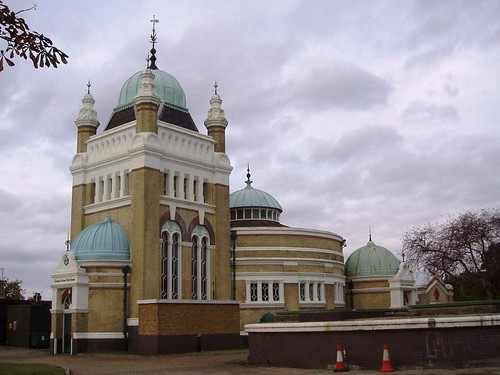
On our way we see this interesting building in Streatham: a pump-house once owned by the Southwark and Vauxhall Water Company. Quite fancy, I think, but it nips away in our wake before I can take a picture of it. Luckily, Ewan-M@Flickr is ready to fill the gap.

Just as we pull into Clapham Junction, the boy announces that he wants to wee-wee. No toilet on the train and nothing for it but to jump out of the train and scurry along the platform to find a WC. None in sight and the boy recognises that he has to return home. He is not happy about this.

"I want to take a fast train, but not a red one, a white one," he insists. The trains home are, unfortunately, all red, and the pressure on his bladder appears to be increasing. He is distracted by a blue wagon in the next train that arrives at our platform, and I whisk him inside briskly. By now he has lost interest in looking out of the window and prefers to pole-dance. A bevy of American girls is impressed with his skills and interrupt their 'I was, like' infused conversation to watch his moves.

When we arrive at our stop, the imp does not want to pee anymore. He wants to take a doubledecker bus. I am not beguiled by this bit of misdirection, and drag him home.

Where he drains into the loo like Niagara Falls.

Feb 3, 2009

Kleptology

What was that story about the teacher and his obedient students? The teacher had a beautiful daughter over whom all his (male, naturally) students salivated. He announced that he would give her hand in marriage to the fellow who could steal an object of value without being witnessed by anyone at all. The horny fellows scarpered into the night and returned with sundry treasures. All of them claimed to have been cat-burglars of exceptional skill, unseen by anybody. But one fellow, the teacher's favourite, came back empty-handed. The teacher, puzzled by this strange inability, demanded to know why.

"There was always one witness to the crime," replied the ideal student. "Myself."

I'm sure there's a lesson in this somewhere, but it is entirely lost in the immorality of the teacher. Sure, he got his students to return their spoils, and the favourite fellow got the girl. But what sort of teacher expected his students to commit a crime in the first place? And make no mistake about it: even in ye olden times, the taking of another's property was a crime, and this is as old a story as the world.

In India, as elsewhere, there have, over the millennia, been various codifications of laws, both spiritual and temporal. The Laws of Manu are one example. Another is Kautilya's Arthasastra, where the duties of the citizenry and the ruling authorities are clearly described.  From the extant literature of the time, ancient India appears to have been quite a turbulent place, full of crime, both petty and great.

In some of the contemporary literary works, criminals are vituperated. The Brhatkatha of Gunadhya describes the comeuppance of adulterous women, false priests, and twisted rogues. There were admonitory works, such as the Mughopadesha, which aimed to educate the reader in the ways of the villainous that they may be detected and avoided. Satire was a finely honed art, as evidenced by the brilliant Kshemendra in his Desopadesa, where he describes the hypocrisy and crime that bedevilled Kashmiri society in his day, and exposes humorously the perfidy of the perpetrators.

Other works exalted the criminal. In the Dasakumaracharita of Dandin one can find all manner of skullduggery (you can find a review of the work itself at the Middle Stage): murder, fraud, impersonation, sundry illicit affairs and abduction. Almost all of these are lovingly treated by Dandin; indeed, more than one of the heroes of the book is a swashbuckling rogue of some kind or the other, bent on ravishing beautiful women as often as stealing their jewellery. What's more, says Dandin, there are treatises on housebreaking available, written by such illustrious thieves as Karnisulta.

The criminal situation in India then as now was a direct function of the puissance of state control. When Fa Hien visited the country during the reign of the Guptas - a strong and disciplined monarchy - he scarcely mentioned any crime, whereas Hiuen Tsang barely two centuries later, visiting Harsha's empire - a much more tenuous enterprise -  was waylaid and attacked by robber bands several times. Furthermore, the Guptas were sufficiently secure in their strength to not punish crime heavily, whereas by the time of Harsha, punitive measures were harsh and cruel.

So how did the authorities in ancient India police their populace? The very oldest works such as the Ramayana talk of policemen on the beat (Dandayudharanapi) whose remit was to chase after criminals. The Matsyapurana enjoins the authorities to ensure vigilance and appoint honest men, else the strong would eat the weak. From other works, it appears that much of the policing responsibility devolved around communal vigilance (merchants keeping an eye on other merchants, foresters on other foresters, and so on), village watchmen, various levels of espionage, and a system of applied penal law.

Kautilya describes an army of policemen in various roles: passport control at the ingress and egress of cities, watchmen at select locales such as wayside inns and places of entertainment, spies at various levels of society, interdiction of suspicious individuals, weapons control, the maintenance of correct weights and measures, and even fire service. He puts into place a system of internal checks in the police and the bureaucracy, and demands the prosecution of embezzlers and corrupt civil servants. Paranoia is not just a word for this astute statesman.

The policemen on the beat rotated every three hours; watch-towers were established. Their chief worked with the assistance of the village heads, and dealt with minor crimes by means of fines and simple punishments (although, occasionally, he also had the power to expel a person from the area). Hunters and dog-trainers were often employed for guard-duty, especially to watch out for roving bands of dacoits.

More serious crimes were dealt with by a system of magistrates appointed by the king. Breaking religious law or the ordnance laid down by the king were serious offences. Cases were brought forward by royal appointees who prosecuted the malefactors. I have not come across any mention of legal defence, or indeed experts speaking on behalf of the defendant. Cases were likely settled on the basis of hear-say, or the social differences between accuser and the accused.

The punishment for crimes against property was in direct proportion to the value of the object stolen. Petty criminals who stole out of economic necessity were often exonerated. Seasoned thieves might pay fines. Kidnappers of children for ransom faced more stringent punishment. Violence against women and murder were the most heinous crimes according to the codifiers of ancient law. Sedition was equally serious, and met with the most severe punishment.

Exactly what all these punishments were, I have been unable to determine. Knowledgeable readers may please enlighten the rest of us.

References

1. Das, S., et al, Crime and Punishment in Ancient India, Abhinav Publications, 1990.

2. Shah, G., Image Makers: An Attitudinal Study of Indian Police, Abhinav Publications, 1993.

[From Korrespondent, 03 Feb 2009]

Today, 3 February, in the centre of Kiev, on 35 Bolshoi Vasilkovskiy street, the house of the famous writer Sholem Aleichem was demolished.

Today, after lunch, ten activists from the citizen's initiative Save Old Kiev blocked entry into the building to the builders. Despite this, say the activists, the company Kyiv Housing-Invest Management continues its demolition of the XIX century house, where the author once dwelt for a time.

In fact, added the activists, the demolition proceeded despite a letter from Ruslan Kukharenko, chief of the Office for the Protection of Cultural Heritage.

Policemen and the government authorities concerned did not intervene in the actions of the construction company, said Korrespondent.net.

It appears that planning permission for the demolition was granted by the Kiev city council in 2007. The construction company plans to erect a hotel in its place, in time for Euro 2012.

(Additionally, from here, it appears that the city council is really quite unconcerned about the destruction of the historic quarter.)

Others have described their London-under-snow experiences, and bemoaned the collapsing infrastructure in this city at the merest hint of inclement weather, so I shall not belabour these points and restrict myself to pointing out that, en route to work yesterday, I ended up trudging 3 miles in the crunchy snow.

Which reminds me of an interesting turn of phrase I came across recently: I'd love to eat the sound of snow being crunched by shoes. Indeed.

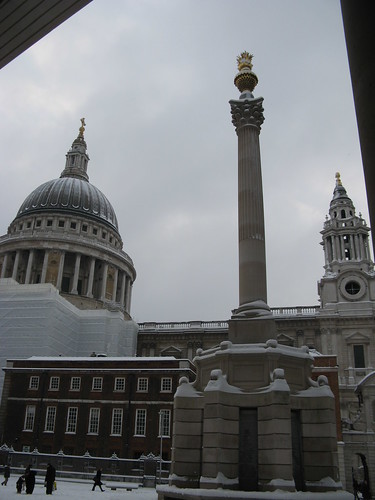
So, for reasons too mundane to limn, I found myself at Tottenham Court Road tube station and facing the prospect of a hike to Bishopsgate. The route is extremely straightforward. New Oxford Street to High Holborn to Holborn Viaduct to Newgate Street to Cheapside to Threadneedle Street to Bishopsgate. It is pretty much one long road, not altogether pretty but with an occasional highlight along the way. And here are some pictures of stuff I saw.


018

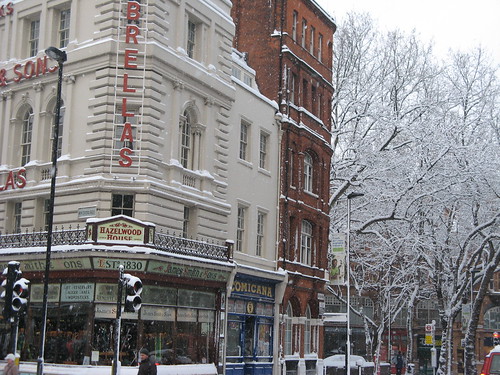
[Old Department Store on New Oxford Street]

021
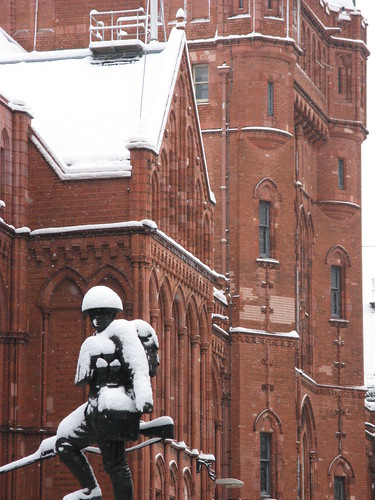
[Memorial to the Infantryman in the Great War, by the Prudential Building]

022
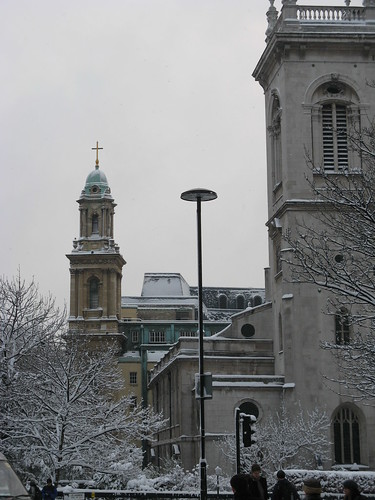
[City Temple (background), St Andrew's Church (foreground)]

024
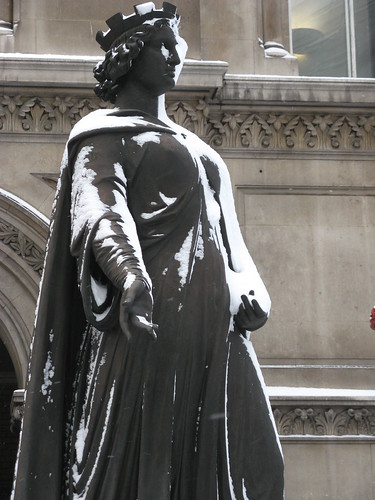
[Statue on Holborn Viaduct]

025
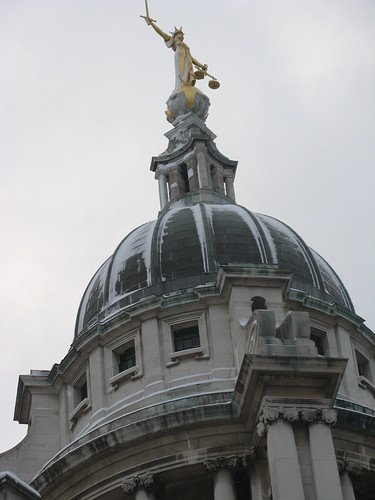
[Cupola of the Criminal Court]

027
[Paternoster Square]

029
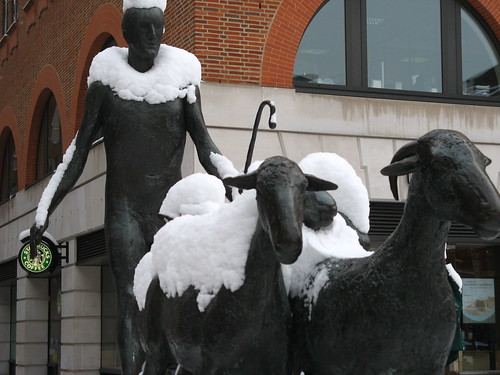
[Elizabeth Frink's Shepherd and Sheep on Paternoster Square, St. Paul's Cathedral.]