The skirmish was suddenly over.Yuri Belash, veteran of WW II, Moscow.
We stopped to roll a smoke
and the Germans did too and
so there we stood,
insane, across from each other -
barely on our feet still.
'Cigarette break,' someone said hoarsely.
The German nodden understandingly: 'Ja, Pause. Sofort!'
We sat down, them and us, in the grass
five paces away from each other;
we laid our rifles at our feet
and plucked
tobacco from our bags.
Yes, the things one sees in war!
Pass it along, not a soul in hell
will believe you. Then calmly, silently
- cautiously looking each other in the eye -
we ground out the final roll-ups, they their cigarettes,
and the same voice rasped, raw and bloodshot:
'End of cigarette break!'
Met a chap the other day. He was getting married and he had invited his ex-girlfriend to the wedding. His name was Rob. Aren't you upset? I asked the bride. No, she said, and urged Rob to tell the story of his ex-girlfriend. She, it seems, had gotten married to some other fellow after she broke up with Rob. Strangely enough, said Rob, her husband's name is also Rob. We stood around and ruminated on this coincidence. I met Rob, said Rob. Or, said Rob, I should say Rob 2.0. Yes, chuckled his bride. Rob 2.0 is not balding. And he's younger. Definitely an improvement on Rob.
Met a chap the other day. He had a lisp. He spoke to me about King Henry the Eighth, who, he said, took a thucthethion of mateth. And inthithted that the monkth were a lazy bunch of thkunkth.
There have been some remarkably good books in the list over the year, and some incredible duds, and it never ceases to amaze me that publishers bemoan the lack of saleability of translated fiction, and yet manage to publish some obvious crap. Perhaps, their reasoning goes, if it was a big hit in the pulp foreign market, it will do well in the English pulp market as well... A lesser man would have tried to conclude this series on a high, but I am afraid I'm not a lesser man and so I'll end with some abject nonsense.
My favourite Russian is back once again! Erast Fandorin's latest escapades were published in yet another excellent translation by Andrew Bromfeld in Boris Akunin's She Lover Of DeathAkunin, as those who read or have heard of his Fandorin novels know, aims to write each volume in a particular genre of crime fiction. This one deals with decadence in turn-of-the-century Moscow. A suicide club has formed and it attracts aficionados from all rungs of society. Written in the multi-person perspective familiar from previous books, here we have the story as seen by a young girl arrived in Moscow from the provinces, a newspaper journalist investigating the club, and the police. Bohemians attracted to the society are urged by its leader to write down their ruminations on death in verse, to be praised or condemned by him. The Russians pride themselves on the poetry in their souls, and so they do not necessarily take kindly to being dismissed, but so in thrall are the cultists to their leader that they accept every word of his as manna. Naturally, the world at large is not indifferent to the club, and both the police and the papers attempt to infiltrate it. Fandorin himself, incognito and persona not very grata in Moscow after the disastrous events of the Coronation, embroils himself, too. There are a couple of twists in the tale, and all once again is not as it seems. This is not as good an offering from Akunin as some of his older works, but still worth an evening by the fireside.
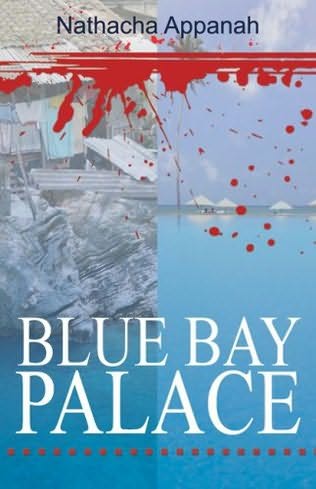
Next, we have Nathacha Appanah, a feted Mauritian writer, who has written Blue Bay Palace
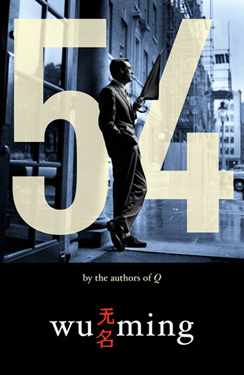
We can ramp right up with '54
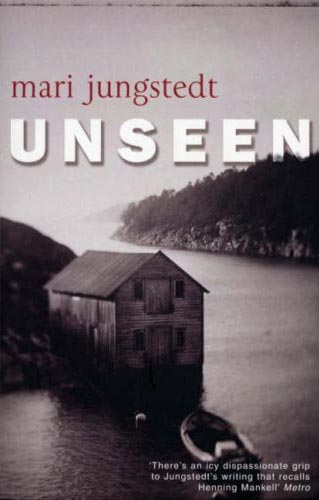
I have to include a Scandinavian, surely? Surely I must. There has been much coverage of the phenomenon of Nordic crime fiction in the press lately (see, most recently, Laura Miller in the Wall Street Journal), most of it very deserved. Here I present Mari Jungstedt's Unseen
From this point, it's all rapidly downhill. We first have the Spanishwoman Matilde Asensi's The Last Cato
Yet another Spanish romp is Julia Navarro's The Brotherhood of the Holy Shroud
So! We've had Dante, the Templars, the Turin Shroud. What do we have left? How about Gaudi's lollypop of a Cathedral, the Sagrada Familia in Barcelona? Clearly there are tales within tales in that concoction! The man himself died under mysterious circumstances, but not so mysterious that a bit of spiritual conspiracy can't be adduced. And so we have The Gaudi KeyAnd that's all, folks. Finis.
The British were fascinated by the Hindu caste system because it appeared to codify social divisions in just the nuanced way that appealed to their own rigid ideas of class. Not content with the general division of their people into royalty and nobility and gentry and the large unwashed masses, they felt the necessity to make finer distinctions. Once they established the sundry orders and awards in their own land, they recognised that their subjects and allies hankered for similar decorations. And so began the institution of orders for the colonies.
Whereas the Order of St Michael and St George was set up for the white dominions, India was honoured with three decorations during the later Imperium. Shortly after the events of 1857, the Most Exalted Order of the Star of India began with subsequent extensions over the decades. In 1878, to coincide with Queen Victoria’s coronation as Empress of India, the Most Eminent Order of the Indian Empire was inaugurated, as well as the Imperial Order of the Crown of India. The first two were the senior orders, and had three levels (paralleling the St Michael / St George order), whilst the last was for women. These were designed to rank not just the British government elite but also the Indian princes, and their civil services. The point of these orders was that they should be open to all, Brits and natives. After all, they were all united in the service of the Empire.
Sir John Lindsay had pointed out years earlier that ‘marks of distinction are exceedingly pleasing in this country; and could any means be fallen on to add to the apparent dignity of Indian princes from Europe, it would be exceedingly flattering to them’. The ruling princes were so desperate for these awards that they competed keenly amongst each other; they seemed to have completely missed the fact that being awarded something like Commander of the Order of the Star of India (CSI) or even Knight Commander of the Order of the Star of India would merely equate them to a high-court judge or a British resident; even so rich and grand a prince as the Maharaja of Mysore expected to be awarded the Knight Grand Commander of the Star of India in every generation, an award that put him at the same rank as, say, the governor-general of Bombay or Madras. And yet, the ruler of Mysore was offered a 21-gun salute, surely a far superior honour? Clearly, the grandees of India were as keen on weighting their chests with medals as any general in the Russian army.
The general trajectory of awards would be a zigzagging path through the Order of the Star of India or the Order of the Indian Empire. A journeyman in the Indian Civil Service would ascend somewhat like one Sir Percy Cox, who started small and ended up big: CIE, CSI, KCIE between 1902-1911 for his services in the Persian Gulf; KCSI and GCIE during the First World War as political officer in the Indian Expeditionary Force on the Western Front; KCMG in 1920 whilst acting British High Commissioner to Persia, and GCMG in 1922 when he became High Commissioner to Iraq. ‘No wonder he was an impressive sight when calling upon King Faisal, his official uniform covered with these accumulated baubles’ as David Cannadine writes in his book, Ornamentalism, from where I got all these tidbits.
The Indian princes wouldn’t necessarily obtain the entire panoply of awards – they would receive them entirely based on their relative ranking, and their prestige at the Viceroy’s office. Naturally, this meant they would jump through hoops to obtain the medals they craved. Rudyard Kipling satirised this obsession:
Rustrum Beg of Kolazai – slightly backward Native State -
Lusted for a CSI - so began to sanitate
Built a Gaol and Hospital - nearby built a City Drain
Till his faithful subjects all thought their ruler was insane.
Strange departures made he then - yea, Departments stranger still,
Half a dozen Englishmen helped the Rajah with a will,
Talked of noble aims and high, hinted of a future fine
For the state of Kolazai, on a strictly Western line.
Rajah Rustum held his peace; lowered octroi dues a half;
Organized a State Police; purified the Civil Staff;
Settled cess and tax afresh in a very liberal way;
Cut temptations of the flesh - also cut the Bukhshi's pay;
Roused his Secretariat to a fine Mahratta fury,
By a Hookum hinting at supervision of dasturi;
Turned the State of Kolazai very nearly upside-down;
When the end of May was nigh, waited his achievement crown.
When the Birthday Honours came,
Sad to state and sad to see,
Stood against the Rajah's name nothing more than C. I. E.!Reference
David Cannadine, Ornamentalism: How The British Saw Their Empire, Penguin, 2001.
I imagine that 2009 was rather good for investment banks, for suddenly their client entertainment budgets expanded, Christmas parties were on full swing, and I received an invitation or two to corporate events. Most recently, I went to the Haymarket Hotel near Piccadilly where a Wine Investment Challenge was held under the aegis of one of our brokers. This was organised in the basement of the hotel right by the swimming pool, which occasioned no end of surprise as the air was thick with chlorine.
So if I was unable to identify the wines, I can safely blame it on the Cl2.
The challenge was organised by Taste of the Vine, which is run by Francis Gimblett, a wine aficionado and stand-up man. He is famous for having unwittingly insulted Gerard Depardieu and then spending several years of his life chasing down the man, and then writing a book about his experiences. Here he tried to rouse the crowd with a wise-crack or two but people seemed more interested in downing their cocktails and piling onto the canapés. He quickly moved on to the challenge itself.
On each of three tables were placed two wines (hidden in cloth), and the task at hand was to identify them based on some hints given out on a printed paper. At the first table, the challenge was to identify the Higher Quality wine from the two Meursaults of the same producer. One was a higher quality ‘premier cru’, the other one a standard issue. Higher quality wines have richer character and more length, we were advised. We had descriptions for each that went something like this:
1) Appearance: Medium Yellow; Nose: Pronounced, Crisp Apple; Palate: Dry, High Acidity, Medium Body, Crisp Peach and Cox Apple.
2) Appearance: Medium Yellow; Nose: Pronounced, Pineapple, Apricot; Palate: Off Dry, High Acidity, Full Body, Tropical, Mango, Buttery.
Francis explained the three kinds of noses. A High Intensity nose is of a wine whose bouquet can be smelled from about five inches away. A Pronounced nose can be smelled from about 3 inches. A Low Intensity nose can only be smelled with the nose (the human one) in the glass.
With my sense of smell somewhat at an ebb and clobbered by all the chlorine, both the wines appeared to have low intensity. They were fine whites, and no amount of swirling helped me to discern the medium yellow or deep yellow appearance that might distinguish them. In the end, entirely at random, I chose ‘Mango, Buttery, High Acidity and Off Dry’ as the higher quality Meursault, and the ‘Dry, High Acidity, Crisp Peach’ offering as the lower quality.
At the next table, the challenge was to identify the older wine. There were two vintages of a premier cru red Burgundy, each of a different vintage (1996, 2004, or 2006). The hint? ‘Older wines exhibit more organic, less fruity character.’ Armed with this advice, I inhaled, sipped, swirled, gargled, rinsed, flushed, pulled up my zip, washed my hands. Here were the descriptions:
3) Appearance: Dark Red; Nose: High Intensity, Tar, Dried Cherry; Palate: Medium Tannin, Full Bodied Game, Strawberry and Herb Flavours.
4) Appearance: Deep Purple; Nose: Low Intensity, Blackcurrant, Vanilla; Palate: Low Tannins, Low Acidity, Medium Bodied Earthy, Blackcurrant.
5) Appearance: Pale Red; Nose: Medium Intensity, Strawberry Jam; Palate: Light Tannin, High Acidity, Medium Bodied, Sweet Red Berry, Herbs.
I have to say that the first wine in this set was exceptional; even as debased a palate as mine could tell that it was superb. But which description did it correspond to? I suspected it was the third, but only because it was indeed lighter in colour than the other one. The experts around me insisted it was a 1996, so I went with that and description (5); and I selected description (4) and 2006 for the other candidate.
Finally, I staggered over to the third table, where the challenge was to identify the climate where the wine was made. Both the wines were from the same grape, but grown in parts of the world. Warmer climates, we were told, gave sweeter smelling and more alcoholic, fuller bodied wines. Here were the descriptions:
6) Appearance: Dark Red to Purple; Nose: Pronounced, Cassis, Sweet Cherry, Mint; Palate: Off Dry, High Tannin, Full Bodied, Blackcurrant, Toasty Oak.
7) Appearance: Deep Red with Garnet Edges; Nose: High Intensity, Cedar Musk, Blackcurrant; Palate: Off Dry, High Tannin, High Acidity, Full Body Sweet Cherry, Earth, Currant, Game.
8) Appearance: Tomato Red, Brown Edges; Nose: High Intensity, Sesame Seed, Gherkin; Palate: Sweetish, Lettuce Acidity, Deep Body, Lingering Black Pepper, Cheese, Onion, Meaty Notes.
I confess at once that I was totally boondoggled at this table. (I was also a bit peckish and weighed into a lamb & couscous dish, which further polluted my palate.) Both were dark dark wines. Was there a hint of pepper in one wine and not the other? Perhaps. I chose Cooler and description (8) for the first wine, and Warmer and description (7) for the second.
By that time, my head was spinning. There weren’t any spittoons, and the generous quantities of wine doled into my glass had sloshed their way through my bloodstream most effectively.
Francis Gimblett then announced the correct answers.
It turned out that I got all the qualities correct at table 1. From then on, it was all downhill. The exceptional Burgundy that we all liked turned out to be the younger one. At the third table, my choice of (8) for the wine had been repeated by many others. Gimblett rolled his eyes and explained that that was the description of the hamburger he had had that day for lunch.
One chap got all the answers right and was awarded a fine wine for his effort. I was troubled to see he was a Sikh. A Sikh! Drinking wine! Heresy! And then he guessed the price of yet another wine, and won that as well. I didn’t stay on to see if he would win the last challenge of all – to enumerate the nine grapes that account for the majority of the wines produced in the world. (If anyone knows what these grapes are, please feel free to list them.)
And here are the wines themselves:
- Étienne Sauzet Meursault Premier Cru 2007
- Étienne Sauzet Meursault Champs Canet 2007
- Echezeaux Domaine Rene Engel 2004
- Echezeaux Domaine Rene Engel 1996
- Peter Michael Les Pavots 1997 (California)
- Penfolds Bin 707 1997 (Australia)
That first Meursault and the 2004 Burgundy were the top of the heap. I’d like to get a bunch of them just so I can pretend to know all about them, but, boy, they sure cost a ton. My birthday will come up sooner or later, so, guys, there’s no need to think too much about what to get.
Cheers!
1. this is one of the best posts on this blog
2. lewis was one of the finest writers and one of my all time favorites.
3. i dont believe in Darwin's theory in the first place..
4. the building looks beuutiful, not only historical.
5. fantastic post!!
He is not entirely altruistic and supportive of my effort, of course. What he wants is backlinks to his own site, one that appears to prepare essays on demand for students too lazy to do their own homework.
The Daleks had it right: Exterminate!
Update: the fellow has now returned under a new moniker, and has the following to say:
1. no doubt, thats a bad experience. but this does'nt mean that all the immigrants behave like that..
2. the lament by Mary Brooksbank is wonderful :)
3. such a tragic story of such a pretty lady...
4. good post. it really concludes the real reasons of war since the beginning till now.
"We need to relax," said the Russian.
"Shall we take a few days off?" said the Indian.
"We've got the client coming in on Tuesday," said the Yorkshireman.
"I know!" said the Russian. "We can do one of those team-bonding exercises."
They thought about this for a while. Nobody voiced the thought that if the last six months hadn't bound them, a weekend probably wouldn't either.
"Scuba-diving?" suggested the Yorkshireman.
"I can't swim," said the Indian.
"I have asthma," said the Russian.
"Hiking in the Peak District?" suggested the Russian.
"Canoeing in Cornwall?" said the Yorkshireman.
"Fly-fishing!" said the Indian.
For some reason, that last idea appealed to all of them.
A few short Google queries later, they learned that Scotland was possibly the best place to attempt this sport of kings.
The Yorkshireman, as an honorary Scot, was tasked with researching locations, accommodations, transportation. The others went off to purchase the equipment.
The next evening, they arrived at their cottage on the banks of a fast-flowing stream, changed into their brand-new fishing outfits, grabbed their fishing rods and bait and things, and rushed to the river.
A couple of elderly Scotsmen watched them approach.
"Where's a good place to fish?" said the Russian.
One of the Scotsmen pointed wordlessly at the river.
The other Scotsman gruffly said, "You need a licence to fish in these waters."
The visitors screeched to a halt.
"A licence? What licence? Where?" said the Indian.
"I knew I forgot something," said the Yorkshireman.
"You can get a licence at the store in the village," said the other Scotsman.
They piled back into their car and drove madly to the village, where they found the store. It was closed.
"Now what?" said the Russian.
"We can watch the football," said the Russian. "We'll start fishing early tomorrow."
They went back to the cottage, gathered around the dining table, turned on their portable TV, cracked open some beers, and spent the rest of the evening urging one team or the other.
The next morning, they appeared at the store as it opened.
"Four fishing licences, please," said the Indian.
"Sorry," said the storekeeper. "Only locals are allowed to fish in our waters on Saturdays."
They staggered under the blow.
"But we have come all the way from London!" wailed the Russian. "We are only here for the weekend!"
"Sorry," said the storekeeper.
Crestfallen, they headed back to their cottage. On the way they found several locals standing knee-deep in the river. There was much cheer among the locals. The locals were catching and releasing shiny fish of this colour and that size.
The visitors slunk into the cottage. They drank more beer. They didn't talk to each other much. They didn't watch football.
The next morning, Sunday, they appeared at the store. It didn't open. They hung about the village, took brief walks around the village pond, and waited some more. The store didn't open.
A helpful villager said that the store was closed on Sundays. Could they get the licence elsewhere? Unlikely, but did they want to try in town several miles away?
It was too much to bear. Neither the beer (which by now they were running out of) nor the football could raise their spirits that day.
On Sunday night, the Russian said,"We have come here to fish, and by thunder, we will fish. We'll get the licence tomorrow, we'll fish till 2 o'clock, and we'll drive back to London in time for the client visit."
The Yorkshireman sang a maudlin song. The Russian snored. The Indian shrugged despondently.
The next morning, they appeared at the store as it opened. The storekeeper sold them four licences. This time they didn't rush enthusiastically to the river. They walked, brows furrowed in thought. They avoided the other anglers and fly-fishers, and headed towards a spot by a bend in the river. They waded into the stream and cast their lines, which snagged on rocks and trees and the occasional twig floating by. They sighed, now with contentment and then with exasperation.
Besides the chirping of the birds, there was the quiet splish-splosh of the fish, the sussuration of the breeze, the whirr of the fishing lines. There were faint buzzing sounds and sporadic cracks as one fisherman after another slapped himself on the arm or the face. Other than these noises, there was peace and quiet.
Which was broken suddenly by a moan from the Russian and a shriek from the Yorkshireman.
The Russian and the Indian craned their necks to investigate.
"My God," said the Yorkshireman,"What's happened to your face?"
The moaning Russian sagged to his knees and moaned some more. The Russian and the Indian stared with horror at his face.
It had swollen and expanded. His cheeks covered his eyes. His ears were the size of cauliflowers. As they looked on, his hands began to swell up and then his neck. His lips expanded and so did his tongue. He looked nothing less than the Incredible Hulk.
All around, the midges swarmed and stung.
The Russian and the Indian and the Yorkshireman dragged the moaning Russian out of the water. Expensive fishing rods and fancy bait were forgotten in their headlong flight towards the car. They drove with appalling speed to the village and then to a town miles away where a helpful medic injected copious doses of antihistamine into the Russian.
Without a backward glance, they jumped back in the car and sped southwards to England and safety. Near the outskirts of London, several hours later, the moaning Russian stopped moaning. He could see again and talk once more. Out of the window flew the fisherman hats and the fisherman jackets, the fisherman permits and the fisherman boots. They returned to London and the comforts of their office and cast fishing and bonding out of their minds.
The next day they met the client and landed the contract. And they celebrated by going to a nearby pub where again they watched football with fresh hope and pleasure renewed.
[There once used to be a neat little website for the North London Walkers describing some interesting walks in this great city. It no longer exists. Luckily the time machine that is archive.org has snapshots of it from before it went kaput. I’m reposting the (slightly) re-edited versions here, with added pics.]
This Trail starts at Marble Arch Tube Station and is 12 Kilometres Long. The first part of the route takes you through Hyde Park, emerging by the Royal Albert Hall. This is then followed by a walk through the Royal Borough of Kensington and Chelsea, passing on the way the Natural History Museum, Harrods Department Store and the Chelsea Royal Hospital (designed by Sir Christopher Wren in the 17th Century).
You then enter the City of Westminster and pass by Buckingham Palace, St.James's Palace, Trafalgar Square (with Nelson's Column) and the Royal Courts of Justice before finishing at the Temple Tube Station.
Start:- Marble Arch Tube Station (Central Line)
Upon emerging from the Station leave the subway by exit No.9, via exits 3 and 10, which will take you past The Marble Arch. Enter Hyde Park through Cumberland Gate and follow the Ring, North Carriage Drive (the road just inside the park) to Victoria Gate.
Q1 - There is a building next to Victoria Gate. What is it called?
Where the Ring turns left, continue along it until you reach the Serpentine. Turn right here and follow the road between the Serpentine and the Long Water (across bridge), to Alexandra Gate. Turn right through Coalbrookdale Gate passing in front of the Albert Memorial, with the Royal Albert Hall and Royal College of Art opposite, and exit Hyde Park through Queens Gate.
Q2 - Opposite Queens Gate there is a statue. Who does it commemorate?
Cross over Kensington Gore and walk along Queens Gate, past the Bulgarian Embassy, the Imperial College of Science and Technology and the Sultanate of Oman Embassy to Cromwell Road and the Scout movement headquarters, Baden Powell House. Turn left here and pass in front of The Natural History Museum. Continue along Cromwell Road, past the Venezuelan Embassy, the Victoria and Albert Museum, and The Oratory where Cromwell Road joins Brompton Road, passing Harrods as you walk up to Knightsbridge.
Q3 - What is the name of the Hotel opposite Harvey Nichols Store and Knightsbridge Tube Station?
At Knightsbridge turn right into Sloane Street. Follow Sloane Street all the way down passing the Peruvian Consulate and the Royal Danish Embassy and emerging in Sloane Square. Go straight across the square and exit into Lower Sloane Street. At the junction with Royal Hospital Road turn right and continue down to the River Thames passing the Chelsea Royal Hospital and the National Army Museum on the way. Once at the River Thames turn left into Chelsea Embankment.
Q4 - Above the door to No.9 Chelsea Embankment there is a blue plaque. Who does it commemorate?
On the opposite bank of the Thames you can see Battersea Park and the Peace Pagoda; continue along towards Chelsea Bridge. At the Bridge turn left into Chelsea Bridge Road; on this corner there is a memorial to the VI Dragoon Guards (The Carabiniers). Take the first right turn, Ebury Bridge Road, passing along the side of Chelsea Barracks. At the end of Ebury Bridge Road go straight across into Buckingham Palace Road. Continue up Buckingham Palace Road passing Victoria Coach Station, The National Audit Office, Victoria Railway Station and The Grosvenor Hotel. At the end turn left into Grosvenor Gardens, leading to Grosvenor Place.
Q5 - On the corner of Grosvenor Gardens and Hobart Place there is a First World War Memorial. To which Regiment is it dedicated?
At the end of Grosvenor Place you will come to Hyde Park Corner with the Wellington Arch and on the opposite side the Wellington Museum (Apsley House). Turn right here along Duke of Wellington Lane and go down Constitution Hill with Green Park on your left and Buckingham Palace Gardens on your right (the other side of the big wall). This will bring you out at the Queen Victoria Memorial and Buckingham Palace. Go around the Memorial and along the Mall, past Lancaster House, Clarence House, St.James Palace and the Duke of York Column on your left and St.James Park on your Right to Admiralty Arch. Pass through the Arch.
Q6 - Just through Admiralty Arch on the left is Uganda House, above the door there is a plaque. Which bird is depicted on the plaque?
Continue straight ahead and leave Trafalgar Square by the Strand, passing in front of Charing Cross Railway Station, past the Savoy Hotel.
Q7 - Just a little beyond the Savoy Hotel, and opposite the Strand Palace Hotel, there is a small turning called Savoy Buildings (Pedestrian Access only). On either side of the entrance there is a plaque. What was the former name of this alleyway and when did it change?
Then cross over Lancaster Place and continue along past St. Mary-le-Strand, Somerset House and Kings College. Turn right into Arundel Place (the turning just before St. Clement Danes) and continue down to
Finish:- Temple Tube Station (District and Circle Lines)
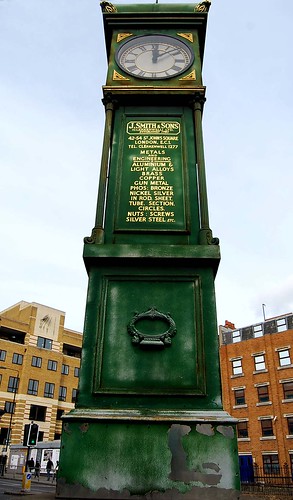
Upon emerging from the tube station turn left. At the junction of Islington High Street and Pentonville Road cross over and continue walking along St. John’s Street.
1. On the corner of St. Johns Street and City Road there is a building. At the top of this building there is an engraving giving the buildings former use. What was the building originally and when was it built?
![]() |
| Finsbury Town Hall (by Alan Stanton) |
Turn right into Roseberry Avenue (2nd Right). Travel along Roseberry Avenue past Sadlers Wells Theatre, Spa Green and the Fleet River Head. Turn left into Garnault Place, this runs down the left hand side of the old Finsbury Town Hall. At the end cross over the road into Exmouth Market.
2. Above the door to No.56 Exmouth Market there is a blue plaque. Which famous clown does it commemorate and when did he live here?
3. The notice board of St. James Clerkenwell gives details of its history. Since when has there been a church on this site and when was the present building completed?
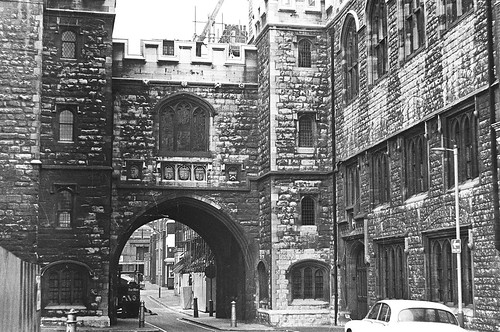
Here you will find the former Clerkenwell Assizes, then a Masonic Hall, and the Karl Marx Memorial Library. Turn left towards Aylesbury Street then turn right into Jerusalem Passage. This emerges into St. John Square, cross over Clerkenwell Road and walk towards St. Johns Gate. This is the last remnant of the priory of St. John of Jerusalem, it is today a museum and the headquarters of the Order of St. John. Pass under St. Johns Gate and continue along St.Johns lane, bear right at the end of the lane, along St.Johns Street and across Charterhouse Street to Smithfield Meat Market. Pass through Smithfield Meat Market (Grand Avenue), across West Smithfield, towards St.Bartholomew's Hospital. Follow the road going around to the right in front of the hospital (West Smithfield /Giltspur Road).
4. On the wall of St.Bartholomew's Hospital (about 10 yards from the corner of West Smithfield and Little Britain) there is a memorial plaque. Which famous Scotsmen does it commemorate and why?
At the traffic lights turn left into Newgate Street, passing the Old Bailey Central Criminal Court, then turn right into Warwick Lane, past Cutlers Hall and Stationers Hall. At the end of Warwick Avenue turn left and go along Ludgate Hill/Cannon Street, past St.Pauls Cathedral to Mansion House tube station. Turn left here into Queen Victoria Street, go past the remains of the Temple of Mithras and the City of London Magistrates Court to The Mansion House.
5. On the corner of Mansion House, below the street sign (Walbrook) there is a square blue plaque. What building formerly stood on this site?
Turn right at the Mansion House into Walbrook, past St. Stephens Walbrook to Cannon Street. Turn right and go back towards Mansion House tube station. At the Station turn left into Queen Victoria Street and go past Cole Abbey Presbyterian Church and the Salvation Army Headquarters to Peters Hill, opposite the Royal College of Arms. Turn left into Peters Hill past the City of London Boys School and down the steps leading to the River Thames. At the bottom of the steps turn right and walk along the Embankment, under Blackfriars Bridge and past HMS PRESIDENT. Cross over the road and turn right into Middle Temple Lane past the Middle Temple, Inner Temple and the Temple Church to the end of the lane. At the end of the Lane cross over the Strand and turn left past the Law Courts and St. Clement Danes and follow the road round to the right past Australia House and into Kingsway.
6. There is a small brass plaque on the wall of St. Catherine’s House, on the corner of Kingsway and Aldwych. What was the former name of St.Catherine’s House and who was it used by?
Go along Kingsway, past the Office of Public Census and Survey, the Public Trust Office, the Civil Aviation Authority Headquarters and the Ministry of Agriculture Fisheries and Food (Victory House), and turn left into Great Queen Street (4th Left). Travel along Great Queen Street, past the New Connaught Rooms and Freemasons Hall.
7. On either side of Freemason's Hall main entrance there is a plaque. Who opened Freemason's Hall and when?
Then cross over Drury Lane and go along Long Acre. Take the next left, Bow Street, and go past the Magistrates Court and turn right past the Royal Opera House, then go straight along to Covent Garden Market. Turn left and walk around the market, past the London Transport Museum, and the front of St. Paul’s Church and turn left into Kings Street. Cross over Garrick Street and into New Row. At the end of New Row cross St.Martin’s Lane and enter St. Martins Court.
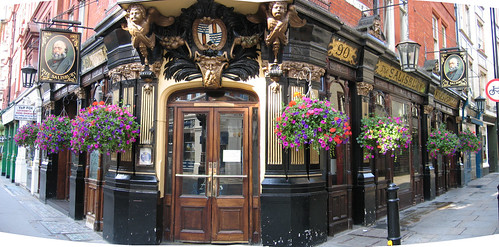
8. Above the Salisbury public house (corner of St. Martin’s Lane and St. Martin’s Court) there is a clock. What is depicted on the clock face?
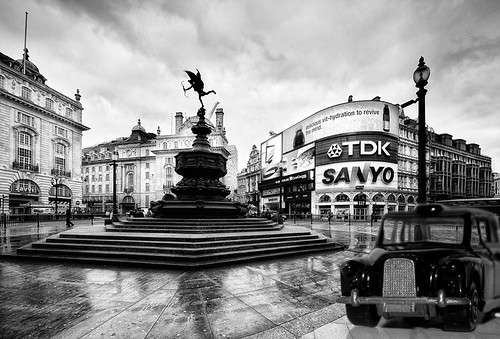
Turn right out of St. Martin’s Court and cross over Charing Cross Road at the traffic lights next to Leicester Square tube station. Go straight ahead past the Hippodrome along Cranbourn Street and into Leicester Square. Go across the Square past Equinox and the Empire to New Coventry Street and the Swiss Centre. Cross over Wardour Street into Coventry Street past Planet Hollywood, the Trocadero and the London Pavilion to Piccadilly Circus.
9. Which Roman God overlooks Piccadilly Circus?
Go across Piccadilly Circus and into Regent Street. Walk along Regent Street passing Hamleys and Liberty's and turn left into Hanover Street (9th left), leading to Hanover Square. Go straight across the square and into Brook Street, following it to Grosvenor Square.
10. Which former US President is the memorial in the Northern end of Grosvenor Gardens dedicated to?
Leave the square by Upper Brook Street. At the end you will come out in Park Lane, turn right and walk up to:
Finish:- Marble Arch Tube Station (Central Line)
[There once used to be a neat little website for the North London Walkers describing some interesting walks in this great city. It no longer exists. Luckily the time machine that is archive.org has snapshots of it from before it went kaput. I’m reposting the (slightly) re-edited versions here, with added pics.]
This 11 kilometre long route starts at the Tower of London and, after crossing over Tower Bridge, follows the River Thames upstream offering panoramic views of the City and Westminster. The South Bank of the Thames at this point is in the London Borough of Southwark and it is here that you will find a full size replica of Sir Francis Drakes Golden Hind and Shakespeare's Globe Theatre.
As you continue along the riverbank you enter the London Borough of Lambeth where you will find the London home of the Archbishop of Canterbury, Lambeth Palace, and the new headquarters of MI5 the British Secret Service.
At this point you recross the river over Vauxhall Bridge and then walk back downstream to the Houses of Parliament, passing on the way the Tate Gallery. Next to the Houses of Parliament you will find Westminster Abbey, where the coronation of England's Monarchs takes place and where many of them were later buried.
The route then continues along the riverbank, past Cleopatra's Needle, to the Temple Tube Station.
Start :- Tower Hill Tube Station (Circle & District Lines)
Upon exiting the station go down steps under road towards The Tower of London. Turn left at the Tower Moat and follow it round to Tower Bridge Approach.
Q1 - On the North Tower of Tower Bridge there is a plaque. Who opened the Bridge?
Cross over Tower Bridge (River Thames) and go down steps in middle of the footpath on the South side. At the bottom of the steps turn Right and travel along the embankment towards HMS Belfast. Proceed past HMS Belfast to Hays Galleria, turn left into the shopping arcade which emerges in Tooley Street. Turn right along Tooley Street, just past the London Dungeons turn right (the road is still Tooley Street). Continue along passing under London Bridge and emerging in Montague Close behind Southwark Cathedral.
Q2 - On the right 10 yards beyond the bridge is a Hall used by three City Livery Companies. What is the name of the hall?
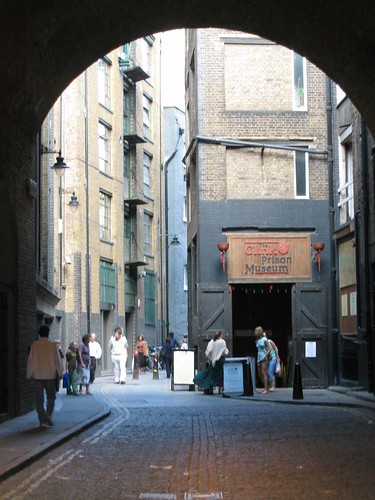
At the end of Montague Close turn right to Pickfords Wharf. Go past St. Mary Overy Dock and the remains of Winchester Palace and into Clink Street. Travel along Clink Street, past the Clink Prison Museum, and turn right after passing through the railway arch. This will bring you back out onto the South Embankment. Turn left and continue following the riverside path, going under Southwark bridge and past the Globe Theatre and the former Power Station and on to Blackfriars Bridge.
Q3 - At Blackfriars Bridge there is the remains of the old railway bridge. Which Railway Company's crest is displayed here?
Pass under the bridge and then past Sea Containers Wharf, Gabriels Wharf and the London Weekend Television Centre. You will then come across a complex comprising The Royal National Theatre, The National Film Theatre, The Queen Elizabeth Hall, Royal Festival Hall, The Hayward Gallery and the Museum of the Moving Image.
Q4 - Along the route at various points there are silver plaques on the ground. What do these plaques commemorate?
Continue along the River bank past the above complex and under Waterloo Bridge and Hungerford Railway bridge and past Jubilee Gardens and the Old County Hall. Go under Westminster Bridge and continue along the Riverside path (Albert embankment) past St. Thomas's Hospital and Lambeth Palace to Lambeth Bridge.
Q5 - What museum is situated near the entrance to Lambeth Palace?
Go under Lambeth Bridge and continue along the Albert Embankment past the Headquarters of the London Fire Brigade and the new headquarters of MI5 (Vauxhall Cross) to Vauxhall Bridge. Cross over the River at this point, turn right on the far side and walk along Millbank back towards Lambeth Bridge, passing the Tate Gallery on the way.
Q6 - In the gardens to the right of the main entrance to the Tate Gallery there is a statue. Who is it of?
At Lambeth Bridge cross over the road and go down the steps into Victoria Tower Gardens. Travel through the gardens towards Palace of Westminster/Houses of Parliament. Walk around the perimeter of the Houses of Parliament to the Clock Tower (Big Ben), passing on the way Westminster Abbey and Parliament Square. Once at the Clock Tower cross over Bridge Street and continue along Victoria Embankment.
Q7 - On the corner of Westminster Bridge opposite the Houses of Parliament there is a statue. Who is it of?
Walk along the North Bank past Scotland Yard, Ministry of Defence and the old paddle steamers SS Tatershall Castle and the Hispaniola. Then pass under Charing Cross Railway Bridge past Cleopatra's Needle and then under Waterloo Bridge. You then pass Somerset House and Kings College and about 30 yards further along come to the finish.
Q8 - Almost opposite Temple Tube Station there is the first of three ships moored. What is its name?
Finish:- Temple Underground Station (Circle & District Lines)
The Anne S. K. Brown Military Collection at Brown University is a repository of much military art, from which (with the kind permission of the Curator) I reproduce the following.
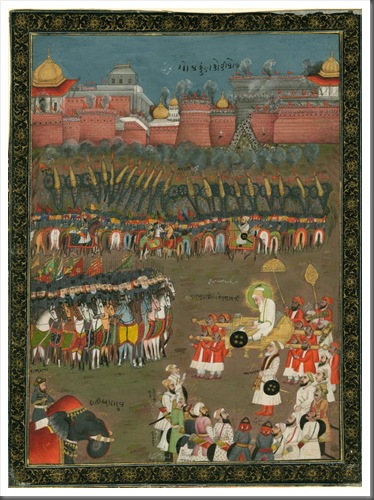
The first is a gouache dating from between 1750-90 of the last Great Mughal, Aurangzeb, at the Siege of Golconda. The Qutb Shahi rulers of this kingdom in the Deccan had refused to bow to the Mughal imperium, and to punish them for their insolence, Aurangzeb himself led his forces against them in 1687. Under the redoubtable Tana Shah, the fortress at Golconda withstood the siege for eight months, ably supported by the Marathas who harried the Mughal army endlessly. Eventually, through bribery, the redoubt fell, and the Mughals marched in victoriously, extinguishing the Qutb Shahis.
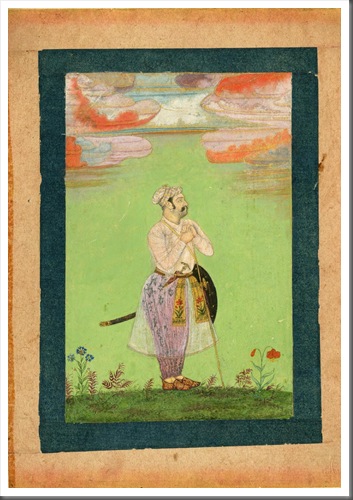
So what did a Mughal military officer look like in the 17th century? Here is a watercolour that shows one such, circa 1650. Mughal military ranks, inspired by the Persians, were numerical, named mansab, that, beginning in 1573, denoted an officer’s salary, obligations, and position in the hierarchy. Mansabs were further divided by ethnic origin (in Mughal studies, at least) such as Iranis, Turanis, Afghans, Indian Muslims, Marathas, Rajputs, and other Hindus. Though they were usually of aristocratic origin, the mansabs were not hereditary ranks. There were 33 grades of mansabs, commanders of 10 through to commanders of 10,000, either of cavalry or infantry; their pay (jagir) was expected to support not only themselves but also supply and equip their troops. Finally, any mansab could be transferred from one part of the empire to another, although in practice, the senior-most very likely stayed in their own fiefs until called upon for service.
Two hundred years later, the East India Company controlled two-thirds of the subcontinent. Its armies comprised Indians from almost every part of the country. From Kerala came the martial clans known as Nairs. This picture shows some of its members part of a Nair brigade in the service of the British, as painted by the Swiss artist Paul Aimé Vallouy (1832-1899) and part of a series of three charcoal and watercolour drawings made in 1855.
Links
About Me
Categories-
- advertising (10)
- afghanistan (2)
- africa (9)
- algeria (2)
- alphabet (1)
- andorra (1)
- anglo-indians (3)
- apple (2)
- arabs (9)
- archaeology (7)
- architecture (23)
- argentina (6)
- armenia (3)
- art (94)
- astronomy (14)
- australia (6)
- austria (5)
- automobile (3)
- beer (5)
- behaviour (12)
- belgium (9)
- bengal (7)
- berlin (1)
- biography (45)
- birthdays (7)
- blogs (42)
- bolivia (1)
- book (1)
- books (398)
- bosnia (1)
- botswana (2)
- brazil (7)
- bridges (14)
- burma (4)
- business (45)
- cambodia (1)
- campanology (2)
- canada (8)
- caucasus (5)
- chechnya (3)
- cheese (4)
- chemistry (6)
- child abuse (3)
- chile (2)
- china (26)
- chocolate (2)
- climate (8)
- cocktail (5)
- coffee (5)
- colombia (3)
- computing (10)
- conference (5)
- congo (2)
- côte d'ivoire (2)
- credit (1)
- cricket (2)
- crime (1)
- cuba (4)
- culture (21)
- cyprus (1)
- czech (4)
- delhi (3)
- denmark (5)
- economics (16)
- edinburgh (3)
- education (15)
- egypt (13)
- england (143)
- environment (4)
- epidemiology (5)
- eritrea (1)
- espionage (2)
- estonia (3)
- etymology (5)
- evolution (8)
- exhibitions (7)
- family (77)
- fashion (8)
- film (39)
- finance (33)
- finland (2)
- folk tales (2)
- fonts (5)
- food (234)
- france (99)
- fraud (7)
- friends (12)
- fruit (3)
- gaming (10)
- genetics (2)
- geodesy (2)
- georgia (6)
- germany (54)
- ghana (3)
- greece (25)
- guatemala (1)
- health (9)
- hindi (4)
- history (219)
- holland (4)
- humour (63)
- hungary (8)
- iceland (2)
- ICM (10)
- IISc (13)
- IKEA (1)
- india (139)
- indonesia (5)
- inquisition (1)
- internet (18)
- iPod (2)
- iran (10)
- ireland (4)
- israel (8)
- italy (74)
- jamaica (1)
- japan (16)
- jordan (1)
- kazakhstan (1)
- kenya (1)
- kerala (6)
- kidnapping (1)
- korea (5)
- kurds (4)
- language (78)
- lebanon (2)
- life (127)
- london (98)
- low-cost airlines (2)
- malaysia (2)
- mali (2)
- manipur (2)
- maps (3)
- mathematics (70)
- mauritius (1)
- medicine (13)
- memory (1)
- mexico (15)
- mobile phone (2)
- mongolia (2)
- morocco (7)
- moscow (5)
- music (61)
- myth (16)
- names (4)
- nepal (1)
- netherlands (9)
- networking (3)
- neuroscience (1)
- new zealand (2)
- newspapers (15)
- nigeria (2)
- norway (7)
- oranges (2)
- pakistan (4)
- palestine (1)
- paris (6)
- parsis (4)
- persia (10)
- peru (2)
- philippines (1)
- photography (33)
- physics (18)
- poetry (66)
- poland (9)
- politics (28)
- polynesia (1)
- portugal (4)
- psychology (7)
- pubs (3)
- quiz (8)
- race (7)
- religion (73)
- risk (4)
- roaring twenties (5)
- robotics (1)
- romania (4)
- rome (9)
- russia (77)
- samsung (1)
- saudi arabia (2)
- science (68)
- scotland (26)
- search (1)
- serbia (2)
- sex (25)
- singapore (4)
- society (73)
- south africa (4)
- spain (42)
- sports (17)
- sri lanka (1)
- St. Stephen's (9)
- suicide (1)
- surreal (2)
- sweden (12)
- switzerland (8)
- syria (3)
- tahiti (1)
- taiwan (1)
- tajikistan (2)
- tamil (2)
- tata (3)
- tea (3)
- technology (16)
- television (16)
- thailand (6)
- thames (9)
- theatre (4)
- tibet (1)
- tolkien (2)
- trade (6)
- translation (23)
- travel (135)
- tunisia (1)
- turkey (22)
- typesetting (6)
- uganda (1)
- ukraine (4)
- uruguay (1)
- USA (87)
- uzbekistan (3)
- venezuela (2)
- vietnam (3)
- visa (1)
- vodka (4)
- wales (5)
- walks (20)
- war (23)
- web (2)
- west indies (3)
- whisky (3)
- wine (23)
- wodehouse (6)
- work (24)
- yemen (2)
- york (1)
- zambia (1)
- zimbabwe (1)
- zoroastrianism (4)