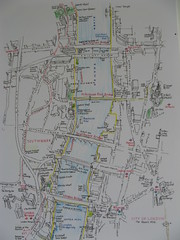
I took this photo of a display map of the London Mayor's Thames Festival displayed near London Bridge. The boy and I were on a small expedition along the river to Waterloo.
Why, goes the question, would there have been astronomy in ancient times? Everyone then thought that the sky was Heaven, and that it was filled with mysterious creatures. Stories about these creatures and their doings formed our earliest myths. Was there any connection at all between this early mysticism and the beginnings of astronomy? Behind these tales of gods and monsters, was there a glimpse of divine reason?
When our ancestors gazed into the night sky, they saw more than stars. They saw heavenly creatures and terrible beasts whose moods could shape their lives and fortunes. These heavenly denizens were feared and worshipped by the ancients, who recorded their stories of love and war, jealousy and revenge. These stories are nowadays dismissed as fairy tales, but Dr Allan Chapman believes they are the earliest records of astronomical observation, and do much more than expected in explaining the beginnings of human civilization.

We know almost nothing about the people who built Stonehenge. We know nothing about why they built the monument; we know nothing of their beliefs. So the Druids who assemble each year at Stonehenge to indulge their rituals and mystical mumbo jumbo are enacting a modern fantasy. But we know far more about another ancient culture, and we might profit from an investigation into their astronomical achievements.

At the beginning of time there was boundless chaos and out of this chaos came Ra, not begotten of any father, not conceived of any mother. Of his own volition, he gave himself a body and entered into active existence. The demiurge, the supreme being, the quintessence of all the forces and elements of nature! Praise to thee, oh Ra, exalted power and lord of the hidden circles!


So what does this have to astronomy? Well, Ra is the Sun God, and his journey across Nut’s back is the path taken by the sun across the sky. The Sun represented light and dark, hot and cold, life and death, and defined the cardinal points of the compass – North, South, East, West. And when it came up in the morning, the deep dark was banished, and light was cast over the land of Egypt.
We should not be surprised that so many ancient peoples worshipped the Sun. Its appearance every morning represented the victory of day over night, life over death, good over evil. But why did the Ancient Egyptians believe that the Sun was swallowed by a giant woman who later gave birth to him? The story of Ra and Nut is not just a description of the daily journey of the Sun – it is also a clever way of representing the position of the Sun in the sky at different times of the year.


The myth of Ra and Nut, then, helped the Egyptians mark two points in their year: the vernal equinox and the mid-winter solstice. But decoding the myth raises further questions: why did they want to mark these points of the year? And why did they worship the objects in the sky as Gods?
Historians are loath to accept any astronomical significance to ancient monuments (New Age nonsense, they scoff), but Allan Chapman believes that it is difficult to understand the purpose of such edifices as the Great Pyramids without recourse to astronomy. The steps leading to the tomb of Cheops in the greatest of the pyramids rises at a particular angle, and while it’s true that this angle has little significance today, we must remember (as historians often tend to forget) that the positions of the stars in the heavens are not fixed for all eternity. They have, in fact, moved in the 4500 years since the construction of the Pyramids. It is possible to calculate what the steps would have pointed towards at the time of the construction – they pointed at a very significant part of the night sky, which the astronomer priests of Egypt associated with Heaven.
They had observed that there was a small group of stars that did not rise, travel across the sky, and set as the other stars did. The Northern circumpolar stars were always visible. These are the stars we call the Great Bear. The Egyptians called them Ikhemusek – the Ones Not Knowing Destruction.
With the Ancient Egyptians we see for the first time the idea of a Heaven in the skies, and this heaven was populated by a bizarre collection of gods and goddesses that they associated with the stars and planets. When they looked at the planet Mercury, the Egyptians imagined the god Seth, the evil god of chaos and destruction. When they observed the planet Venus, they thought of Isis, the lovely goddess of fertility. And when they looked upon red Mars, they imagined they were charting the progress of angry Horus, the falcon-headed son of Isis.
If we visit the tombs of the ancient Egyptians we see that they are covered with strange incantations to the great Gods, with symbols for the moon and stars and the planets. But why should the priests of the land have been so fixated with astronomical bodies? To understand, we need to acquaint ourselves with the daily rhythms of life in Egypt, lives that were so intimately connected to the mighty river Nile.
Egypt was one of the world’s first agricultural civilisations, and its fortunes, thus, were related to those of the immensely long river that flowed through it. Farming requires planning: you need to know when to sow, when to reap, and you need to know when the river will burst its banks and cover the plain with fertile mud. For all this, you need a concept of time.
To make use of the Nile’s life-giving properties in the dreary desert of Egypt, it was vital for the farmers to know when the river was about to flood. For them, an ability to measure time was literally a matter of life and death, and it was to the gods in the sky that they turned to for help. The use of astronomy in the all-important prediction of the annual inundation of the Nile can be seen in that myth of drunkenness and murder involving the seductive goddess Hathor. Hathor, also known as the star-spangled heavenly cow, was a seductive courtesan and dancer, and also, herself, a lover of the great Ra. We are told of a time when the divine Ra had grown old and dribbled at the mouth, and was mocked by mortal men and women. He summoned the other gods and goddesses to his great house, and spoke to them of the evil words used against him. It was decided that the Eye of Ra should go forth on Hathor and destroy all those who had spoken ill of him. Hathor rampaged throughout Egypt, putting the insolent mortals to the sword. The savage massacre continued until there were hardly any humans left. But Ra realised that Hathor had to be stopped in order to preserve humanity. So he made seven thousand pots of beer and poured them into the Nile. The river rose, flooding the land around, and Hathor noticed her lovely reflection in the rising waters and knelt before the Nile to drink. She drank and drank, until the river subsided, and by the time she had drunk all the seven thousand pots of beer, she was in no condition to kill any more.
The Ancient Egyptians connoted the Sun with Ra, who grows feeble as the summer comes to an end. Hathor they associated with what they called the Dog Star, or Sirius, the brightest star in the sky. Sometime in 3500 BC, it was observed that there was a time of the year when Sirius rose just before the Sun at dawn. This event, it was further noted, presaged the annual flooding of the Nile. By charting the progress of the divine gods, the Egyptians realised they could predict momentous events on Earth, such as the passing of the seasons and the floods of their life-giving river. The acts of the gods had direct consequences on their lives, and that is why it was necessary to worship these gods.
But Ra and Hathor only told the time two or three times a year. The Egyptians needed to tell time at greater frequency than this, and they turned to the wisest of the gods for assistance. Thoth, who accompanied Ra in his royal barge across the day, was the god of wisdom and time. He was depicted with an ibis-head crowned by the rising moon, and this is no accident. The moon, realised the priests of Egypt, was an uncannily regular timekeeper. Over its period of 28 days, it waxed and waned, and its phases had bearings on events on Earth – the tides, for example, or the menstrual cycle of women. And as far as we know, the Egyptians were the first people to divide the year into months, and this was such an important innovation that the moon-god, Thoth, became one of their most revered divinities. And although Ra the Sun was the creator, Thoth the Moon was the controller of the Universe.
But there is a problem. The sun governs the year, the moon controls the month, but there is no satisfyingly regular relation between the length of the month and that of the year. The Egyptians had other difficulties: they didn’t know exactly how long a year was, or when it began and ended. The most important myths of these people, therefore, dealt with their efforts to mark out astronomical time.
Initially, for instance, the astronomer priests believed that the solar year was 360 days long (which, indeed, is the origin of our 360-degree circle). But this error meant that their seasons began to gradually slip out of line, forcing them to adjust their calendars every few years. Finally, they realised that they needed to increase their reckoning of the year by five days, and this realisation manifested itself in yet another myth of revenge and jealousy.
We are told that the beauteous goddess of the Milky Way, Nut, fell in love with her brother, the Earth god Geb, whom the Egyptians depicted as a bird. But when Nut began to make love to Geb, who should appear but her husband, the great god Ra? Trembling with jealous rage, Ra put a curse on his cheating wife: she would be unable to bear children on any day of the year. The clever Nut realised she could get around this curse by extending the number of days in the year, and to achieve this, she seduced Thoth. After having his wicked way with her, Thoth agreed to help, and oddly enough, began a game of draughts with the goddess Isis, wife of Osiris, whose death marked the shortest day of the year. To the Egyptians, draughts charted the movements of the stars and were much used in astrology; indeed, Thoth himself is said to have invented the board. Unsurprisingly, Thoth was able to defeat Isis and claimed the extra five days as his prize, which Nut then used to give birth to five children; and so it was that the ancient Egyptians became the first people to use a 365-day calendar.
Why did the Egyptians require precision to within a day? Farmers only need accuracy up to the seasons, but the civilisation they wrought had need for far finer details in time. The priests were not just astronomers and religious figures; they were also administrators who needed to organise the business of state. They needed to calculate taxes and pay workers; they needed to agree contracts and arrange building work. These people needed to know what day it was. Such was the sophistication of this culture that they needed to measure time in units smaller than a day! Again the Egyptians found the metronome for such time in the heavens, and again they depicted its discovery in their sagas.
Once again, we have a story of Ra and Nut. Every night when Ra was swallowed by Nut, he was transformed into Osiris, the ram-headed god of the dead. As Osiris, he was forced to sail down the Tuapt, the dangerous river that flows through Nut, passing through twelve gates where the powers of evil congregated to thwart him in his progress. Osiris had to defeat living mummies and the terrifying snake demon with twelve human heads on its back, until in the morning he re-emerged as Ra from the birth canal of Nut.


The priests didn’t stop measuring time at dawn; instead, they developed water clock to continue the division of the daytime into twelfths. Thus they became known as the Overseers of the Hours. And here we have the origin of our 24-hour day: twelve-hour night and twelve-hour day. For the Egyptians, the hours were a wondrous thing.
The conquest of time is one of the cornerstones of our civilization, for it allows us to reckon our seasons, grow our food, and order our lives. Astronomical timekeeping in Egypt, then, was not incidental to daily life. It was vital.
But we must remember that to the Egyptians the gods were not mere artefacts of astronomy. They were powerful beings that imposed morality and ethics, whose actions had direct consequences on their daily lives. One of the most bizarre of the myths recounts the battle between Order and Chaos, something that was of supreme relevance to the Egyptians’ existence and prosperity, and their fear that Chaos was an ever-present and lurking danger.
Chaos, the Egyptians knew, was a constant threat. There was natural chaos: disease, famine. There was social chaos: criminals, wars and invasions. Bad monarchs meant that there was no justice in the land. Chaos was personified by Seth, the god of destruction and disorder. We are told that Osiris was killed by Seth who hacked his body and scattered the pieces throughout Egypt. Isis, his wife, was distraught because his death meant that she would have no son to inherit Osiris’s kingdom, which would then fall to Seth. So she went in search of the pieces of her husband so that she might conceive from his reconstructed body. Unfortunately, Seth had thrown Osiris’s phallus into the Nile where it had been eaten by a fish. Nevertheless, Isis was able to construct another phallus from the parts of Osiris’s body she found, and with that was able to conceive a new Sun God, Horus. Horus tried to reconcile the warring gods and Seth invited him to his house. When Seth saw Horus, he became aroused and tried to violate the falcon-headed god. He failed in his attempt, but accidentally ejaculated into the hand of Horus. Horus ran to his mother to complain of his violation; outraged, Isis grabbed a sword and hacked off her son’s polluted hand and threw it into the Nile. She constructed a new hand for Horus and excited him sexually and collected his seed in a pot and secretly went to the house of Seth where she discovered some cabbages and poured the seed onto them. Ignorant Seth ate the cabbages and became pregnant with the child of Horus. Now Thoth, as governor of the living sky gods, entered the story. He summoned Seth and Horus to him to attempt to reconcile the two. He ordered that the child growing within Seth should come forth, and come forth he did, a new planetary disk, child of light and dark. Before Seth could claim suzerainty over the disc, Thoth wrestled it away from him, and triumphantly placed it on his own head.

Astronomy was religion for the Egyptians because of the deep connection that they saw between events in the heavens and the consequences on Earth. They wished to bring the order and reason and truth they saw in the heavens down to earth and make it a living moral force in their own lives. Indeed, they had a goddess whose special task this was. She was the goddess Ma’at, the third traveller in Ra’s royal barge across the sky. Ma’at was a goddess of paramount importance to the Egyptians. When a king ruled in Ma’at’s name, there was peace and prosperity and order in the land. The Pharaohs had to earn the blessing of Ma’at by governing with the same logic and law on earth that they could see manifest in the heavens.
Today we have driven a wedge between religion and science. Religion is about good and evil, whereas Science is about cold facts and truths. But the astronomer priests of antiquity perhaps recognised better than us that the ability to understand the patterns of nature, and to use this knowledge for our own ends is what protects us from Chaos. This kind of knowledge is not neutral. It is a force for good.
[From Allan Chapman’s series on Channel 4 – Gods in the Sky]
In 1890, the effete Maharaja of Manipur was deposed in a palace coup. Of the set of eight brothers in the royal line, four were opposed to the Maharaja, and three supported him. The leaders of the putsch were the Jubraj, or Heir Apparent, the second oldest brother, and the Senapati, or Commander-in-Chief, the third oldest. A few shots were fired at the window of the palace, the Maharaja abdicated, and with his three supporters fled to the British Residency, and the Jubraj installed himself on the throne. Because the Senapati was wildly popular and recognised as the ablest of the fraternity, Manipuris on the street welcomed the coup.
The Maharaja then left the kingdom on a pilgrimage to the Ganga.
It was not British policy to interfere in the governance of a nominally independent kingdom, but the Political Agent at a Residency was meant, first of all, to ensure that no prince who meant harm to the British survived in power, and contrariwise, that no friendly prince should be deposed. So, although the wise advice of the then Political Agent to Manipur, Frank St Clair Grimwood, to the Indian Government was to accept the coup, the Viceroy, Landsdowne, decided on a half-assed compromise: recognise the Jubraj as the Maharaja but demand the expulsion of the Senapati.
And immediately hilarity and tragedy combined.
Landsdowne ordered Quinton, the Chief Commissioner, to march upon Manipur with a detachment of Gurkhas. Quinton was to announce publicly the Indian Government’s decision, arrest the Senapati, and take him out of the state. When Quinton arrived at the palace, the Senapati was understandably suspicious and refused to attend the durbar in his honour, and retired to his own fortress. Quinton followed him there with his Gurkhas, hoping to convince him peaceably to surrender. The most popular man in Manipur ordered his troops to fire upon the British, who then withdrew to the Residency. The Senapati’s troops attacked the Residency, whereupon Quinton was forced to sue for peace. He, Grimwood and three military officers went to the palace to negotiate. By now, the atmosphere was vitiated, and an angry soldier mortally wounded Grimwood.
Realising that if they were to be hanged for a penny, they might as well hang for a pound, the Manipuris beheaded Quinton, attacked the Gurkhas, and chased all the British out of the kingdom.
The British, of course, wouldn’t take this contretemps lying down, and returned later in force. They were not especially vindictive, satisfying themselves by executing the Senapati and four others. Whereas in earlier times they might have then proceeded to annex the state, this time they installed a child prince on the throne, and thenceforth maintained a close grip on the administration of Manipur.
Meanwhile, the absurdity of the Indian Government’s orders were manifest. As Sir William Harcourt pointed out in the House of Commons, recognising the Jubraj and punishing the Senapati was like accepting the restoration of Charles II and demanding the execution of General Monck. Lord Curzon, the Viceroy a decade later, was even more scathing: The Manipuris were the most good-natured, harmless, though excitable, people in creation, … were driven into a revolt against us by a series of blunders almost unparalleled in history.
Until 1890, the British had been admired and respected in the North-East. The blow to that reputation after the madcap events of that year was immense.
References
- David Gilmour, The Ruling Caste: Imperial Lives in the Victorian Raj, John Murray, London, 2005.
Well, what do you know? Scarcely hours after I posted my plaint against WestLand, I received a flurry of conciliatory emails from up and down the publisher's hierarchy. Even Kamini Karlekar, author of the book that prompted all the brouhaha, left an apologetic note. All these are much appreciated. I'm not entirely sure how they all found out about my rant (I think Space Bar did some undercover work - thanks!) but they did, and either the power of the internet, or the power of networking manifested itself once again.
Even more happily, WestLand reimbursed the moolah they'd invoiced my in-laws for the 'replacement' books, and threw in a couple of other books, which, they hoped, would restore my faith in their production quality.
As I type, I await the arrival of said books when a friend arrives from Bangalore in a week or so.
Meanwhile, I'd like to thank the good folks at WestLand for sorting this out.
And Kamini should be pleased to see that her book no longer appears as 'forthcoming' on the publisher's website.
Even more happily, WestLand reimbursed the moolah they'd invoiced my in-laws for the 'replacement' books, and threw in a couple of other books, which, they hoped, would restore my faith in their production quality.
As I type, I await the arrival of said books when a friend arrives from Bangalore in a week or so.
Meanwhile, I'd like to thank the good folks at WestLand for sorting this out.
And Kamini should be pleased to see that her book no longer appears as 'forthcoming' on the publisher's website.
According to its publicity site, WestLand (an Indian publisher under the Tata umbrella) has several years of retail and distribution to its credit. A few years ago they decided to move into publishing. I have no idea how good their retail capability is, but their publishing is scarcely of high quality.
A few months ago I asked my in-laws to bring along Kamini Karlekar’s Unsettled when they visited us in London. They purchased the book at one of Bangalore’s bookstores, a spanking new copy, and I pounced on it like an elderly tiger. Imagine my toothless bafflement and fury when I saw that the first twenty or so pages of the book were blank. There were faint traces of print, but nothing was legible.
Clearly, quality control is sorely lacking at WestLand. (You can see how lackadaisical they are – even now, almost a year since the book was released, the website says it is ‘forthcoming’.)
I sent an email to the contact address given at WestLand’s website, explaining what had happened, and asking that a replacement book be sent to me. I also left a comment at Karlekar’s blog suggesting that she might want to take up the production values with her publishers. There was no reply to either message. Luckily, Space Bar was able to dig up WestLand’s Delhi office chief, Mr Yashjeet Singal’s email address for me; when I emailed him, he was good enough to write back. He would, he said, arrange for a replacement to be sent.
Weeks went by with no sign of the book; the in-laws returned to Bangalore. I wrote to Mr Singal again that I hadn’t received the replacement, and suggested that, at any rate, WestLand might as well send me some other book instead. Maybe Devdutt Pattanaik’s 7 Secrets from Hindu Calendar Art?
Yashjeet Singal replied a little while later to say that both the books were being couriered to my in-laws’ address. At this point, in my mind, Mr Singal was a signal fellow indeed.
A fellow showed up with a packet at my in-laws’ doorstep a few days later, handed over the books, and said that the attached invoice for Rs 500-odd needed paying. In my idiocy, I had forgotten to tell my in-laws to expect the replacement book. So they unwittingly paid up.
I must confess I feel extremely stupid, but never in a century did I expect that WestLand would want me to pay for a replacement for their shoddiness. I wrote an indignant email to Mr Singal, asking that he reimburse my in-laws for this nonsensical rigmarole. It has been three weeks since, and he has not bothered to reply.
Shoddy production quality is one thing. But this lack of ethics is entirely another.
At any rate, I will not be buying anything again from WestLand or EastWest or Tranquebar.
Camomile Street Library has come up trumps, I must say, and delivered four out of six books I had requested. If the remaining two do not appear, I am allowed to request - at no extra charge - two other books. There are another five in the pipeline. This inter-library loan business is a good business. Foreign crime, here I come.
 I'll start this month's round-up, however, with an old favourite: Boris Akunin's latest in the Erast Fandorin series. The Coronation (Erast Fandorin 7)
 is Akunin's attempt at the high-society detective (recall that he writes each novel according to some stereotype of the genre), and in this novel, Erast Fandorin is as high-society as high-society can be - beloved of a Russian princess and investigating the kidnapping of a cousin of the newly crowned Czar. Nicholas II is a weak man and needs his coronation to complete without a hitch, but the kidnappers promise to deliver pieces of the little boy if their demands are not acceded to, and the Czar finds himself torn between regal duty (the Imperial diamonds absolutely should be present during the ceremony) and love for family. The story is related by a family retainer, a butler, and the story is deeply reminiscent of Kazuo Ishiguro's The Remains of the Day
 , wherein loyalty to the family is the man's creed, and he is willing to sacrifice everything at the altar of duty, including his happiness and the happiness of the princes and princesses he has taken care of since their childhood. This is a reflective novel, elegiac in tone - Nicholas II is, after all, the last of the Czars, although nobody knew this at the time he acceded to the throne. It is quite different from the humorous and over-the-top and bombastic tone of the earlier episodes in Fandorin's career; it is clear that a coldness has entered Russia's heart, and Fandorin feels it, and even if he saves the Romanovs, it is at terrible cost and ends in tragedy for everyone concerned.
 From the philosophy of loyalty to the philosophy of detection, it is no great leap in the hands of the Argentinian author Pablo de Santis. His account of the development of the twelve Master Detectives followed by a brutal series of murders in the run-up to the inauguration of Paris's World Fair, you know, the one that unveiled the Eiffel Tower, is ponderous and pondering. The Paris Enigma
 describes a secret club comprising the top detectives of the world and their faithful assistants, and reports their petty machinations for power and influence, and discusses the classification and analysis of crime. The structure of the detectives' club ostensibly mirrors society at large: the detectives are supposedly men of high social status, while the assistants are commoners; women are excluded; but it also analyses the possibility of upward mobility and reveals that a detective is only as good as his assistant. The novel reads somewhat jerkily as it attempts to intersperse a criminal investigation with a larger rumination on the art of detection; the two halves of this narrative would be fairly trite individually, but together form a sort of clumsy completeness. I was somewhat bemused at the end, having neither liked it much nor disliked it.
 Didier Daeninckx wrote Murder In Memoriam (Five Star Paperback)
 in 1984 and caused a sensation in France. The French have a long history of self-analysis, even if little concrete comes out of it. The collaboration with the Nazis is something that was hidden in bureaucratic archives soon after the Liberation; the brutal suppression of the Algerian independence movement is another blot on their history. The French like to claim that once someone is French, their origins are irrelevant - a fine theory but much remiss in practice. So when crowds of Algerians decided to demonstrate in 1961 against French policy in North Africa, the police clubbed them to death in their hundreds; the ensuing news embargo ensured that the population at large remained ignorant of the truth, and continued to believe that the protestors had been violent (what else to expect from those uncivilised Beurs?). A French teacher on his way home is shot during the demonstrations; twenty years later, his son meets a similar death. Inspector Cadin, an iconoclast if ever there was one, pursues the investigation with single-mindedness, and uncovers dirt on monumental scale suppressed by the powers-that-be. Because it is France, justice can often be denied in favour of power. But Daeninckx is as left-wing an author as they come, and makes no apologies for his revulsion for this kind of national anomie; small wonder that his revelation of the terrible truths of 1961 and earlier created so much angst and outrage among his countrymen. This is a book well worth a read.
 Yet another North African connection is revealed in Amara Lakhous's sparkling little book about a murder in a multicultural building in Rome, Clash of Civilisations Over an Elevator in Piazza Vittorio
 . Lakhous is of Algerian origin but writes in Italian, and this book was quite a success in that sunny country. It comprises interview accounts by the residents of that building on the Piazza Vittorio; each interviewee reveals further information about the motivations and passions of their predecessor. And what a motley bunch of characters! The vicious thug Gladiator is the murder victim, but not before he has terrorised women in the building; there is a Milanese professor filled with revulsion at the uselessness of the southern Italian (mirroring, in fact, a desire among many northern Italians to secede from the unemployable social leeches of the south) and disdain for the immigrant; the Bangladeshi and the Iranian, each of whom has fled some terror in his past and finds some measure of acceptance in Rome; the Neapolitan concierge who resents the foreigners and hates the Milanese; and there is the elevator itself, which crystallises the residents' loathing for each other. But Amedeo, the man suspected by the police of the murder, is uniformly respected and liked by the residents; his identity comes as a surprise and eye-opener to the bigots and the welcoming alike. Lakhous is not polemical at all in this novella; rather, he likes send up stereotypes; above all, he recognises that in Rome, a foreigner is as welcome as any Italian, despite the hostility and the boorishness shown both by the native and the immigrant.
 Next up, Emilio Calderon's The Creator's Map
 , which is set in the emigre Spanish community in 1930s Italy. Although Spain is riven with sectarian strife, the snooty expatriates are all Nationalists, and would like nothing better to ally themselves both with Mussolini's Fascists, and the nascent Nazis who are going from strength to strength. This is a somewhat laboured spy novel with all the simplifications and generalisations attendant upon a conspiracy to take over the world. Calderon, however, seems to be pitching it as a sort of Indiana Jones caper, with frequent references to the Nazi desire to snatch antiques of power, such as the chalice of Jesus and the Ark of the Covenant and sundry other relics from the Christian past. The main narration follows an architect who rises in the Fascist and Nazi hierarchies under the aegis of an influential and immensely wealthy prince; both these men are in love with a (obviously) beautiful and vivacious girl. There is a motley collection of men named Smith who recruit the architect and his girl to spy upon the prince and the Church; meanwhile, the spies are being spied upon by the counter-intelligence of the Nazis and the Vatican; the plot is somewhat tenuous and the book is ultimately quite plodding. At the end comes the rather facile conclusion that nothing is as it seems, and people fighting on the opposing side may just as likely be on yours. The blurb calls it 'part love story, part espionage novel and part mystery'. It fails at all three.
 Rolo Diez, though, is a wonderful find. In his Tequila Blue
 , we see his sympatico character, Carlito Hernandez, a cop who is honest by his lights, but sees nothing wrong in dealing in arms, running a protection racket, or maintaining two households (a wife and kids in one, a mistress and kids in another). He is that non-pareil, the Mexican macho man, capable of deep love (his kids adore him) and incredible selfishness (he'll sleep with any woman who gives him an erection - and he is quite catholic in this department). This is as thorough a social criticism as you can find of the deep corruption in Mexico: the police barely get paid and so have to fund their pursuit of serious crime by tolerating and abetting lesser crime. The entire structure of justice is rotten, of course, with everyone on the take; women recognise their relative powerlessness in this male-dominated hierarchy, and promote their own agendas with sexual cunning. On top of it all is the overbearing presence of the mighty neighbour to the North from where arrive protected individuals seeking release for their tawdriest and most brutal passions among the impoverished and desperate Mexicans. Carlito seeks his own version of justice for the indigent and the brutalised, and braves gang wars and politicos and large quantities of alcohol in his quest. This is a darkly humorous and deeply satirical novella. Don't miss it.
 To round it all off, I will mention Nii Ayikwei Parkes's Tail of the Blue Bird
 . This is not translated fiction, although really it could be, as it has lengths of conversation in the pidgin of Ghana with little more than context to help the reader to decipher it. But it is a lovely tale of the clash between modernity and traditional values, and somewhat mystical in its acceptance that science and technology do not always have the answer when the age-old magics are at play in the world. So what happens in the book? Well, the girlfriend of a high-level politician finds a misshapen body in a hut in a little village she is visiting, and is so horrified by it that the politician demands a thorough investigation. Nobody can tell if the body is human or animal, much less if there is even a crime to investigate, but the policemen sent in are baffled by the villagers' lack of cooperation. A newly-minted forensic investigator, a genteel and polite Ghanaian man educated in England, is forcibly coopted by the chief of police (who, obviously, has his own agenda in pursuing the case). Once in the village, his innate courtesy admits him into the village's confidence: both the great hunter and the medicine-man take him under his wing. He soon recognises that there is hidden evil in the minds of men even in this bucolic setting, and the consequences of that evil are not readily explained by his rationality and science. An endearing book.
 I'll start this month's round-up, however, with an old favourite: Boris Akunin's latest in the Erast Fandorin series. The Coronation (Erast Fandorin 7) is Akunin's attempt at the high-society detective (recall that he writes each novel according to some stereotype of the genre), and in this novel, Erast Fandorin is as high-society as high-society can be - beloved of a Russian princess and investigating the kidnapping of a cousin of the newly crowned Czar. Nicholas II is a weak man and needs his coronation to complete without a hitch, but the kidnappers promise to deliver pieces of the little boy if their demands are not acceded to, and the Czar finds himself torn between regal duty (the Imperial diamonds absolutely should be present during the ceremony) and love for family. The story is related by a family retainer, a butler, and the story is deeply reminiscent of Kazuo Ishiguro's The Remains of the Day, wherein loyalty to the family is the man's creed, and he is willing to sacrifice everything at the altar of duty, including his happiness and the happiness of the princes and princesses he has taken care of since their childhood. This is a reflective novel, elegiac in tone - Nicholas II is, after all, the last of the Czars, although nobody knew this at the time he acceded to the throne. It is quite different from the humorous and over-the-top and bombastic tone of the earlier episodes in Fandorin's career; it is clear that a coldness has entered Russia's heart, and Fandorin feels it, and even if he saves the Romanovs, it is at terrible cost and ends in tragedy for everyone concerned.
 From the philosophy of loyalty to the philosophy of detection, it is no great leap in the hands of the Argentinian author Pablo de Santis. His account of the development of the twelve Master Detectives followed by a brutal series of murders in the run-up to the inauguration of Paris's World Fair, you know, the one that unveiled the Eiffel Tower, is ponderous and pondering. The Paris Enigma describes a secret club comprising the top detectives of the world and their faithful assistants, and reports their petty machinations for power and influence, and discusses the classification and analysis of crime. The structure of the detectives' club ostensibly mirrors society at large: the detectives are supposedly men of high social status, while the assistants are commoners; women are excluded; but it also analyses the possibility of upward mobility and reveals that a detective is only as good as his assistant. The novel reads somewhat jerkily as it attempts to intersperse a criminal investigation with a larger rumination on the art of detection; the two halves of this narrative would be fairly trite individually, but together form a sort of clumsy completeness. I was somewhat bemused at the end, having neither liked it much nor disliked it.
 Didier Daeninckx wrote Murder In Memoriam (Five Star Paperback) in 1984 and caused a sensation in France. The French have a long history of self-analysis, even if little concrete comes out of it. The collaboration with the Nazis is something that was hidden in bureaucratic archives soon after the Liberation; the brutal suppression of the Algerian independence movement is another blot on their history. The French like to claim that once someone is French, their origins are irrelevant - a fine theory but much remiss in practice. So when crowds of Algerians decided to demonstrate in 1961 against French policy in North Africa, the police clubbed them to death in their hundreds; the ensuing news embargo ensured that the population at large remained ignorant of the truth, and continued to believe that the protestors had been violent (what else to expect from those uncivilised Beurs?). A French teacher on his way home is shot during the demonstrations; twenty years later, his son meets a similar death. Inspector Cadin, an iconoclast if ever there was one, pursues the investigation with single-mindedness, and uncovers dirt on monumental scale suppressed by the powers-that-be. Because it is France, justice can often be denied in favour of power. But Daeninckx is as left-wing an author as they come, and makes no apologies for his revulsion for this kind of national anomie; small wonder that his revelation of the terrible truths of 1961 and earlier created so much angst and outrage among his countrymen. This is a book well worth a read.
 Yet another North African connection is revealed in Amara Lakhous's sparkling little book about a murder in a multicultural building in Rome, Clash of Civilisations Over an Elevator in Piazza Vittorio. Lakhous is of Algerian origin but writes in Italian, and this book was quite a success in that sunny country. It comprises interview accounts by the residents of that building on the Piazza Vittorio; each interviewee reveals further information about the motivations and passions of their predecessor. And what a motley bunch of characters! The vicious thug Gladiator is the murder victim, but not before he has terrorised women in the building; there is a Milanese professor filled with revulsion at the uselessness of the southern Italian (mirroring, in fact, a desire among many northern Italians to secede from the unemployable social leeches of the south) and disdain for the immigrant; the Bangladeshi and the Iranian, each of whom has fled some terror in his past and finds some measure of acceptance in Rome; the Neapolitan concierge who resents the foreigners and hates the Milanese; and there is the elevator itself, which crystallises the residents' loathing for each other. But Amedeo, the man suspected by the police of the murder, is uniformly respected and liked by the residents; his identity comes as a surprise and eye-opener to the bigots and the welcoming alike. Lakhous is not polemical at all in this novella; rather, he likes send up stereotypes; above all, he recognises that in Rome, a foreigner is as welcome as any Italian, despite the hostility and the boorishness shown both by the native and the immigrant.
 Next up, Emilio Calderon's The Creator's Map, which is set in the emigre Spanish community in 1930s Italy. Although Spain is riven with sectarian strife, the snooty expatriates are all Nationalists, and would like nothing better to ally themselves both with Mussolini's Fascists, and the nascent Nazis who are going from strength to strength. This is a somewhat laboured spy novel with all the simplifications and generalisations attendant upon a conspiracy to take over the world. Calderon, however, seems to be pitching it as a sort of Indiana Jones caper, with frequent references to the Nazi desire to snatch antiques of power, such as the chalice of Jesus and the Ark of the Covenant and sundry other relics from the Christian past. The main narration follows an architect who rises in the Fascist and Nazi hierarchies under the aegis of an influential and immensely wealthy prince; both these men are in love with a (obviously) beautiful and vivacious girl. There is a motley collection of men named Smith who recruit the architect and his girl to spy upon the prince and the Church; meanwhile, the spies are being spied upon by the counter-intelligence of the Nazis and the Vatican; the plot is somewhat tenuous and the book is ultimately quite plodding. At the end comes the rather facile conclusion that nothing is as it seems, and people fighting on the opposing side may just as likely be on yours. The blurb calls it 'part love story, part espionage novel and part mystery'. It fails at all three.
 Rolo Diez, though, is a wonderful find. In his Tequila Blue, we see his sympatico character, Carlito Hernandez, a cop who is honest by his lights, but sees nothing wrong in dealing in arms, running a protection racket, or maintaining two households (a wife and kids in one, a mistress and kids in another). He is that non-pareil, the Mexican macho man, capable of deep love (his kids adore him) and incredible selfishness (he'll sleep with any woman who gives him an erection - and he is quite catholic in this department). This is as thorough a social criticism as you can find of the deep corruption in Mexico: the police barely get paid and so have to fund their pursuit of serious crime by tolerating and abetting lesser crime. The entire structure of justice is rotten, of course, with everyone on the take; women recognise their relative powerlessness in this male-dominated hierarchy, and promote their own agendas with sexual cunning. On top of it all is the overbearing presence of the mighty neighbour to the North from where arrive protected individuals seeking release for their tawdriest and most brutal passions among the impoverished and desperate Mexicans. Carlito seeks his own version of justice for the indigent and the brutalised, and braves gang wars and politicos and large quantities of alcohol in his quest. This is a darkly humorous and deeply satirical novella. Don't miss it.
 To round it all off, I will mention Nii Ayikwei Parkes's Tail of the Blue Bird. This is not translated fiction, although really it could be, as it has lengths of conversation in the pidgin of Ghana with little more than context to help the reader to decipher it. But it is a lovely tale of the clash between modernity and traditional values, and somewhat mystical in its acceptance that science and technology do not always have the answer when the age-old magics are at play in the world. So what happens in the book? Well, the girlfriend of a high-level politician finds a misshapen body in a hut in a little village she is visiting, and is so horrified by it that the politician demands a thorough investigation. Nobody can tell if the body is human or animal, much less if there is even a crime to investigate, but the policemen sent in are baffled by the villagers' lack of cooperation. A newly-minted forensic investigator, a genteel and polite Ghanaian man educated in England, is forcibly coopted by the chief of police (who, obviously, has his own agenda in pursuing the case). Once in the village, his innate courtesy admits him into the village's confidence: both the great hunter and the medicine-man take him under his wing. He soon recognises that there is hidden evil in the minds of men even in this bucolic setting, and the consequences of that evil are not readily explained by his rationality and science. An endearing book.
Peter Damian, full of brimstone and Latin rhetoric, raged against the 'wives' of priests. (Did he fulminate against those sinful priests as well? I don't know.)
Oh wait, you want the translation.
Interea et vos alloquor; o lepores clericorum, pulpamenta diaboli, proiectio paradisi, virus mentium, gladius animarum, aconita bibentium, toxica convivarium, materia peccandi, occasio pereundi. Vos, inquam, alloquor ginecea bostis antiqui, upupae, ululae, noctuae, lupae, sanguisugae, "affer; affer" sine cessatione dicentes. Venite itaque, audite me, scorta, prostibula, savia, volutabra porcorum pinguium, cubilia spirituum inmundorum, nimphae, sirenae, lamiae, dianae.Stirring stuff, eh? Pulpamenta diaboli! I wish I could use that on someone.
Oh wait, you want the translation.
Meanwhile, I address you too, you charmers of the clergy, you titbits of the devil, you refuse of paradise, slime that fouls minds, blade that slays souls, wolfsbane of drinkers, poison of table companions, the stuff of sin, the occasion of death. You I address, you harem of the ancient enemy, you hoopoes, screech owls, night owls, she-wolves, horse leeches saying over and over, 'Produce again, again.' Come then and hear my words, you whores, harlots, kissing-mouths, sloughs for fat pigs, couches for unclean spirits, nymphs, sirens, bloodsucking witches, dianas..."(Technically speaking, this is the rhetoric of invective (more about it here): composed in rhymed, rhythmic prose, makes use of stressed phonic effects that tend the turn the rich vocabulary emplyed into what are in effect maledictory formulae)
When can a blog be truly said to have arrived? Why, when the Bong Blogosphere makes mention of it.
প্রায় একমাস আগে, জোস্ট আ মন ব্লগ এপ্রিল মাসে পড়া হয়েছে এমন ‘ভাষান্তরকৃত অপরাধ ও রোমাঞ্চ গল্পের‘ একটি রিভিউ পোস্ট করেন- যার মধ্যে বেশ কিছু বই ছিল মধ্য আর পূর্ব ইউরোপের লেখকদের।
Eh? Eh?
And, of course, I only found out about it two months after.
প্রায় একমাস আগে, জোস্ট আ মন ব্লগ এপ্রিল মাসে পড়া হয়েছে এমন ‘ভাষান্তরকৃত অপরাধ ও রোমাঞ্চ গল্পের‘ একটি রিভিউ পোস্ট করেন- যার মধ্যে বেশ কিছু বই ছিল মধ্য আর পূর্ব ইউরোপের লেখকদের।
Eh? Eh?
And, of course, I only found out about it two months after.
At the always excellent BibliOdyssey a few days ago was a set of prints of French cartoonery from the 19th century. Here's one of them.

Inspired by this, the boss decided to scan and put up his own lot (which he had inherited from his grandmother years ago) from the early 20th century, made by the cartoonist SEM (Georges Goursat). He thinks this one might be of Coco Chanel.


Inspired by this, the boss decided to scan and put up his own lot (which he had inherited from his grandmother years ago) from the early 20th century, made by the cartoonist SEM (Georges Goursat). He thinks this one might be of Coco Chanel.

Wonder no more. The engraver Renold Elstrack (1570-1625?) made the print which I show here, published by John Stafford (1631-1665). The wonderful bpi1700 (British Printed Images To 1700) website has this image, and a small description.

"Portrait of the Mogul Emperor Jahangir, three-quarter length in a lettered oval, long moustache, wearing turban with beads, embroidered tunic, and bead necklace, and holding a falcon. Engraving."
Who was Renold Elstrack? In his time, he was considered the finest engraver around. He produced mainly portraits and maps; his attention to detail and beauty of composition made his productions highly desirable. A collection of his art is available at the National Portrait Gallery in London.
After the less than riotous UK Citizenship ceremony a few months ago, I've had to visit the Identity and Passport Service office at Elephant and Castle to verify my identity to get my passport. Elephant and Castle is not exactly the prettiest part of London. All concrete and rundown and quite the place to score a hit or two. I braved it all in the afternoon to present myself on the ninth floor of Hannibal House for my interview.
Saner minds than mine have questioned the need for this newfangled procedure. IPS claim that they have done away with cases of identity theft in passport applications, but close questioning of said claim reveals that there haven't really been any stolen identities before. Just as I thunk: freakin' Labour's penchant for blowing our hard-earned money on nonsensical bureaucracy.
At any rate, I was greeted by four people before I managed to get at the IPS desk to register my arrival. How's that for full employment for the masses? The woman at the desk was a friendly sort.
'Anything interesting?' she said.
I stared at her blankly.
'You've got three books. Anything interesting?' she said.
We desis are used to the idea of waiting prodigious amounts of time at sundry offices. I was therefore toting - as the woman cunningly noted - three books.
'They are all right,' I said.
'What are they?' she said.
'One's on the proof of a mathematical theorem , another's a Mexican crime novel, and the third is a history of the Roman Republic
 ,' I said.
Her eyes lit up.
'Ooh, ooh, can I see the Mexican one?' she panted, and grabbed it from me, and read the blurb at the back.
'Here,' she added, thrusting a piece of paper and a pencil to me. 'Could you please write down the title and author while I register you?'
Dutifully, I obeyed.
'Why the maths book?' she asked me presently. 'History, I can understand. Why maths?'
I shrugged.
'Why not?' I said.
Although I had an appointment, I had to wait for over half an hour to be seen by one of the IPS types. This worthy promised me that any information I supplied would be destroyed after my passport was issued. She added that I wasn't allowed to refer to any documents whilst the interview was in progress. She stressed that this would be a friendly interview. She would ask me various questions that supposedly only I knew the answer to. (Thankfully, many of these questions have already been published in the press; an engineering geek such as I knows all about cheat sheets.)
She wanted to know where I was born. When I said 'Burma', she reeled. Failed the identity check at the very first question! Woohoo! Finally, the millions spent on catching identity thieves bear fruit!
'Is that what you filled in the form?'
'I wrote "Myanmar",' I said.
'Then what's this Burma?' she said.
'When I was born, the country was called Burma,' I said. 'They renamed it a few years later.'
(Interestingly, the citizenship application accepts 'Burma', but the online passport form only allows 'Myanmar'.)
She looked simultaneously relieved and disappointed.
Over the next seven minutes, we went over my name, address, previous address, telephone number, email address, whether my brother ever lived at the same address as I do, my parents' names and birthplaces, what credit cards I had, which mortgages I was repaying, when I got naturalised, and who countersigned my passport application. Had I heard of Equifax or Experian? Did I need a leaflet explaining identity theft?
Now I have to wait another ten days before the biometric red passport arrives. It will be yet another bittersweet moment in Feanor's existence, I'm afraid, for soon thereafter I'll have to surrender my beloved blue sixty-page Indian passport. Ah, the vagaries of a vagabond's life.
Saner minds than mine have questioned the need for this newfangled procedure. IPS claim that they have done away with cases of identity theft in passport applications, but close questioning of said claim reveals that there haven't really been any stolen identities before. Just as I thunk: freakin' Labour's penchant for blowing our hard-earned money on nonsensical bureaucracy.
At any rate, I was greeted by four people before I managed to get at the IPS desk to register my arrival. How's that for full employment for the masses? The woman at the desk was a friendly sort.
'Anything interesting?' she said.
I stared at her blankly.
'You've got three books. Anything interesting?' she said.
We desis are used to the idea of waiting prodigious amounts of time at sundry offices. I was therefore toting - as the woman cunningly noted - three books.
'They are all right,' I said.
'What are they?' she said.
'One's on the proof of a mathematical theorem
, another's a Mexican crime novel, and the third is a history of the Roman Republic,' I said.Her eyes lit up.
'Ooh, ooh, can I see the Mexican one?' she panted, and grabbed it from me, and read the blurb at the back.
'Here,' she added, thrusting a piece of paper and a pencil to me. 'Could you please write down the title and author while I register you?'
Dutifully, I obeyed.
'Why the maths book?' she asked me presently. 'History, I can understand. Why maths?'
I shrugged.
'Why not?' I said.
Although I had an appointment, I had to wait for over half an hour to be seen by one of the IPS types. This worthy promised me that any information I supplied would be destroyed after my passport was issued. She added that I wasn't allowed to refer to any documents whilst the interview was in progress. She stressed that this would be a friendly interview. She would ask me various questions that supposedly only I knew the answer to. (Thankfully, many of these questions have already been published in the press; an engineering geek such as I knows all about cheat sheets.)
She wanted to know where I was born. When I said 'Burma', she reeled. Failed the identity check at the very first question! Woohoo! Finally, the millions spent on catching identity thieves bear fruit!
'Is that what you filled in the form?'
'I wrote "Myanmar",' I said.
'Then what's this Burma?' she said.
'When I was born, the country was called Burma,' I said. 'They renamed it a few years later.'
(Interestingly, the citizenship application accepts 'Burma', but the online passport form only allows 'Myanmar'.)
She looked simultaneously relieved and disappointed.
Over the next seven minutes, we went over my name, address, previous address, telephone number, email address, whether my brother ever lived at the same address as I do, my parents' names and birthplaces, what credit cards I had, which mortgages I was repaying, when I got naturalised, and who countersigned my passport application. Had I heard of Equifax or Experian? Did I need a leaflet explaining identity theft?
Now I have to wait another ten days before the biometric red passport arrives. It will be yet another bittersweet moment in Feanor's existence, I'm afraid, for soon thereafter I'll have to surrender my beloved blue sixty-page Indian passport. Ah, the vagaries of a vagabond's life.
I never thought Cherrapunji (once the wettest place on Earth) had another, even more remarkable, claim to fame.
Root Bridges!
Trees whose secondary roots can extend many metres across streams and are strong enough to support up to fifty people at a time!
Amazing stuff.
Root Bridges!
Trees whose secondary roots can extend many metres across streams and are strong enough to support up to fifty people at a time!
Amazing stuff.
By Setareh Sabety
Forty days ago we died
Along with that mother
Whose scream I still hear
Not only in my ear
But deeper
In the bloody cracks
Of my broken heart.
Forty days ago
We saw life
Chased out of
The young eyes
Of someone else’s daughter
Forty days ago
We all died
Bearing witness
To the naked cruelty
Equally random and arrogant
Of those we refuse to call
Men
Songs of heroism anger me,
Drown in the wail
Of mourning mothers
Churning in my stomach
Martyrs we do not need
We are dead already
We died forty days ago
Bearing witness
To the uncensored
‘Graphic content’
Of human cruelty!
What we need
Is a miracle:
A mother
Whose newborn’s
First cry
Rips through
The clean crisp
Air of freedom
Finally found.
(From Tehranbureau)
Forty days ago we died
Along with that mother
Whose scream I still hear
Not only in my ear
But deeper
In the bloody cracks
Of my broken heart.
Forty days ago
We saw life
Chased out of
The young eyes
Of someone else’s daughter
Forty days ago
We all died
Bearing witness
To the naked cruelty
Equally random and arrogant
Of those we refuse to call
Men
Songs of heroism anger me,
Drown in the wail
Of mourning mothers
Churning in my stomach
Martyrs we do not need
We are dead already
We died forty days ago
Bearing witness
To the uncensored
‘Graphic content’
Of human cruelty!
What we need
Is a miracle:
A mother
Whose newborn’s
First cry
Rips through
The clean crisp
Air of freedom
Finally found.
(From Tehranbureau)
Subscribe to:
Posts (Atom)