JOST A MON

The idle ramblings of a Jack of some trades, Master of none

4.30.2011

Da Blues Food

Ah, the blues. Nothing like a bit of foodiness in them to expose one's longing. Here is Phillip Walker in 'I Got A Sweet Tooth For You':

You're like a cake and ice cream
You're a chicken 'n' rice
You taste so good to me woman
Each and every night
I got a sweet tooth for you, baby
I'm gonna lip-tease you ...

4.28.2011

Perversion #31

I went to get my retina examined the other day, seven years after my previous visit to the specialist. I was referred by my optician. The retinal specialist had told me on my last examination that there was no need for regular checkups, which is why I only went back to him recently. The good thing about these Harley street types is that even if they last saw you last half a century ago, you get a discount as a follow-up.

Anyway, I received a copy of his report to the optician a few days after my visit. 
Thank you for referring this young man in having observed a colour change in the periphery of his left retina. He is a known myope.
A known myope?  A known myope? A known myope? Sounds like a perfidious perversion.

Any minute now I expect the rampaging lynch mob at my door.

4.26.2011

Carnivalesque 73

Welcome, folks, to the seventy-third Carnivalesque, the Ancient/Modern edition of the popular History blog carnival. Thanks to all those who contributed and sent suggestions.

To start with, take a look at this timeline (timelines being some sort of minor addiction for me) of historical events that occurred in years ending in 73. Trite, eh? There’s considerable uncertainty about the older dates, of course, but if there’s at least one source that speculates an event occurred in such a year, well, I’ve bunged it in.

Events in the years before Christ (or Common Era, to be less religious) appear against negative numbers in this timeline. If you click on any of the titles, a little window should open up with some extra information.


This is the week after Easter, and so a light Christian history thread runs through this carnival. But fear not – there’s lots of other stuff to whet your secular appetites.

And so, to begin:

Africa


Kemsit, the Nubian queen of the Egyptian King Mentuhotep II (2061-2010 B.C.), and her servants; from a painting in her tomb chamber wall; Metropolitan Museum of Art, New York; from Naville, The XI Dynasty Temples at Deir el-Bahri III (London: Egypt Exploration Fund, 1913), pl 3.
Kemsit, the Nubian queen of the Egyptian King Mentuhotep II (2061-2010 B.C.), and her servants; from a painting in her tomb chamber wall
Would you be willing to trek across the Egyptian desert all the way to Chad? Even today it’s a perilous journey, and yet there’s evidence that the Pharaoh Mentuhotep II (2061-2010 BC) organised an expedition to that western land. Read about it in Owen Jarus’ post in Unreported Heritage News.


*********


Europe


Around 3500 BC, the Neolithic inhabitants of the island of Jersey built a worship mound that came to be known as La Hougue Bie. Millennia later, a church was built atop it. The Neolithic mound was equinoctically aligned, and it turns out so is the church. Alun Salt tells the story.

You may have seen some racy news recently - First Gay Caveman Found! - etc. Bunkum. The Corded Ware (2900-2500 BC) burial site near Prague was not of cavemen; rather it's of pre-Bronze Age farmers.  Why do they think it was a gay caveman? John Hawks does a spot of debunking.


If you have wondered why Isocrates (436-338 BC) is not as well-known as, say, Plato, wonder no more. Michael Anderson has the scuttlebutt in his Ancient History Blog.

How likely is it that a list of survivors of the Battle of Marathon survived to this day? Or that such a list ever existed? Rogueclassicism has an overview of the affair of the Marathon tablet (403 BC ?) and its epigraphy.

What do Nerva, Trajan, Hadrian, Antoninus Pius, and Marcus Aurelius have in common? Adrian Murdoch’s series of podcasts on Gibbons’ “five good emperors” (AD 96-180) reveals all that you  might want to know. Get them at his blog Bread and Circuses.

Ivan Bilibin's Illustration to the Lay of Igor's Campaign (from Wikimedia Commons)
‘In AD 1185, as the Kievan Rus Empire was starting to deteriorate, a little known prince on the eastern Russian borders led his outnumbered men into battle against Mongolian invaders, the Polovtsians (Kumans). This battle and its aftermath would become the topic of the Russian literary epic, “The Lay of Igor’s Campaign.”’ Seesaw discusses the battle, the epic and its musical successors in Russia, Past and Present.


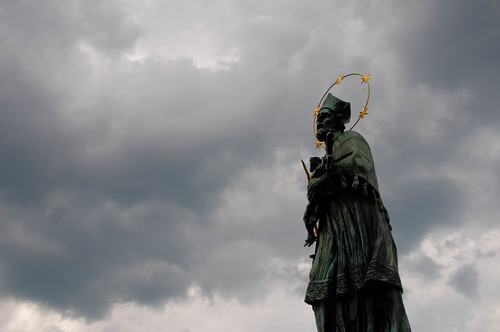
St. John of Nepomuk, Charles Bridge, Prague
St. John of Nepomuk, Charles Bridge, Prague by dlnwelch, on Flickr

If you wander about the Upper Palatinate in Germany, you might find yourself wondering – as Patrick Shrier did – why there are statues of St John of Nepomuk (d. 1398) on nearly every bridge in sight. What’s a Czech saint doing in Germany? Shrier investigates and reports in Patrick’s Military History Blog.


A oft-repeated statement is that the famous vegetarian Leonardo da Vinci (1452 - 1519) was 'ahead of his time' in sundry disciplines. While this may be somewhat true of his art, it doesn't apply to his technical work, says Thony C. in the Renaissance Mathematicus.

There’s no end to weirdness in Europe, and Vlad the Impaler is about as weird as a historical character can get. Soon after taking up the throne of Wallachia (1457), he invited the nobility to an Easter feast and – well, Executed Today has the story.

'Tis the 550th anniversary of the Battle of Towton (1461) - one among many in the Wars of the Roses in sunny England - and there are no pictorial representations extant of that battle. So what was Sheila Corr to do when she had to provide a suitable illustration for an article in History Today? Find out here.


Speaking some more of seriously weird things: there was much faith in putting one’s fate in the hands of chance (or God) – even secular arguments were sought to be settled by means of trial by fire. One of the last such trials occurred in Florence in 1498, as Beachcombing’s Bizarre History Blog reports in Barbecuing Friars in Late Medieval Florence.


*********

Middle-East


While it’s widely believed that the Abrahamic faiths are monotheistic, there is considerable evidence that Judaism, the oldest of them, was initially polytheistic. JK at Varnam explains the ins and outs of how god became God and acquired a wife, and other gods were consigned to oblivion (c. 8th century BC)

What’s up with physicists thinking they can contribute to historical analysis? Surely the age of the dilettante is past? Jona Lendering in New at LacusCurtius & Livius excoriates Colin Humphreys for his claim that Christ’s Last Supper took place on a Wednesday, and not – as historians agree – on Maundy Tuesday. “The trouble with the Jaubert-Humphreys Thesis is that it solves a problem that does not exist by using a method that is self-contradictory…Unfortunately, this is not an innocent, funny story about scientists who should not pretend they are historians.”

In the early days of Christianity, Easter was the chief religious festival. Birthdays were considered a pagan relic. So how did Christmas become the important festival it is today? Ranjith Kollanur explains in his blog A View From My Disjointed Laptop.

European depiction of the Persian (Iranian) doctor Al-Razi, in Gerardus Cremonensis "Recueil des traités de médecine" 1250-1260. (Wikimedia Commons)
European depiction of the Persian doctor Al-Razi, in Gerardus Cremonensis "Recueil des traités de médecine", 1250-1260. (Wikimedia Commons)
When and where was the definitive recognition of smallpox made? In Persia around AD 900, a medic called al-Razi wrote a treatise named al-Judari wa al-Hasbah (On Smallpox and Measles). Lapham’s Quarterly blog has a small write-up.

*********

Asia

74,000 years ago, human beings were passing the Malay peninsula on their great migration across the planet. Archaeological digs in Perak revealed a sumptuous burial of a man, which showed that Malaysia was no civilisational backwater. Judith Weingarten has the story of the digs and the feisty woman who conducted the research in her blog Zenobia: Empress of the East.


According to the Vedas, a mighty river called the Saraswati flowed through the plains of north India. There have been efforts to identify this river - which no longer exists (in its original size, at least) - and there are controversies galore about its history. Researchers in geology, linguistics, archaeology, history, and climate science have contributed, and Michel Danino has a post discussing some of this interdisciplinary work.

Emperor Wu dispatching Zhang Qian to Central Asia from 138 to 126 BCE, Mogao Caves mural, 618-712 CE (Wikimedia Commons)
Emperor Wu dispatching Zhang Qian to Central Asia (138 to 126 BCE), Mogao Caves mural, 618-712 CE (Wikimedia Commons)
Tired of horsemen attacking his villages, kidnapping the women and killing the men, and realising that they were untouchable until he obtained a powerful cavalry, in 103 BC the Chinese emperor Wu sent a taskforce to the land of the Wusun to bring back the heavenly horse. Heather Pringle tells the story and its later ramifications.

Japanese samurai boarding Yuan ships in 1281 (Wikimedia Commons)
In AD 1281, Kublai Khan sent a fleet to invade Japan. 730 years later, the History Channel purported to explain it all to unsuspecting aficionados of popular history.  Learn what really happened, and why you shouldn’t trust (ever!) the History Channel - in this piece by Tatsunoshi in Shogun-Ki.


*********

The Americas

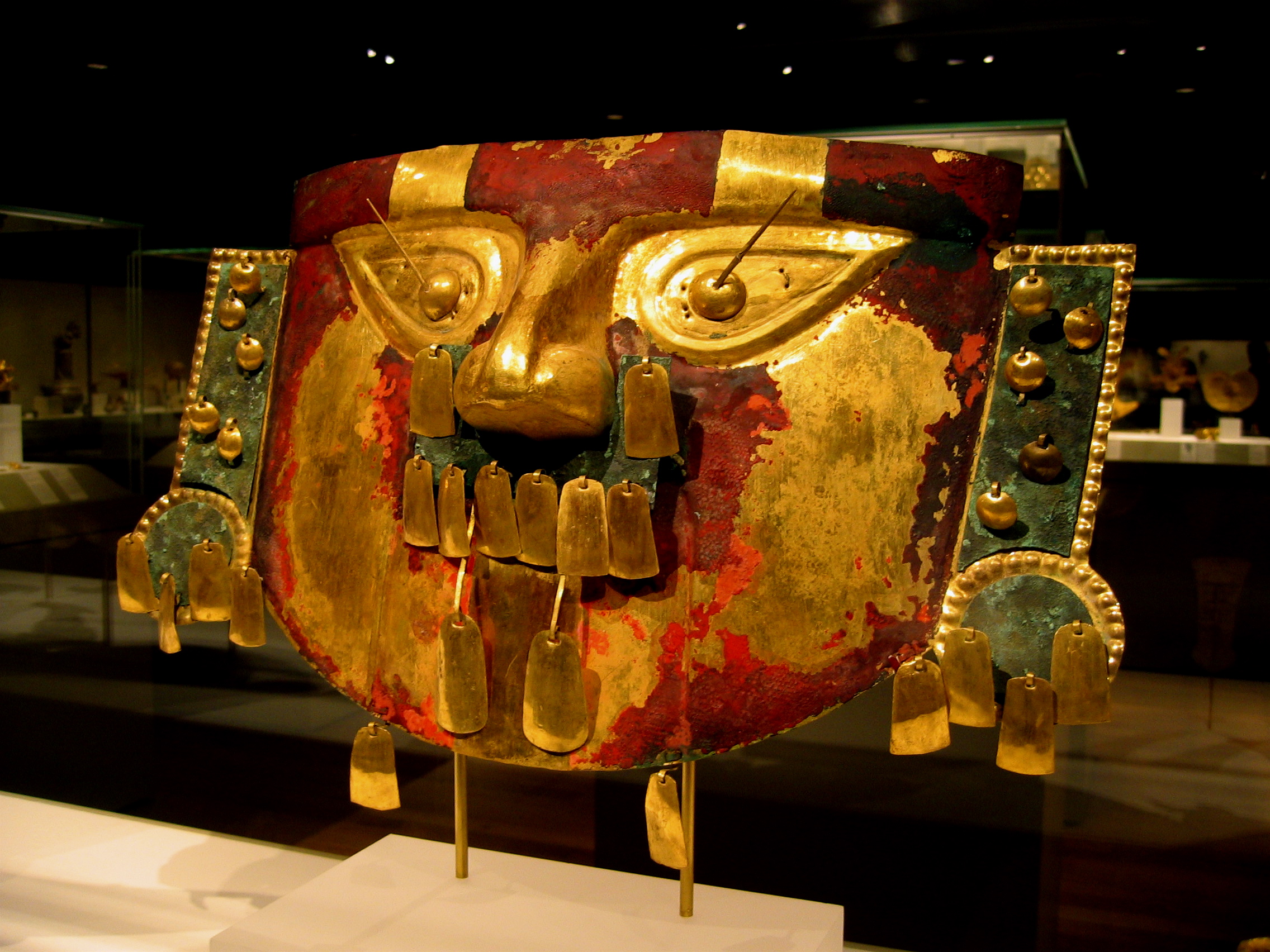
Funerary Mask, 9th-11th century Peru; (Lambayeque) Hammered gold with cinnabar and copper overlays, cinnabar; H. 11 1/2 in. (29.2 cm) Gift and Bequest of Alice K. Bache, 1974, 1977 (1974.271.35) (Wikimedia Commons)
Funerary Mask, 9th-11th century Peru; (Lambayeque) Hammered gold with cinnabar and copper overlays, cinnabar;  (Wikimedia Commons)
From the 8th century AD, the Lambayeque culture flourished in northern Peru. Like their more famous successors, the Incas, these were a people wont to fertility rituals and human sacrifices. How about combining the two by sacrificing women? Monty’s World has the story.

Archaeologists long thought that the cultures of Central America and North America had little or no interaction. Now it appears that there may have been thriving trade between them, lasting as long as five centuries from AD 900. The Pueblos of southwest USA drank cacao, which they could only have got from Mesoamerica. As Gregory LeFever reports in his blog Ancient Tides, they would have paid for the cacao with turquoise.

The 400-breasted Mayahuel Aztec Goddess of the maguey or agave (Wikimedia Commons)
Why not ponder the fate of the Aztecs (13th – 16th centuries) and their rabbits? Even before the sanguinary and Easter-loving Spaniards turned up at their doorstep, they celebrated the bunny by naming a day in its honour. And they got as drunk as 400 rabbits. Say what? Judugrovee reveals the story in the blog The Complete Mesoamerica … and more.

*********

And, to round things off, interdisciplinaryment:

Art

When a snake escaped the Bronx Zoo a few days ago, a contest was announced in some papers to name her. Why not Wadjet? Here’s a post by Madeleine Cody in the Brooklyn Museum’s blog about the ancient Egyptian snake goddess, her history, her mythology and some of the art based on her.

Have you heard of the Codex Aureus? It’s a beautiful 10th century parchment manuscript featuring the four gospels. Peacay at the ever wonderful BibliOdyssey has the scoop.

Allegoric figure of Fortitude from the Four Virtues by unknown artist (also attributed to Botticelli), c. 1490, fresco, Castle Chapel, Esztergom
Lovely Renaissance frescoes (1460s) were found in Esztergom, in Hungary. Zsombor Jékely in Medieval Hungary investigates - are they really by Botticelli?

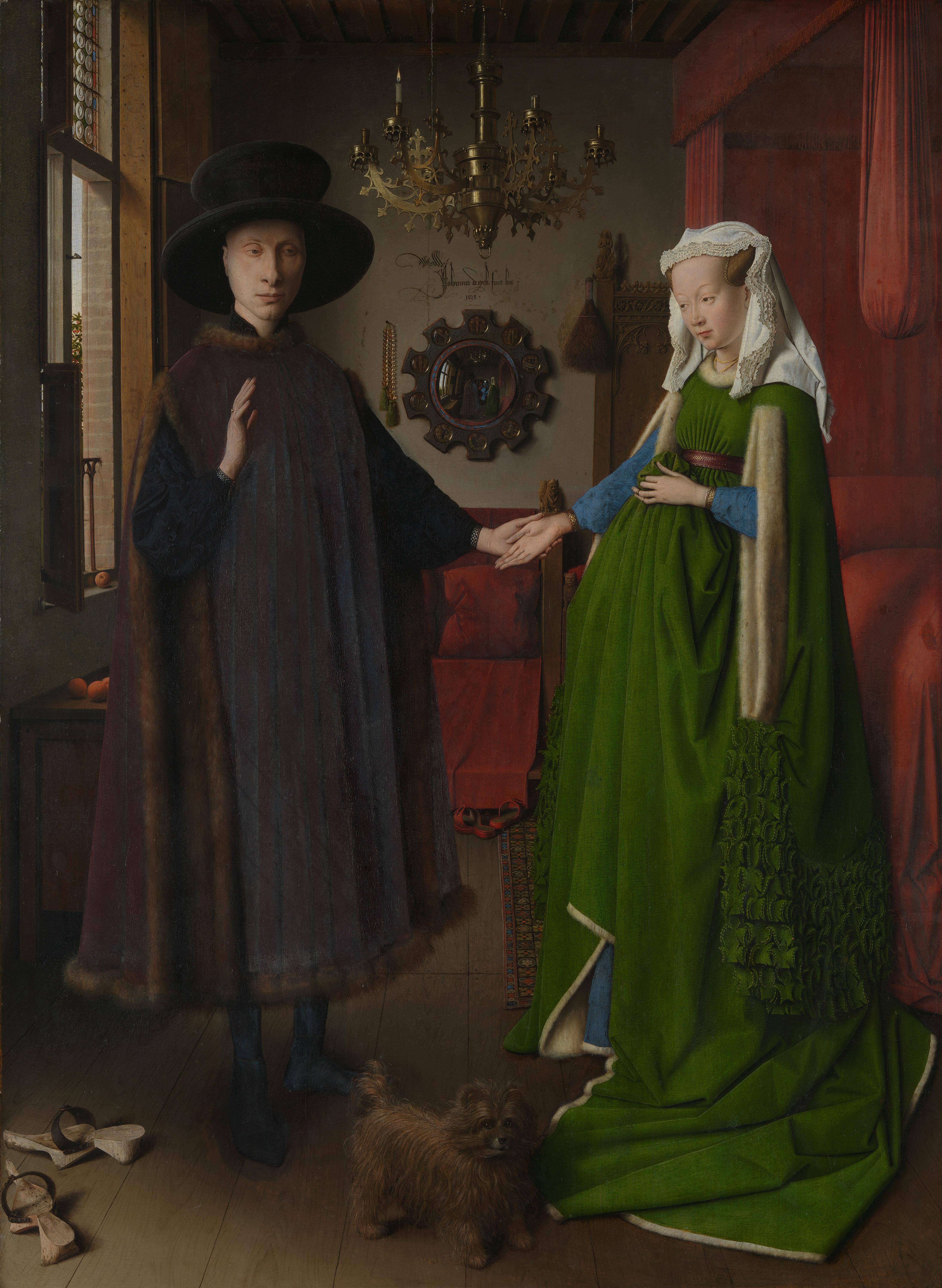
Untitled, by Jan van Eyck (or Portrait of Giovanni Arnolfini and his Wife) (Wikimedia Commons)
And we have another question: Is Van Eyck’s painting titled Arnolfini Portrait (1434) meant to portray Arnolfini’s wife? Considering there were five Arnolfinis in Bruges at the time, and we aren’t even sure which Arnolfini commissioned the painting, this might appear to be a fraught query. Alberti’s Window has a report.

*********

A Review or Two

Ever wondered about water and windmills? In Medieval History Geek, Curt Emanuel posts a review of Wind and Water in the Middle Ages: Fluid Technologies from Antiquity to the Renaissance. |The book is a scholarly compendium in ‘three general thematic sections with three papers having an archaeological focus, five concentrating on how mills "worked"; not physically but rather how they and their uses were integrated into society. The final three papers discuss how mills and milling were viewed by contemporaries through an examination of art and literature.’

While one Goth sacked Ancient Rome, a Vandal was its saviours. How’s that, you ask? That helpful Vandal was Stilicho. In Armarium Magnum, Tim O’Neill reviews at length a recent book by Ian Hughes titled Stilicho: The Vandal Who Saved Rome.

*********

That’s all for now, folks. Hope you enjoyed this round-up. The host of the next edition of this carnival will be announced shortly at the Carnivalesque website, and here’s a heads-up: it will cater to the Early Modern period, that is, AD 1500-1800.

4.24.2011

Art Appreciation

Recently we were in Florence. We are all aficionados of the Renaissance and pasta, so Florence is a good place to be. We are aware, however, that there is only so much of the Renaissance one can take before one wishes for  an early death. We therefore did not go to the Uffizi. We did eat a lot of pasta.

We took the boy to the Accademia to see Michelangelo's David. He was very interested.

"Who is Michelangelo?" he said.

"He was a sculptor and a painter," I said.

"When did he die?"

"A long time ago."

We saw David. The boy could not stop giggling.

"I can see his willy," he said loudly, and his voice rang out in the museum.

"I can see his bottom," he added, after taking a circuit around the great statue.

"Why is he not wearing any clothes?" he asked.

"Because when Michelangelo made the statue," I said, "people thought the human body was beautiful."

We admired the sling that draped over David's shoulder and his back. We admired the round stone he held in his hand. 

"Who is David?" said the boy.

"He was a little fellow in Israel who fought a big man called Goliath with his sling and then became king," I said.

"Sling. King. Hey, that rhymes," said the boy. He muttered under his breath, "Sling. King. Sing. Bing. Jing."

We took another circuit around David.

"When did he die?"

"A long time ago."

"Let's look at the other statues," said the boy. "Let's see if they all have willies."

I have to say the boy got very well acquainted with David's willy. Later, we walked around Florence, and we saw postcards of David. Some were of his face, others of his entire body, and still others showing just his crotch. 

"Acha, acha," shrieked the boy. "David's willy everywhere!"

4.23.2011

Pals

The other day, the boy and his mum had a brief conversation on their way back home from school. He is not yet six and has gained a deep understanding of the ways of the world.

"I only want to play with J," he said. "He is my best friend."

"But he'll go back to China in two months," said his mum. "You need to be friendly to all the boys."

"I only have one friend," the boy shouted, close to apoplexy. "Do you know how difficult it is to make friends?"


************


The boy's cousins, the chetas, are due to visit us in a few days. He is very pleased and goes around with a grin of anticipation on his face. He is already plotting his activities with them.


************


The boy fought with J yesterday. 

"I said, 'What the hell?' and he said, 'What the hell?'"

"I said, 'What are you talking about?' and he said, 'What are you talking about?'"

"I punched him in the face," he shouted, "and then he punched me in the face."

After a pause for breath, he continued, "I'll punch him in the face tomorrow. And when he goes back to China, I'll take my chetas and go over there and we'll all punch him in the face."

And so he has learned another valuable lesson in life. When explaining to someone what's what, it's good to have a couple of heavies behind you.

Alex Kapranos, the intellectual front-man for the rock troupe Franz Ferdinand, blogged about the food he ate and the drinks he swilled during one of his tours. Between 16 Sep 2005 and 25 Aug 2006, he posted weekly updates in the Guardian. Much of it comprises quiet observation. Sometimes, it's yum.
Kidney beans seem to be a British interpretation of Mexican food, like mayonnaise with sushi or lasagne and chips. I order migas especiales con hongos, which is eggs scrambled with tortilla strips and mushrooms under a blanket of cheese and red chilli sauce. There is a pool of black beans and a glorious guacamole, light with lime and coriander, on the side. It is perfect breakfast food: homely and reassuring, with enough piquancy to wake you up.
(He had just asked some Texans if they ate kidney beans. Eew, gross, was the reply.)

In Sebastien Japrisot's very moving novel of the slaughterhouse of Verdun, Very Long Engagement, there is a lovely fellow called Célestin Poux, much appreciated by his fellow-soldiers for his uncanny ability to obtain food and supplies even during the worst moments of the war. He is even credited with having stolen a entire ceremonial meal destined for the higher officers, and having fed his shattered companions in the trenches. Still, there were many who traduced his character. Here is what he has to say:

Commenting on the references to himself in the letters she has received, he explains, "It's all a pack of lies. All right, I cut some corners here and there, but I never cheated anyone and I always gave favour for favour. The cauldron of soup, for example, was only a kettle that barely held enough to fill two canteens, and teh cooks were telling the truth, I was in cahoots with them. As for the bigwigs' dinner, who's to complain? Not anybody in my section, you can bet. It was a wonderful leg of mutton, nicely roasted on the outside, tender and juicy on the inside. And the peaches in syrup. Simply marvellous. It was just as well off in our bellies as it would've been inside those pompous old sticklers. And I gave my source there packets of Caporal tobacco for the tip."

The great Polish poet Zbigniew Herbert managed to eke out the five dollars he was allowed when he left his country to travel around 'Western' Europe. When he returned, he had three dollars with him, much to the bemused notice of the Communist apparatchik at customs. When quizzed how he had managed six months abroad on such a little amount, he replied, 'I saved.'

Here's an oenological excerpt from his masterpiece of travel-writing, Barbarian in the Garden. He is in Orvieto:
On the menu I find a wine named after the town. The padrone praises it more loudly than the cathedral... It is more difficult to describe the wine than the cathedral. It is the color of straw and has a strong, elusive aroma. The first sip is rather unimpressive. The effect starts after a moment. The well-like chill flows down, freezing the intestines and heart while the head begins to blaze... The sensation is enchanting.

From Ewa Hryniewicz-Yarbrough's review of the book, here.

4.14.2011

Akunin at Foyles

Boris Akunin was at Foyles yesterday. You know, the biggest bookshop in Europe. On Charing Cross Road. It hosted Russia's biggest author. Akunin's not physicall big, unlike the bookstore. In the world of letters, though, he is a giant.

I'm sure you've heard of him and his prolific list of entertaining and sophisticated works of fiction - historical novels and novellas featuring crimebusters and cemeteries. His real name is Grigori Chkhartishvili, which he uses only for serious works of non-fiction; works, he said, that are as difficult to read as his last name is to pronounce. He was interviewed by his old friend Tibor Fischer, an English writer and critic best known for writing that the thuggish fans of Millwall were completely outclassed by Hungarians years ago, when Millwall played a Hungarian club 1.

Akunin's known Fischer for over seventeen years; he was instrumental in Fischer's works getting translated into Russian. Akunin himself is a famous literary translator into Russian, notably from the Japanese. He was interested in Japan from early childhood, he said, when his teacher divided the countries of the world among his classmates for a news project, and he ended up with Tunisia and Japan. He found little of interest in the press for the former, but there were stories of Yukio Mishima's hara-kiri that fascinated him, and launched him on the road to Japanophilia. Among his happiest subsequent achievements was his translation of Mishima's books into Russian.

Although Erast Fandorin appears to have an English sensibility, being a mix of James Bond and Sherlock Holmes, he really is a samurai who obeys the doctrine of fidelity to conscience more than to his master. Akunin's not religious, but he obviously admires men of conscience; this applies, for example, to his support for the (falsely, he says) imprisoned Mikhail Khodorkhovsky.

On the other hand, despite his personal irreligiousness, he has created a set of supernatural works starring the nun Pelagia. The last one in the trilogy is particularly somber, which he admitted goes against the grain of Akunin's oeuvre. People read Akunin to be entertained, not to be hit on the head with a hammer. He should have used another pseudonym if he wanted to write serious fiction, he opined.

(Despite the general Pelagic spirituality, I enjoyed her second outing (Pelagia And The Black Monk) - I've mentioned it before. Akunin's playfulness is in full spate here, especially with his references to Masha and glowing rocks; it was particularly satisfying for me to recognise Marie Curie and radioactivity in these allusions.)

Playfulness abounds in Akunin's works. He said he found it easy to imitate nearly any author's style; it's his own, Chkhartishvili's, that is otiose and dry. He only works an hour or so in the mornings and perhaps an hour or so in the afternoons, he said, and spends the rest of the time recharging his batteries. This period of gathering his strength no longer involves reading books - that was his main pastime in the last century.

If you named a country, he'd be able to recall an author from there that he enjoyed. Fischer (of Hungarian descent) asked what Hungarians he could name. Akunin went into a pensive coma. Good question, he said presently. Esterhazy?

Very good, said Fischer, a cultured choice.

But then Akunin responded 'Arundhati Roy' when someone asked about Indian authors, and the sheen slightly tarnished.

Sometime in the late 1990s, he said - addressing those in the audience older than 40 - he observed that he could classify the people he had known into sixteen types. You know what I mean, he said, you meet a new person and within moments you are able to tell what sort of a person she is, and what she is likely to say in a given circumstance. Then he learned that there's a post-Jungian psychological theory called socionics that does exactly the same, which somewhat dished him: his discovery wasn't new, after all.

There are only twelve psychological types, Fischer quipped then. No, no, said Akunin. You just haven't met the other four. But I'm two years older than you, so you still have time.

Akunin's plan was to write sixteen novels - the Erast Fandorin cycle - in which each personality type is addressed. This was news to me as I always thought that he intended to write each book in a particular sub-genre of thriller fiction, such as espionage, the locked-room, the high society murder, and so on. Akunin said that he could accurately place any individual into the relevant socionic type by finding out which Fandorin novels they liked most and least. And because people are lemmings, immediately the audience piped up to find out their own types by offering their favourite and detested Fandorin book.

Akunin's a sardonic self-deprecating and humorous man with strong opinions. Piracy in Russia is rampant, he said, and how to protect oneself against it when the police is corrupt, the judiciary crooked, and people don't care for the law. He scoffed at someone's suggestion that piracy was probably inherited from the tradition of samizdat of Soviet times. Romantic nonsense, those pirates are too young to have ever heard of it, he said. His solution was to offer digital books in an inexpensive format that obviated piracy. It is something he is working on, he said.

Someone wanted to know why the films made of his early books were so varied in quality and style. Well, he said, he is a control freak and when producers came knocking on his door, he insisted on full control: he wanted to choose the actors, the director, write the screenplays, and wouldn't brook any changes. Go to hell, said the producers, and didn't approach him for several years. A particularly smart fellow then agreed to all his terms and went on thereafter to do whatever he fancied. When Akunin objected, he said Boris, you are an executive producer, you should come over to the sets and we'll discuss and make whatever changes you want. When Akunin realised that that meant travelling into deepest darkest Russia, he decided it wasn't worth the trouble, and producers thenceforth no longer feared him, but signed him up on his conditions and did whatever they wanted.

And so there you have it.

 ***************

[1] What Fischer wrote was:
Lewisham, a West Ham fan talking of England's visit to Hungary in 1983, says "the local government were considering calling the troops to sort us out". No, Lewisham, they weren't. England's hooligans have always come off worst against Hungary's own distinguished tradition of football violence. I have particularly fond memories of Millwall fans begging for mercy.

The Strand Magazine, known for yonks as a fine source of detective short fiction, and more recently, venue for the publication of newly discovered stories by P.G. Wodehouse and Mark Twain, has in its March 2009 issue, a neat tale of haute cuisine gone awry. Excerpt from Andrew Taylor's The Woman Who Loved Elizabeth David.
"I thought we'd have filet de porc en sanglier. It's one of my Elizabeth David recipes. Pork that tastes like wild boar. The secret is the marinade. And you can't skimp on the ingredients either - things like coriander seeds, juniper berries, basil. There's a little shop in Brewer Street where you can get them. I think it must be the only place in England."
Black market ingredients, I thought. Pork and all. The bitch. The cow.
While Marina talked, the rich odours of the meal wafted though the hatch into the living room. My hands were sweaty on the cold glass. In my nervousness, I finished the drink more quickly than I should have done.
[...]
It is strange how in a crisis one finds reserves of strength one did not suspect existed. Somehow I went back into the living room and accepted another dry martini. Somehow I made myself eat the ghastly, over-flavoured pork, which Marina served up with such a triumphant flourish that I wantd to throw the plate at her. I even complimented her on her cooking. She said she would give me the recipe.
The meal dragged on. It was far too heavy and elaborate for lunch. Marina served it in the French way, with salad after the main course, and then cheese before the pudding. So pretentious. What was wrong with our way of doing things?

4.03.2011

Wireless Trends

The Wall Street Journal had a recent article about a bunch of entrepreneurs gathering in New York to discuss trends in wireless technologies. Of course, there is food involved:
Around 8 p.m., dinner was served. Guests had two choices: Arctic char with green cabbage, cauliflower and American caviar, or a braised flat iron steak with caramelized shallots, squash and sweet potatoes.

In the middle of dinner, Rush Doshi, co-founder of SuperGlued, a free iPhone app that lets users share concert experiences and buy tickets, threw a mind grenade onto the table. "I don't think people realize how much data they are giving away," said Mr. Doshi. "I think you'll start hearing a lot more about privacy."

"You share much more information on the Web than you do on your phone," replied Eric Litman, chief executive of Medialets, a two-year-old company that helps advertisers create and serve ads on mobile devices.

As the waiters brought out a dessert of sticky toffee fig cake, entrepreneur Jonathan Wegener said the emergence of tools that allow people to set up private groups would help solve the problem. "People will take back privacy by creating groups," said Mr. Wegener, co-founder of Exit Strategy, which makes an app with New York subway and street maps.